
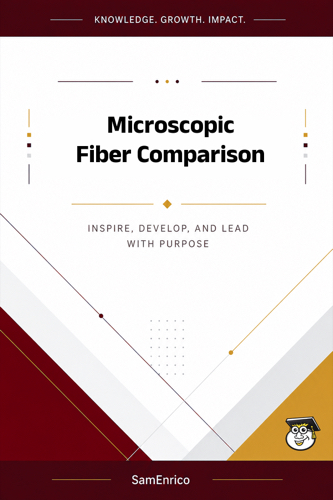
Non-FictionTrue CrimeMicroscopy
Microscopic Fiber Comparison Audiobook
Cross section and longitudinal characteristics of
by March Digna
Cross section and longitudinal characteristics of crime scene fibers.
Formats
Free sample
Chapter 1: The Silent Thread...--–- The body lay motionless on the bedroom floor, a faint smear of blood leading toward the bathroom. The room was otherwise unremarkable: beige carpet, white bedding, a scattering of personal effects. The forensic team worked silently, documenting footprints, collecting swabs, and photographing every surface. But it was the evidence they could barely see—the evidence that floated in the air, clung to fabric, and transferred with every touch—that would ultimately solve the case. Twenty-three fibers, invisible to the naked eye, recovered from the victim's clothing and the suspect's vehicle, would tell a story no witness could.This is the reality of forensic fiber examination.
While fingerprints and DNA often capture public attention, fibers are the silent witnesses present at nearly every crime where human contact occurs. They are ubiquitous, diverse, and surprisingly persistent. And when properly analyzed—specifically through the lens of their cross-sectional shape and longitudinal surface characteristics—they can place a suspect at a scene, link multiple crime locations, or exclude an innocent person from investigation.The Locard Exchange Principle, formulated by French criminologist Edmond Locard in the early twentieth century, states a simple but profound truth: every contact leaves a trace. When two objects or people interact, materials transfer between them. A hand brushes against a wool sweater and sheds cotton fibers from a shirt cuff.
A car seat contacts a jacket and leaves behind nylon filaments from the upholstery. A struggle on a carpet drives hundreds of fibers into the fabric of the combatants' clothing. These transfers are inevitable, unconscious, and permanent until disrupted by cleaning, weathering, or deliberate destruction.Among all trace evidence types—hair, paint, glass, soil, gunshot residue—textile fibers hold a special position. They are nearly universal in human environments. Clothing alone produces an endless variety of fiber types: cotton t-shirts, wool sweaters, polyester athletic wear, nylon stockings, acrylic scarves, silk blouses.
Beyond clothing, carpets, upholstery, bedding, towels, curtains, car interiors, and industrial materials add to the diversity. A single household may contain dozens of distinct fiber types, each with unique physical and chemical properties.The diversity of fibers is matched by their persistence. A fiber transferred during a violent encounter may remain on a victim's clothing for days, surviving multiple washes, abrasion against other surfaces, and exposure to the elements. In one documented case, fibers recovered from a body exposed outdoors for twenty-nine days retained…
This is the end of the free sample. Get the Audiobook to keep going. Buy now
About this book
Details
- Author
- March Digna
- Publisher
- SamEnrico
- Language
- English
- Genre
- Non-Fiction, True Crime, Microscopy
- Released
- 2026-06-09
- Pages (approx.)
- 152
- Available as
- eBook, Audiobook

Listen in the VoxFlicks app
Audiobooks and audio dramas wherever you go. Sign in with your SamEnrico account and press play.
More by March Digna
 Cancel Culture Self ProtectionMarch Digna$11.99
 Wrestling Self Hypnosis GuideMarch Digna$11.99
 The Vegan Micronutrient GuideMarch Digna$11.99
 Math SRS Card DesignMarch Digna$11.99
 Workaholic Sleep HygieneMarch Digna$11.99
 Jumia Returns Policy GuideMarch Digna$12.99
 Emotional Repair GuideMarch Digna$11.99
 Stillbirth Healing ManualMarch Digna$11.99
 The Ghosts of the Gulf: The Pirate Wars That Shaped the Modern Middle EastMarch Digna$11.99
 The Ghosts of the Berlin Wall: Stasi Spies and the Paranormal BetrayalsMarch Digna$11.99
 How to Produce a Scale InhibitorMarch Digna$11.99
 How to Start a Courier (other Than National Post) Licensed Business (Beginners Guide)March Digna$11.99
You may also like
 Hong Kong Handover 1997Dunn Johnnie$11.99
 Zumba For Postnatal Recovery CourseNeal Christian$11.99
 Zumba for BeginnersLadner Nikia$11.99
 YouTube Comment Mining GuideHumes Pandora$12.99
 Worry Box MeditationCarlin Rudy$11.99
 Workplace Stress MeditationNguyen Lynn$11.99
 Workplace Stress and Sleep RepairHawley Ivory$11.99
 Workplace Perfectionism CureDelaney Jeffry$11.99
 Workplace Injustice Anger GuideWallen Isabelle$11.99
 Work Addiction and Burnout LinkGreenwood Ester$11.99
 Women in Yoga and WellnessBeattie Galina$11.99
 Women in Stand Up ComedyChun Evangeline$11.99