
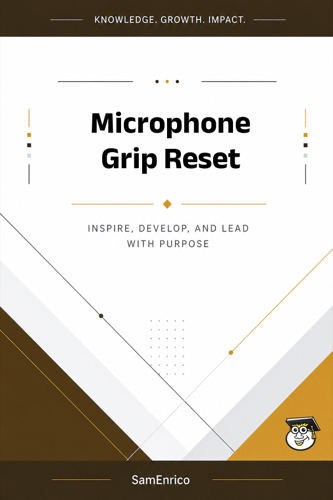
Non-FictionMental WealthSensory Integration
Microphone Grip Reset eBook
Use tactile feedback to anchor present moment awar
by Ferrer Brain
Use tactile feedback to anchor present moment awareness before speaking.
Formats
Free sample
Chapter 1: The Three-Second Abyss--–- The microphone felt like a foreign object. Cold. Heavy. Alive with judgment. Sarah had delivered this exact presentation fifty times before—in boardrooms, at conferences, even to the same client team six months ago.
But as the host said her name and the room turned toward her, something shifted. Her hands began to tremble. Her throat tightened. The opening sentence she had rehearsed thirty times evaporated like breath on glass. She walked to the podium, wrapped her fingers around the microphone stand, and for three full seconds—three agonizing, eternal seconds—she said nothing.
The audience waited. She waited. Her mind raced through every piece of public speaking advice she had ever read: Breathe. Visualize success. Imagine them in their underwear.
You've got this. None of it worked. When she finally spoke, her voice came out thin, reedy, and pitched a full octave higher than normal. She finished the presentation. No one mentioned the shaky start.
But Sarah knew. And she never forgot that feeling: the sense that somewhere between her name being called and her first word, she had lost herself entirely.This is not a story about a bad speaker. Sarah is a senior vice president at a Fortune 500 company. She has trained with vocal coaches, attended executive presence workshops, and read more public speaking books than she cares to admit. But none of that preparation mattered in the three seconds that actually counted.
And that is the central problem this book exists to solve.Most public speaking advice focuses on what happens during the speech—structure, storytelling, slides, vocal variety, body language. Some of it focuses on what happens before the speech—preparation, rehearsal, visualization, breathing exercises. Almost none of it focuses on what happens in the gap between those two phases: the three seconds between being introduced and uttering your first word. That gap is where speeches are won or lost. That gap is where your nervous system decides whether you will sound like yourself or sound like someone who has forgotten how to breathe.
That gap is the subject of this chapter.The Invisible Window Let us name the thing that has no name. Call it the Three-Second Abyss. It is the interval between the end of your introduction and the beginning of your speech. It is short enough to feel insignificant. It is long enough to destroy you.Psychologists who study working memory and performance anxiety have identified this window as uniquely dangerous for a specific reason: it is the moment when your brain receives maximum social threat input (an audience looking at you) with minimum cognitive structure (you have not yet begun your prepared content).
Your amygdala—the brain's threat detection system, which we will explore in detail shortly—does not know the difference between a boardroom presentation and a saber-toothed tiger. It only knows that 150 pairs of eyes are suddenly fixed on you and that your survival may depend on whatever happens next.Consider what happens in those three seconds. You walk to the front of the room. You turn to face the audience. You open your mouth.
In that sequence—steps, turn, open—your body moves from a state of relative anonymity to absolute visibility. Every eye is on you. Every sound you make will be amplified, judged, remembered. Your nervous system, which has been quietly doing its job for your entire life, suddenly receives a cascade of threat signals: increased heart rate, redirected blood flow, shallow breathing, muscle tension, dry mouth, sweating palms.This is not a design flaw. This is your body trying to keep you alive.
The problem is that public speaking is not a life-threatening situation, but your body does not know that. And the three-second gap is when it makes that catastrophic miscalculation.The Neuroscience of the Gap To understand why the Three-Second Abyss is so treacherous, we need to take a brief journey inside your skull. This will be the only chapter in this book that goes deep into the neuroscience. Later chapters will reference these concepts, but the full explanation lives here.Your brain has a threat detection system centered on a small, almond-shaped cluster of nuclei called the amygdala. Its job is simple: scan the environment for danger, and when danger is detected, initiate a cascade of physiological changes that prepare your body to fight, flee, or freeze.
The amygdala does not think. It does not reason. It does not consider context or nuance. It reacts. And it reacts fast—faster than your conscious mind can process information.Here is the critical fact for public speaking: the amygdala can detect a social threat (an audience) and trigger a fight-flight-freeze response in under 200 milliseconds.
That is roughly the time it takes to blink. Your conscious mind, by contrast, takes about 500 milliseconds to become aware of a stimulus and another 300-500 milliseconds to formulate a response. By the time you realize you are nervous, your amygdala has already been working for a full second.But the amygdala does not work alone. When it detects a threat, it sends signals to two other key brain regions. First, it activates the hypothalamus, which triggers the release of stress hormones like cortisol and adrenaline.
This is why your heart races, your palms sweat, and your breathing becomes shallow. Second, and most importantly for public speaking, the amygdala sends inhibitory signals to your prefrontal cortex (PFC)—the part of your brain responsible for executive functions like planning, reasoning, impulse control, and working memory.This is the mechanism behind "mind going blank." Your PFC is not failing. It is being actively suppressed by your amygdala. Blood flow literally shifts away from the PFC toward survival circuits in the brainstem and limbic system. You cannot think your way out of this because the part of your brain that does the thinking has been temporarily deprioritized.
It is not broken. It is just not in charge.In the Three-Second Abyss, this entire cascade happens in real time. You hear your name. You begin walking. Your amygdala detects the audience.
Stress hormones flood your system. Your PFC goes offline. You reach the microphone. You open your mouth. And nothing comes out—or worse, something comes out that sounds nothing like you.Your Personal Alarm Signature Not everyone experiences the Three-Second Abyss the same way.
Your body has a unique "alarm signature"—a specific pattern of physical sensations that signals your amygdala has taken the wheel. Learning to recognize your signature is the first step toward resetting it.Based on research in sports psychology, performance anxiety, and clinical studies of social anxiety disorder, we can identify four common alarm signatures. Read each description and notice which one feels most familiar.The Freezer. Your mind goes blank. The sentence you were about to speak disappears.
You find yourself staring at the audience, searching for words that will not come. Your body may feel stiff, locked in place. Your voice, if it emerges at all, may sound flat or robotic. The Freezer experiences the PFC suppression most acutely. The thoughts you rehearsed are there—somewhere—but you cannot access them.The Rambler.
Words pour out of you uncontrollably. You speak faster than you think. Sentences run together. You repeat yourself. You say…
This is the end of the free sample. Get the eBook to keep going. Buy now
About this book
Details
- Author
- Ferrer Brain
- Publisher
- SamEnrico
- Language
- English
- Genre
- Non-Fiction, Mental Wealth, Sensory Integration
- Released
- 2026-06-07
- Pages (approx.)
- 144
- Available as
- eBook, Audiobook

Read better in the ZLOADR app
Your eBooks on your phone or tablet. Sign in with your SamEnrico account and start reading.
More by Ferrer Brain
 Stroke Recovery Self Esteem CourseFerrer Brain$11.99
 DoorDash Zone SelectionFerrer Brain$11.99
 The Science of Breath AwarenessFerrer Brain$11.99
 The Indian Subcontinent Remote Work GuideFerrer Brain$11.99
 The Apalachin Massacre: The Day the Mafia Exposed ItselfFerrer Brain$11.99
 Understanding Lujan–fryns SyndromeFerrer Brain$17.99
 Growth Marketing InternFerrer Brain$11.99
 Brazil Agribusiness Export GuideFerrer Brain$12.99
 Executive Summary Checklist HandbookFerrer Brain$12.99
You may also like
 Hong Kong Handover 1997Dunn Johnnie$11.99
 Zumba For Postnatal Recovery CourseNeal Christian$11.99
 Zumba for BeginnersLadner Nikia$11.99
 YouTube Comment Mining GuideHumes Pandora$12.99
 Worry Box MeditationCarlin Rudy$11.99
 Workplace Stress MeditationNguyen Lynn$11.99
 Workplace Stress and Sleep RepairHawley Ivory$11.99
 Workplace Perfectionism CureDelaney Jeffry$11.99
 Workplace Injustice Anger GuideWallen Isabelle$11.99
 Work Addiction and Burnout LinkGreenwood Ester$11.99
 Women in Yoga and WellnessBeattie Galina$11.99
 Women in Stand Up ComedyChun Evangeline$11.99