
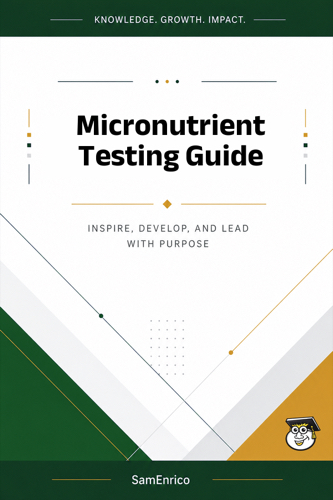
Micronutrient Testing Guide eBook
Interprets blood levels and deficiency markers.
by Stine Alva
Interprets blood levels and deficiency markers.
Formats
Free sample
Chapter 1: The 2 PM Crash--–- Sarah was thirty-four years old, ran half-marathons, ate organic kale salads for lunch, and spent eighty dollars a month on a premium multivitamin. By all external measures, she was the picture of health. But every day at two in the afternoon, her body betrayed her. The fatigue hit like a wave—not the gentle kind you can push through with another cup of coffee, but the bone-deep exhaustion that makes you wonder if you have a serious illness. Her hair had been thinning for two years.
Her skin was dry despite expensive moisturizers. She hadn't slept through the night since her twenties. And her doctor, after running a standard panel of tests, had given her the most frustrating sentence in modern medicine: "Everything looks normal."–- Sarah is not unusual. She is not broken. And she is not imagining her symptoms.
What Sarah is experiencing is the invisible epidemic of our time: micronutrient insufficiency that never progresses to full-blown deficiency disease but slowly erodes energy, cognitive function, immune resilience, and long-term health. The standard medical approach—waiting for someone to develop scurvy, rickets, or pellagra before intervening—leaves millions of people like Sarah stranded in a gray zone of "not sick enough to treat" but "not well enough to thrive."–- This chapter is the door you walk through to understand why that happens, why it matters more than you think, and why the solution—micronutrient testing—has been hiding in plain sight.The Myth of "Eating Healthy"–- Let us address the most damaging misconception head-on: the belief that if you eat a balanced diet, you cannot be deficient in any nutrient. This myth persists because it feels intuitively true. After all, humans evolved to extract everything we need from food. Our ancestors did not have blood tests or supplement regimens.
So why would modern humans, with access to unprecedented dietary variety, need to test their nutrient levels?–- The answer lies in three forces that have fundamentally altered the nutritional landscape in the last century: soil depletion, industrial food systems, and individual biological variation. Each of these forces creates gaps between what you put on your plate and what your cells actually receive.–- Soil depletion is the most invisible culprit. A landmark study published in the Journal of the American College of Nutrition compared the mineral content of forty-three different fruits and vegetables between 1950 and 1999. The results were alarming: average declines of 5 to 40 percent in iron, zinc, calcium, magnesium, and other minerals. More recent research from the University of Texas found that you would need to eat eight oranges today to get the same amount of vitamin A your grandmother got from one.
The reason is straightforward: industrial agriculture prioritizes yield, pest resistance, and shelf life over nutritional density. Crops are bred to grow faster and larger, which dilutes mineral content. Soil is depleted and replenished with only a handful of synthetic fertilizers (nitrogen, phosphorus, potassium), while dozens of trace minerals are not replaced. The food on your supermarket shelf looks like food and tastes like food, but it is not the same food nutritionally.–- Modern supply chains compound the problem. The average head of lettuce travels fifteen hundred miles from farm to plate.
In that journey, it loses nutrients with every passing day. Vitamin C, for example, degrades rapidly after harvest. A study of commercial broccoli found that it lost 56 percent of its vitamin C within seven days of harvest and 84 percent within fourteen days. By the time you buy that "fresh" produce, it may be weeks old. Frozen vegetables, counterintuitively, often retain more nutrients because they are flash-frozen within hours of harvest.
But even frozen produce cannot compensate for the baseline decline in soil quality.–- Individual biological variation is the third and most personal force. Two people can eat identical diets and have completely different nutrient status. Genetic polymorphisms affect how efficiently you absorb, transport, and utilize virtually every vitamin and mineral. The MTHFR gene variant, carried by approximately 40 percent of the population, impairs the conversion of dietary folate into its active form. The VDR gene variant affects vitamin D receptor function.
People with certain variants of the TMPRSS6 gene absorb less iron from food. And that is just the tip of the iceberg. Beyond genetics, gut health varies enormously. Celiac disease, Crohn's disease, ulcerative colitis, small intestinal bacterial overgrowth (SIBO), and even subclinical gut inflammation dramatically reduce absorption. A person with healthy gut function might absorb 25 percent of the iron from a spinach salad.
A person with celiac disease might absorb close to zero.–- Put these three forces together, and the myth collapses. Eating healthy is necessary but not sufficient. You can do everything right and still be deficient. The only way to know is to test.Hidden Hunger: The Epidemic You Did Not Know You Had–- The World Health Organization coined the term "hidden hunger" to describe micronutrient deficiency that occurs without overt clinical signs. Unlike the dramatic deficiencies taught in medical school—scurvy (vitamin C) with its bleeding gums and broken capillaries, rickets (vitamin D) with its bowed legs and bone deformities, pellagra (niacin) with its dermatitis, diarrhea, and dementia—hidden hunger produces subtle, diffuse, and easily dismissed symptoms.–- How common is hidden hunger?
The statistics are sobering. According to data from the National Health and Nutrition Examination Survey (NHANES), which is the most comprehensive ongoing assessment of the nutritional status of the United States population:–- Approximately 40 percent of adults are deficient in at least one micronutrient. That is nearly one hundred million Americans.–- Vitamin D deficiency affects 42 percent of the population, with rates as high as 70 percent in certain groups (people with darker skin, those living in northern latitudes, and individuals who spend most of their time indoors).–- Magnesium insufficiency affects roughly 50 percent of the population, though serum testing dramatically underestimates this number because magnesium is primarily stored in bone and cells, not in blood.–- Iron deficiency affects approximately 10 percent of women of reproductive age, but functional iron deficiency—where ferritin levels are "normal" but insufficient for optimal function—affects far more.–- Vitamin B12 deficiency affects up to 15 percent of older adults and a significant percentage of vegetarians and vegans, but many cases go undiagnosed because serum B12 alone is a poor marker.–- Zinc deficiency affects an estimated 17 percent of the global population and is particularly common in older adults, vegetarians, and people with digestive disorders.–- These are not fringe conditions affecting only the malnourished or the elderly. These are mainstream, common, and largely undiagnosed. And they produce real, measurable consequences.The Symptom Map: What Hidden Hunger Feels Like–- If you are reading this book, there is a good chance you recognize yourself in at least some of these symptoms.
Hidden hunger does not announce itself with a single dramatic sign. Instead, it manifests as a constellation of vague complaints that doctors are poorly trained to connect.–- Fatigue is the most common symptom of hidden hunger, and it is also the most nonspecific. Iron deficiency causes fatigue because iron is required to produce hemoglobin, the protein in red blood cells that carries oxygen.…
This is the end of the free sample. Get the eBook to keep going. Buy now
About this book
Details
- Author
- Stine Alva
- Publisher
- SamEnrico
- Language
- English
- Genre
- Non-Fiction, Health & Wellness, Lab Testing
- Released
- 2026-06-06
- Pages (approx.)
- 142
- Available as
- eBook, Audiobook

Read better in the ZLOADR app
Your eBooks on your phone or tablet. Sign in with your SamEnrico account and start reading.
More by Stine Alva
 Method of Loci For Software CodeStine Alva$11.99
 Stress Reduction Memory AgingStine Alva$11.99
 Ectopic Pregnancy GriefStine Alva$11.99
 Lineup Procedure FlawsStine Alva$11.99
 Low Carb Snacking Survival KitStine Alva$11.99
 Quit Smoking for AthletesStine Alva$11.99
 Fear of Failure Support GroupsStine Alva$11.99
 Whispers of the Marid: The Djinn Who Commanded the TidesStine Alva$11.99
 The Iron Duke and the Siege of Badajoz: Wellington's Bloodiest TriumphStine Alva$11.99
 How to Produce Textured GlazeStine Alva$11.99
 How to Produce SpacersStine Alva$11.99
 A Collector's Handbook to the Daf 46Stine Alva$11.99
You may also like
 The IBS Lab Testing GuideEngle Ruthe$11.99
 IGF One Testing GuideRutherford Millicent$11.99
 Vitamin D Deficiency TestingKowalski Keturah$11.99
 Microbiome Clinical TestingPerron Lyndon$11.99
 Vitamin B7 Biotin Lab Test GuideStern Dorthy$11.99
 PCOS Hormone Testing GuideCosta Lucius$11.99
 Vegan Lab Testing GuideNagy Celine$11.99