
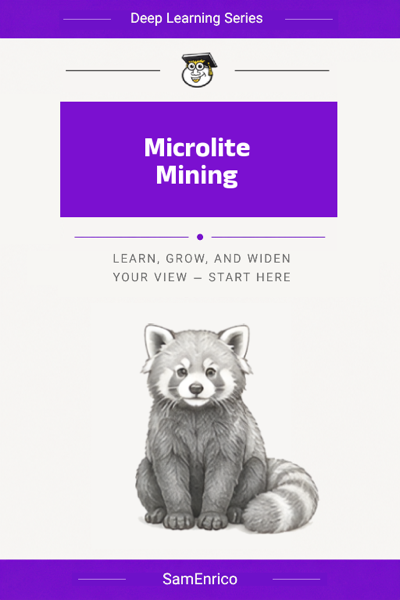
Microlite Mining eBook
A Coursebook on Microlite Mining
by Rowan Vikki
A Coursebook on Microlite Mining
Formats
Free sample
Chapter 1: The Ghost in Your Pocket--The smartphone in your hand contains more than a billion transistors, a dozen rare earth elements, and a single component so small you could lose it in a grain of sand. That component is a tantalum capacitor. Without it, your phone would not power on. It would not hold a charge. It would not exist as you know it.
And deep inside that capacitor, invisible to any microscope, lies a story that begins not in a Silicon Valley clean room, but in a muddy hand-dug pit on the other side of the world.That story is the subject of this book. It is the story of microlite mining.Most people have never heard the word “microlite.” Even among geologists, it sits in the shadow of its more famous cousin, coltan. But microlite is the mineral that gave us the tantalum that makes modern electronics possible. It is the ghost in your pocket, the silent partner in every video call, every GPS direction, every electric vehicle silently rolling down a city street. And yet, the people who dig it from the earth remain largely invisible, working at the intersection of extreme poverty and extreme value.This chapter is your introduction to that world.
It resolves the central ambiguity of the book’s title, establishes a clear framework for everything that follows, and answers the first question any reader should ask: What exactly is microlite mining, and why should I care?The Two Meanings of a Single Word To understand this book, you must first understand that “microlite” means two very different things, and confusing them is the fastest way to misunderstand everything.First, microlite is a mineral. Specifically, it is a tantalum-rich oxide mineral belonging to the pyrochlore supergroup. Its chemical formula is complicated—(Na,Ca)₂Ta₂O₆(O,OH,F) for those who care about such things—but what matters is this: microlite is one of the primary ore minerals for tantalum, a refractory metal with extraordinary properties. Tantalum has a melting point of 5,462 degrees Fahrenheit, higher than most steel. It is incredibly dense, resistant to corrosion, and biocompatible, meaning it does not react with human tissue.
That is why it is used in everything from smartphone capacitors to artificial hip joints to the turbine blades of jet engines.Second, “microlite mining” is a practice. It refers to the intentional, low-capital, technically informed extraction of tantalum-bearing minerals from small, high-grade deposits. The “micro” refers not to the mineral but to the scale of operation. A microlite mine typically processes between five and fifty tons of ore per day. That is minuscule compared to an industrial copper mine that might process fifty thousand tons per day.
But it is not the same as artisanal mining, which is often informal, uses rudimentary tools, and operates below five tons per day.Throughout this book, the term “microlite mining” will be used in its second sense—the practice. When we mean the mineral, we will say “microlite mineral” or simply “microlite.” This distinction matters because the mineral can be found in deposits of various sizes, but the practice is defined by its scale. You can have a large industrial mine that extracts microlite. That is not microlite mining as this book defines it. You can have an artisanal miner who happens to be digging tantalum ore.
That is not microlite mining either. Microlite mining sits in the middle, occupying a specific operational band: 5–50 tons per day, semi-mechanized, legally permitted, and systematically managed.Why does this distinction matter? Because the challenges, opportunities, and techniques of a 20-ton-per-day operation are fundamentally different from those of a one-ton-per-day artisanal pit or a twenty-thousand-ton-per-day industrial complex. Microlite mining requires a different mindset. It requires enough capital to buy a small crusher and a shaking table but not enough to hire a mining engineer from a global corporation.
It requires legal permits but not a team of compliance lawyers. It requires geological knowledge but not a full exploration drilling program. It is, in every sense, a middle path.A Brief History of Small-Batch Extraction Humans have been mining small deposits for a very long time. The ancient Egyptians mined gold in the Nubian desert using hand tools and simple gravity separation. The Romans dug tin in Cornwall from narrow veins that no modern company would touch.
In the Americas, pre-Columbian cultures extracted copper from small surface pits using fire-setting—heating the rock with fire then dousing it with water to crack it.These early miners were not “microlite miners” in the modern sense, but they shared the same essential logic: find a small, rich pocket of metal, extract it with minimal capital, and move on when it is exhausted. They were opportunists, but they were also observant. A successful Roman tin miner knew how to read stream sediments, how to follow a vein underground, and how to smelt the ore with charcoal. That combination of geological intuition and practical skill is the direct ancestor of today’s microlite mining.The Industrial Revolution changed everything for large deposits. The steam engine allowed mines to go deeper than ever before.
Dynamite made blasting cheap and powerful. Railroads meant that low-grade ore could be shipped hundreds of miles to centralized processing mills. By 1900, mining had bifurcated: the big deposits went to big companies with big machines, and the small deposits were abandoned.But not entirely. Throughout the twentieth century, small-scale miners continued to work deposits that were too small, too remote, or too erratic for the majors. In Brazil, garimpeiros dug for tantalum in the pegmatites of Minas Gerais.
In Rwanda, small teams worked the coltan-rich placers of the Congo-Nile watershed. In Canada, prospectors staked claims on lithium-cesium-tantalum pegmatites in Manitoba and Quebec. These were not industrial operations. They were microlite mining, though nobody called it that yet.The term “microlite mining” emerged only recently, driven by two converging trends. First, the demand for tantalum exploded with the rise of consumer electronics.
When the first i Phone was released in 2007, it contained about ten tantalum capacitors. By 2023, the average smartphone contained thirty to forty. Electric vehicles, medical implants, aerospace components, and industrial sensors all added to the demand. Tantalum went from an obscure metal to a critical mineral, designated as such by the United States, the European Union, and China.Second, the formalization of artisanal mining changed how small operations were perceived. For most of history, small-scale mining was synonymous with illegality, environmental damage, and child labor.
That reputation was often deserved. But beginning in the 2000s, organizations like the Responsible Minerals Initiative, the OECD, and Fairmined began creating standards that allowed small miners to operate legally and ethically. A new category emerged: the legal, semi-mechanized, small-scale mine. That category needed a name. “Microlite mining” fit.Today, microlite mining is a recognized practice in more than twenty countries.
It supplies an estimated 15–20 percent of the world’s tantalum. And it supports the livelihoods of tens of thousands of people—miners, sorters, drivers, brokers, and their families. It is not a solution to global poverty, but it is a lifeline for communities sitting on top of some of the most valuable rocks on Earth.How Microlite Mining Differs from ASM…
This is the end of the free sample. Get the eBook to keep going. Buy now
About this book
Details
- Author
- Rowan Vikki
- Publisher
- SamEnrico
- Language
- English
- Genre
- Non-Fiction, Informative, Educational
- Released
- 2026-05-11
- Pages (approx.)
- 150
- Available as
- eBook, Audiobook

Read better in the ZLOADR app
Your eBooks on your phone or tablet. Sign in with your SamEnrico account and start reading.
More by Rowan Vikki
 Parental Anger And Child Potty TrainingRowan Vikki$11.99
 Shadow Self Talk IntegrationRowan Vikki$11.99
 Stress Induced Criticism Couples GuideRowan Vikki$11.99
 Fitness for Absolute BeginnersRowan Vikki$11.99
 Mindfulness for Beginner RunnersRowan Vikki$11.99
 The Berlin Shadow: How a Stasi Agent Turned the Cold War Inside OutRowan Vikki$11.99
 The Silk Road Queen: The Untold Story of the Woman Who Outsmarted the MafiaRowan Vikki$11.99
 WCAG Accessibility ComplianceRowan Vikki$12.99
 Turkish Student Budget GuideRowan Vikki$12.99
 Understanding Delayed Speech Facial Asymmetry Strabismus Ear Lobe CreasesRowan Vikki$17.99
 How to Become a Diesel MechanicRowan Vikki$11.99