
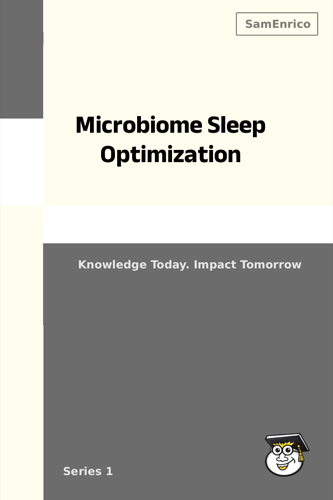
Microbiome Sleep Optimization eBook
Improves rest quality through gut-brain axis balan
by Gracia Jose
Improves rest quality through gut-brain axis balance.
Formats
Free sample
Chapter 1: The Insomnia Paradox--–- The woman sitting across from me had tried everything. Melatonin in every dose from 0.5 to 10 milligrams. Prescription sleep aids that left her groggy until noon. Meditation apps. Acupuncture.
A $2,000 “smart” bed that tracked her every toss and turn. She had blackout curtains, a white noise machine, and a strict 10 PM bedtime. By all accounts, she was doing everything right. And yet, for the past seven years, she had not slept more than four and a half hours on any single night.Her name was Sarah, a 42-year-old marketing executive, and she had become the face of a quiet epidemic. When she first came to my clinic, she brought a three-inch binder filled with sleep logs, food diaries, and printouts from her wearable device.
Her frustration was palpable. “I’ve spent thousands of dollars and hundreds of hours trying to fix my sleep,” she said, her voice cracking. “And nothing works. Nothing.”I asked her a question that no other clinician had ever posed. “What did you eat for dinner last night?”She blinked.
“What does that have to do with anything?”That question—and the answer that would unfold over the following months—is the subject of this book. Because Sarah’s insomnia was not a brain problem. It was a gut problem. And until we addressed the trillions of bacteria living in her digestive tract, no amount of blackout curtains or white noise machines was going to give her a good night’s rest.The Epidemic No One Is Talking About Let us begin with a staggering statistic. According to the Centers for Disease Control and Prevention, more than one in three adults in the United States does not get enough sleep on a regular basis.
That is approximately 84 million people. The World Health Organization has declared insufficient sleep a public health epidemic across industrialized nations. And here is the paradox that gives this chapter its name: despite the proliferation of sleep-tracking technology, wearable devices, smart mattresses, blue-light-blocking glasses, and a multi-billion-dollar supplement industry, insomnia rates have climbed more than 30 percent in the last decade alone.We are sleeping worse while trying harder than ever to sleep well.This is not a failure of individual effort. It is a failure of the prevailing paradigm. For decades, the medical establishment has treated insomnia as a disorder of the brain.
The standard approach goes something like this: your brain is too active, your neurotransmitters are imbalanced, your circadian rhythm is disrupted, or your anxiety is preventing you from relaxing. And so the solutions have followed logically from that assumption. We prescribe medications that suppress brain activity. We recommend cognitive behavioral therapy to quiet racing thoughts. We tell people to dim the lights, turn off screens, and meditate before bed.These interventions help some people, some of the time.
But for millions of others—people like Sarah—they provide at best temporary relief and at worst no relief at all. Why? Because they are treating the wrong organ.The Hidden Metabolic Costs of Poor Sleep Before we journey into the world of the microbiome, let us first understand precisely what is at stake. Poor sleep is not merely unpleasant. It is metabolically destructive.
The consequences cascade through every system in your body, creating a vicious cycle that is remarkably difficult to break without addressing its root cause.Consider inflammation. When you sleep poorly, even for a single night, your body produces higher levels of inflammatory markers called cytokines. Interleukin-6 and tumor necrosis factor-alpha (TNF-α) rise measurably after just one night of restricted sleep. Over time, chronic sleep deprivation produces a state of low-grade, systemic inflammation that has been linked to every major chronic disease of our era: cardiovascular disease, type 2 diabetes, Alzheimer's, depression, and even certain cancers. But here is the twist that most people do not understand: inflammation also causes poor sleep.
The relationship is bidirectional. Inflamed bodies do not sleep well, and poorly slept bodies become inflamed. It is a trap.Then there are the cravings. Sleep deprivation alters the hormones that regulate hunger and satiety. Ghrelin, the hormone that signals hunger, increases by as much as 28 percent after just four nights of restricted sleep.
Leptin, the hormone that signals fullness, decreases by 18 percent. This hormonal shift explains why exhausted people reach for sugar, refined carbohydrates, and calorie-dense foods. Your body is not weak-willed when you are tired. It is biochemically desperate for quick energy. And those midnight snacks?
They feed the wrong bacteria in your gut, setting the stage for further sleep disruption.Brain fog is the third metabolic cost. After one night of poor sleep, cognitive performance declines by an average of 25 percent. After a week of insufficient sleep, the decline rivals that of legal intoxication. The hippocampus—the brain's memory center—shows reduced activity. The prefrontal cortex, responsible for decision-making and impulse control, becomes less effective.
The amygdala, your emotional alarm system, becomes hyperactive. This is not a psychological failing. It is a neurological reality.Sarah had all of these symptoms. She was constantly fighting off colds. She craved sugar by mid-afternoon so intensely that she had hidden candy bars in her desk drawer.
She forgot meetings, lost her train of thought mid-sentence, and snapped at her children over minor frustrations. She had been told she was anxious, possibly depressed, and certainly in need of better sleep hygiene. What she had never been told was that the problem might be located six feet away from her brain, in the winding coils of her digestive tract.The Paradigm Shift: From Brain to Gut This book is built on a single, transformative idea: insomnia is not purely a brain disorder. It is often a gut disorder. And by reframing sleep as a whole-body process that begins in the digestive tract, we open up entirely new avenues for intervention that have nothing to do with sleeping pills, meditation apps, or blackout curtains.The gut-brain axis is the communication superhighway that connects your digestive system to your central nervous system.
For decades, researchers assumed that most of the traffic flowed from brain to gut—that stress and anxiety caused stomach problems, not the other way around. But we now know that the reverse is equally true. The gut sends vast amounts of information to the brain, and much of that information comes from the trillions of bacteria that live in your intestines.Your microbiome is not a passive passenger. It is an active organ, weighing between two and five pounds and containing more than 100 trillion microbial cells. These bacteria produce hundreds of bioactive compounds that travel through your bloodstream and along your vagus nerve directly to your brain.
They manufacture neurotransmitters. They regulate inflammation. They influence your stress response. And, as we will explore throughout this book, they control the chemistry of sleep.Consider this staggering fact: approximately 90 to 95 percent of the body's serotonin is produced in the gut, not the brain. Serotonin is the precursor to melatonin, the hormone that regulates your sleep-wake cycle.
If your gut bacteria are not properly converting tryptophan (an amino acid from food) into serotonin, your brain cannot produce enough melatonin. You could swallow melatonin pills until you turn blue…
This is the end of the free sample. Get the eBook to keep going. Buy now
About this book
Details
- Author
- Gracia Jose
- Publisher
- SamEnrico
- Language
- English
- Genre
- Non-Fiction, Health & Wellness, Sleep Health
- Released
- 2026-06-10
- Pages (approx.)
- 139
- Available as
- eBook, Audiobook

Read better in the ZLOADR app
Your eBooks on your phone or tablet. Sign in with your SamEnrico account and start reading.
More by Gracia Jose
 Sunshine Vitamin D BlueprintGracia Jose$11.99
 The Parental Addiction and TrustGracia Jose$11.99
 Mindful Movement For PainGracia Jose$11.99
 England 1966 to Italia 90: The Golden Thread of English Football’s ResurgenceGracia Jose$11.99
 How to Start a Mill Board Business (Beginners Guide)Gracia Jose$11.99
 How to Produce BumpersGracia Jose$11.99
 US Business Visa Pathways for LLC OwnersGracia Jose$12.99
 Fire Door InspectionGracia Jose$11.99
You may also like
 Sleep Solutions for PerimenopauseWillingham Boris$11.99
 Magnesium Relaxation Mineral GuideCarlton Karyn$11.99
 5 HTP Sleep GuidePierce Rolando$11.99
 Menopause Sleep Recovery PlanMount Senaida$11.99
 Gaming Addiction Sleep LossBurton Dean$11.99
 Sleep As Prevention MedicineShelley Letty$11.99
 Micronutrients For SleepRedd Alejandrina$11.99
 Melatonin Circadian GuideLorenz Gregorio$11.99
 Blue Zone Sleep Patterns GuideBarham Stephaine$11.99
 Gambling and Sleep LossHutchings Robena$11.99
 IBS Sleep Hygiene Improvement HandbookWisniewski Mariann$11.99
 PMS Insomnia Relief HandbookDurand Erwin$11.99