
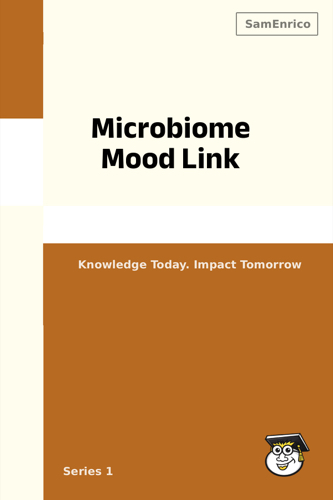
Non-FictionHealth & WellnessPsychobiotics
Microbiome Mood Link eBook
Teaches gut bacteria producing serotonin and dopam
Teaches gut bacteria producing serotonin and dopamine.
Formats
Free sample
Chapter 1: The Second Brain--–- The first time Mira felt her gut betray her, she was twenty-two years old, sitting in a windowless conference room, waiting to present her graduate research to a panel of professors who would decide her future. Her slides were perfect. She had rehearsed for three days. She knew the material cold. But as the door opened and the first professor walked in, her stomach dropped—not metaphorically, but physically.
A churning, twisting sensation erupted below her ribs. Her palms went clammy. Her heart raced. And then came the urgent, unmistakable signal that she needed to find a bathroom immediately.She excused herself, mortified, and spent the next ten minutes hunched over a toilet, her body emptying itself of everything she had eaten that day. When she returned, pale and trembling, she stumbled through her presentation, watching the professors exchange glances she interpreted as pity or judgment.
She didn't get the position. Not because her science was bad, but because she couldn't finish her sentences without pausing to breathe through another wave of nausea.For years, Mira believed she had failed because she was weak. Because she couldn't control her nerves. Because she was "just an anxious person." She tried meditation. She tried therapy.
She tried prescription antacids and elimination diets and, at one desperate point, a probiotic she bought from an infomercial. Nothing worked consistently. Every job interview, every first date, every important meeting brought the same visceral response: her gut would revolt, and her confidence would crumble alongside it.What Mira didn't know—what almost no one knew a decade ago—was that her gut was not simply reacting to her anxiety. In a very real sense, her gut was generating it. The 500 million neurons lining her intestinal tract, collectively known as the enteric nervous system, were not passive bystanders in her emotional life.
They were active participants. And the trillions of bacteria living inside her—her microbiome—were constantly sending chemical messages that shaped whether she felt calm or panicked, focused or foggy, motivated or paralyzed.This book is the guide Mira wishes she had. It is the manual for understanding and rewiring the most underappreciated relationship in your body: the connection between the bacteria in your gut and the chemistry of your brain. If you have ever felt inexplicably low after a weekend of junk food, experienced "butterflies" before a stressful event, or wondered why your mood seems to have a mind of its own, you are not broken. You are not weak.
You are simply unaware of the conversation happening inside you right now—a conversation this book will teach you to listen to, interpret, and ultimately control.The Misunderstood Messenger: Why Your Gut Is Not Just for Digestion For most of medical history, the gut was viewed as a glorified processing tube. Food went in, nutrients were extracted, waste came out. The brain gave orders—"I'm hungry," "I'm full," "I need to find a bathroom"—and the gut obediently followed. Any emotional experience originating in the gut was dismissed as a metaphor: "gut feeling," "butterflies," "a knot in my stomach." These phrases were considered poetic, not physiological.That view has been demolished by three decades of cutting-edge research. We now know that the gut contains an estimated 500 million neurons—more than the spinal cord and the peripheral nervous system combined.
These neurons form a complex, semi-autonomous network called the enteric nervous system (ENS) , and it has earned the nickname "the second brain" for good reason. The ENS can operate independently of the central nervous system (your brain and spinal cord). It can learn, remember, and respond to stimuli without waiting for instructions from above. It produces over thirty different neurotransmitters, including the same ones your brain uses to regulate mood. And it is in constant, two-way communication with your brain via a massive nerve cable called the vagus nerve.Let that sink in.
Your gut has a brain of its own. Not a brain that writes poetry or solves calculus, but a brain that senses danger, remembers past traumas, and sends powerful emotional signals that your head brain cannot ignore. When you feel "butterflies" before a presentation, that is not your imagination. That is your ENS releasing a flood of neurotransmitters that travel up the vagus nerve and directly influence the regions of your brain responsible for fear and anticipation. When you experience a "gut-wrenching" loss, that sensation is not metaphorical.
It is the physical manifestation of your second brain responding to psychological pain as if it were a physical threat.This discovery—that the gut has its own nervous system capable of influencing mood—is the foundation of everything that follows. But there is another layer to this story, one that makes it even more extraordinary and actionable. The ENS does not operate in isolation. It is home to approximately 100 trillion microorganisms: bacteria, viruses, fungi, and archaea that collectively make up your microbiome. These microbes are not passive passengers.
They are active metabolic engines that produce thousands of chemical compounds, many of which directly affect your ENS and, through it, your brain.The Invisible Puppeteers: How Gut Bacteria Talk to Your Neurons The idea that bacteria could influence your mood sounds like science fiction. We are conditioned to think of bacteria as germs—things to be sanitized, eradicated, or avoided. But the vast majority of bacteria living inside you are not only harmless; they are essential. They help digest food that your own enzymes cannot break down. They produce vitamins you cannot synthesize.
They train your immune system to distinguish friend from foe. And, as research over the past decade has dramatically shown, they produce neuroactive compounds that directly alter the way your neurons fire.Consider the roundworm C. elegans, one of the most studied organisms in biology. This tiny creature has exactly 302 neurons—a number we know with precision because scientists have mapped every single one. For years, researchers assumed that C.
elegans's simple nervous system was hardwired and fixed. Then came a series of experiments that changed everything. When scientists raised C. elegans in a completely sterile environment—no bacteria at all—the worms' nervous systems developed abnormally. They had fewer synapses, slower signaling, and impaired behavior.
But when the same worms were given specific species of bacteria, their brains literally rewired themselves. The bacteria were not providing food or energy. They were providing instructions—chemical signals that told the worms' neurons how to connect and communicate.Follow-up studies identified the specific molecules involved. Certain bacteria produce serotonin (the "confidence molecule") and dopamine (the "motivation molecule") directly. Others produce precursors that the host's cells convert into neurotransmitters.
Still others produce short-chain fatty acids that bind to receptors on neurons and alter their excitability. The gut microbiome, it turns out, functions as a kind of auxiliary endocrine organ—a massive, distributed chemical factory that manufactures the raw materials your nervous system needs to function properly.But here is the crucial distinction that most popular science books get wrong: when gut bacteria produce serotonin or dopamine, that does not mean these molecules are traveling from your gut to your brain and making you happy directly. They cannot. The blood-brain barrier, a…
This is the end of the free sample. Get the eBook to keep going. Buy now
About this book
Details
- Author
- Benjamin Shantae
- Publisher
- SamEnrico
- Language
- English
- Genre
- Non-Fiction, Health & Wellness, Psychobiotics
- Released
- 2026-06-07
- Pages (approx.)
- 156
- Available as
- eBook, Audiobook

Read better in the ZLOADR app
Your eBooks on your phone or tablet. Sign in with your SamEnrico account and start reading.
More by Benjamin Shantae
 Diplomat International CrisisBenjamin Shantae$11.99
 Self Hypnosis for Fear of TunnelsBenjamin Shantae$11.99
 Laura Benanti Soprano ComedienneBenjamin Shantae$11.99
 The Pregnant Choking GuideBenjamin Shantae$11.99
 African Year of 1960Benjamin Shantae$11.99
 Sober Parenting GuideBenjamin Shantae$11.99
 Child Death Certificate ChallengesBenjamin Shantae$11.99
 Bruce Lee: The Little Dragon's Global Revolution (1950-1973)Benjamin Shantae$11.99
 Raphael's Transfiguration: The Last Masterpiece of the RenaissanceBenjamin Shantae$11.99
 Polish Lowland Sheepdog: Herding BreedBenjamin Shantae$11.99
 How to Start a Combing Leather Business (Beginners Guide)Benjamin Shantae$11.99
 How to Produce Water-based SealantBenjamin Shantae$11.99
You may also like
 Hong Kong Handover 1997Dunn Johnnie$11.99
 Zumba For Postnatal Recovery CourseNeal Christian$11.99
 Zumba for BeginnersLadner Nikia$11.99
 YouTube Comment Mining GuideHumes Pandora$12.99
 Worry Box MeditationCarlin Rudy$11.99
 Workplace Stress MeditationNguyen Lynn$11.99
 Workplace Stress and Sleep RepairHawley Ivory$11.99
 Workplace Perfectionism CureDelaney Jeffry$11.99
 Workplace Injustice Anger GuideWallen Isabelle$11.99
 Work Addiction and Burnout LinkGreenwood Ester$11.99
 Women in Yoga and WellnessBeattie Galina$11.99
 Women in Stand Up ComedyChun Evangeline$11.99