
Non-FictionHealth & WellnessBernese Method
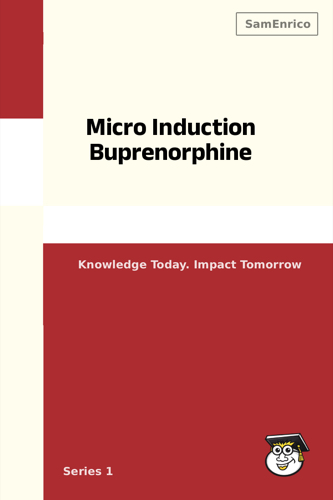
Micro Induction Buprenorphine eBook
Start low dose buprenorphine while still using to
by Le Kyong
Start low dose buprenorphine while still using to avoid withdrawal.
Formats
Free sample
Chapter 1: The Waiting Game...--It is 3:47 on a Tuesday morning, and Marcus is counting tiles on his bathroom floor. He has been here for eleven hours. His shirt is soaked through. His legs will not stop moving. Every few minutes, a wave of nausea rises from his stomach, and he breathes slowly through his mouth until it passes.
On the counter beside him sits a single orange bottle. Inside are eight milligrams of buprenorphine, the medication that is supposed to save his life. He has not taken it yet. He is terrified to take it. Three times before, he has tried to start this medication.
Three times before, he has ended up right here—on a bathroom floor, in withdrawal, crying from frustration, waiting for a sign that will never come. The last time, he waited twenty-six hours. He thought that was enough. He took the buprenorphine, and within forty-five minutes, he was vomiting so hard that he pulled a muscle in his chest. His girlfriend found him curled around the toilet, shaking, saying over and over, “I can’t do this.
I can’t do this.” She drove him to the emergency room, where they gave him fluids and told him to try again in a few days. He did not try again for eight months. In those eight months, he overdosed twice. He was revived with Narcan both times. He is twenty-eight years old.The scene above is not an outlier.
It is not an extreme case. It is the daily reality for hundreds of thousands of people in the United States alone who are caught in a cruel paradox: the medication that could save their lives requires them to first experience the very suffering they are trying to escape. This is called the “waiting period.” It is the single greatest barrier to buprenorphine treatment. And it is based on a lie.The Myth of the Clean Break The dominant cultural story about addiction recovery goes something like this: a person hits rock bottom. They suffer.
They endure withdrawal. They emerge on the other side, cleansed by pain, ready to start over. This narrative appears in twelve-step literature, in television dramas, in memoirs, and in the stories we tell ourselves about what it means to change. There is something almost religious about it—the idea that suffering is a prerequisite for redemption, that you cannot be healed unless you have first been broken open.But this is not medicine. This is theology dressed up as treatment.The history of the buprenorphine waiting period is a history of assumptions that were never properly tested.
When buprenorphine was first approved for opioid use disorder in the early 2000s, the clinical guidelines were written based on studies of people using short-acting opioids, primarily heroin. Heroin leaves the body relatively quickly—typically within twelve to twenty-four hours. The standard protocol was simple: wait until you are in moderate withdrawal, then take the buprenorphine. For most people using heroin in the early 2000s, this worked reasonably well. They would wait twelve hours, feel sick enough, take the medication, and feel better within an hour.
The system was not pleasant, but it was functional.That world no longer exists.What Changed: The Fentanyl Era Sometime around 2015, the opioid supply in North America underwent a silent transformation. Heroin, which had dominated the illicit market for decades, began to be displaced by fentanyl—a synthetic opioid fifty times more potent than heroin. Fentanyl is not just stronger; it is pharmacologically different in ways that matter profoundly for buprenorphine induction. Unlike heroin, which is water-soluble and leaves the body predictably, fentanyl is lipophilic. This means it dissolves in fat and accumulates in adipose tissue.
When a person stops using fentanyl, the drug does not simply clear out of their system in a straight line. Instead, it leaches out of fat stores slowly and unpredictably. A person can wait thirty-six hours, feel significant withdrawal symptoms, take buprenorphine, and still go into precipitated withdrawal because fentanyl is still releasing from fat cells into their bloodstream.Clinicians began noticing this pattern around 2016. Patients would come to the emergency room in obvious withdrawal. They would have high Clinical Opiate Withdrawal Scale scores.
They would have been abstinent for twenty-four, thirty, even forty-eight hours. By every traditional measure, they were ready for buprenorphine. And yet, when the medication was administered, they would experience severe precipitated withdrawal within minutes. This phenomenon came to be known as “fentanyl dumping.” It has made standard induction protocols not just ineffective but actively dangerous for a large percentage of fentanyl users.The statistics are sobering. A 2020 study of emergency department buprenorphine inductions found that standard protocols failed in over forty percent of fentanyl-positive patients.
Other studies have shown even higher failure rates. But statistics do not capture the human cost. Every failed induction is not just a medical event; it is a psychological catastrophe. The person who experiences precipitated withdrawal does not think, “Well, that was a predictable pharmacological interaction.” They think, “The medication hurt me. I cannot trust it.
I cannot trust doctors. I am going to keep using the only thing that has ever made me feel better.”The Psychological Toll of Failed Induction Let us return to Marcus for a moment. After his second failed induction—the one that sent him to the emergency room—he did not use for three days. He was terrified of buprenorphine, but he was also terrified of fentanyl. He had seen two friends die in the past year.
He knew his tolerance had dropped during the brief period he was off opioids. He tried to stop completely. On the third day, the withdrawal became unbearable. He called his dealer. He used a small amount, just enough to stop the sweating and the restless legs.
Within a week, he was back to his full daily dose. The shame he felt was crushing. He told himself he was weak. He told himself he did not really want to get clean. He did not tell anyone what had happened because he could not bear to hear someone say, “You just didn’t want it badly enough.”This is the hidden epidemic within the epidemic: the thousands of people who try to start buprenorphine, fail, and then disappear from the treatment system entirely.
They are counted as “treatment seekers” in intake forms but not as “treatment successes” in outcome studies. They fall into a statistical black hole. Some die. Some keep using for years. Some try again later, but many do not.
And the common thread in their stories is not a lack of motivation or a failure of will. It is a failure of the medical system to meet them where they are.The research on this is clear. A 2018 study published in the journal Drug and Alcohol Dependence followed patients who experienced precipitated withdrawal during buprenorphine induction. The results were stark: over sixty percent of those patients did not return for a second induction attempt within the following twelve months. Some eventually came back, but most did not.
For many, the experience of precipitated withdrawal was so traumatic that they would rather continue using street opioids—with all the attendant risks…
This is the end of the free sample. Get the eBook to keep going. Buy now
About this book
Details
- Author
- Le Kyong
- Publisher
- SamEnrico
- Language
- English
- Genre
- Non-Fiction, Health & Wellness, Bernese Method
- Released
- 2026-06-07
- Pages (approx.)
- 151
- Available as
- eBook, Audiobook

Read better in the ZLOADR app
Your eBooks on your phone or tablet. Sign in with your SamEnrico account and start reading.
More by Le Kyong
 Bipolar And Pregnancy GuideLe Kyong$11.99
 The Intuitive Eating Addiction RecoveryLe Kyong$11.99
 Container Security IncidentsLe Kyong$11.99
 Imposter Syndrome Journal GuideLe Kyong$11.99
 Navarino: The Battle That Shattered Ottoman RuleLe Kyong$11.99
 Construction SuperintendentLe Kyong$11.99
 Understanding Primary Ciliary DyskinesiaLe Kyong$17.99
 Search Console Video IndexingLe Kyong$12.99
 Jewelry Export Ethical SourcingLe Kyong$12.99
 A Beginners Guide to Football tennis (Volume 1)Le Kyong$11.99
You may also like
 Hong Kong Handover 1997Dunn Johnnie$11.99
 Zumba For Postnatal Recovery CourseNeal Christian$11.99
 Zumba for BeginnersLadner Nikia$11.99
 YouTube Comment Mining GuideHumes Pandora$12.99
 Worry Box MeditationCarlin Rudy$11.99
 Workplace Stress MeditationNguyen Lynn$11.99
 Workplace Stress and Sleep RepairHawley Ivory$11.99
 Workplace Perfectionism CureDelaney Jeffry$11.99
 Workplace Injustice Anger GuideWallen Isabelle$11.99
 Work Addiction and Burnout LinkGreenwood Ester$11.99
 Women in Yoga and WellnessBeattie Galina$11.99
 Women in Stand Up ComedyChun Evangeline$11.99