
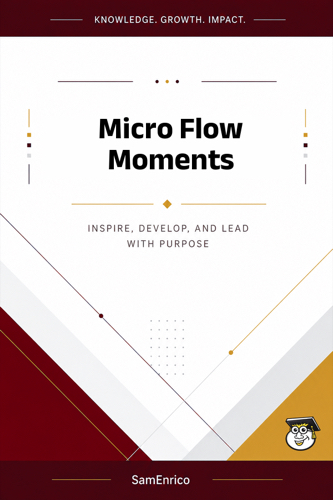
Non-FictionSelf-HelpDaily Habits
Micro Flow Moments eBook
Teaches entering brief flow states for mundane tas
Teaches entering brief flow states for mundane tasks like emails and cleaning.
Formats
Free sample
Chapter 1: The Dishwashing Paradox--The richest man in the world washes his own dishes every single night. This is not a metaphor. This is not a motivational poster. This is a verified, repeated, and deliberate daily practice of Bill Gates, who, at the time of this writing, has a net worth north of $100 billion and employs a staff of dozens. He has chefs who could cook for him.
He has house managers who could clean for him. He has assistants who could delegate the task to other assistants. And yet, every evening, after a day of making decisions that affect billions of people, Gates stands at his kitchen sink, runs the water, picks up a sponge, and scrubs his own plates, forks, and glasses.When asked about this habit in a Reddit "Ask Me Anything" session, Gates gave an answer that should be required reading for anyone who has ever felt exhausted by a day of small tasks. He did not say, "I do it to stay humble." He did not say, "My mother taught me to clean up after myself." He said, "It's a system optimization. After a day of abstract thinking, the tactile, linear feedback loop of washing dishes gives my brain a reset."Let us pause on that phrase: tactile, linear feedback loop.
Gates was not being poetic. He was describing a neurological mechanism that you can access in the next sixty seconds, regardless of your net worth, IQ, or productivity system. The mechanism is this: when you engage in a rhythmic, repetitive, physical task with your full attention, your brain shifts from a state of anxious, abstract problem-solving into a state of relaxed, present-moment focus. The technical term for this state is Micro Flow. And the dishwashing paradox is that the most powerful mental reset available to a human being costs nothing, requires no training, and is hiding in plain sight inside your sink.This book is about finding that reset not once a day, but ten times a day, twenty times a day, in every mundane task you currently dread.
But before we can build the system, we have to understand why the system is necessary. Why do we feel exhausted after a day of "nothing"? Why does answering emails drain us more than running a marathon? And why does a billionaire choose dishwashing over a massage, a nap, or a second glass of wine?The Exhaustion Paradox Let us begin with a scene that will feel familiar. It is three o'clock in the afternoon on a Tuesday.
You have been "working" since nine. Here is what you have actually done: you answered forty-seven emails, most of which were CCs or newsletters. You ran one load of laundry but forgot to move it to the dryer, so you will have to run it again. You unloaded the dishwasher, reloaded it, and ran it. You attended a thirty-minute Zoom meeting that could have been an email.
You ate lunch at your desk while scrolling Instagram. You sorted the recycling. You paid two bills. You texted your partner about dinner. You refilled your water bottle three times.
You looked at the clock and realized it is only three o'clock.You are exhausted. You are bone-tired, foggy-headed, and vaguely irritable. And yet, when you look back at your day, you cannot point to a single "hard" thing you did. You did not run a marathon. You did not file your taxes.
You did not have a root canal. You did not negotiate a merger or deliver a eulogy. You did a thousand tiny, easy, under-stimulating things. And they have left you feeling like you have been hit by a truck.This is the central paradox of modern work and home life. We call it Micro-Stress: the cumulative, invisible weight of a thousand tiny, under-stimulating obligations.
Unlike acute stress—a car accident, a public speech, a near-miss on the highway—which triggers a biological fight-or-flight response followed by resolution, Micro-Stress is chronic low-grade boredom. It is not the scream of a fire alarm. It is the constant dripping of a faucet. It is the feeling of your attention being pulled in twelve directions, none of which are remotely interesting, and all of which leave a residue of "I should be doing something else."The science behind this is brutal but clarifying. When you switch between small tasks—email to laundry to email to recycling to email—you leave a trail of attention residue.
Each switch costs you about twenty-three seconds of recovery time, during which your brain is still partially thinking about the previous task. By the time you have made ten switches, you have lost nearly four minutes to residue. Over a day of forty switches, you have lost fifteen minutes. Over a week, you have lost nearly two hours. But here is the cruel part: you do not feel those minutes as time.
You feel them as exhaustion. You feel them as the vague sense that you have been busy but not productive. You feel them as the question "Where did the day go?"Traditional productivity advice fails to address this problem because traditional productivity advice is written by people who assume you are doing hard, interesting, important work. Wake up at five AM! Use a fancier to-do list!
Batch your tasks! Time-block your calendar! These strategies work beautifully if you are writing a novel, building a startup, or training for a triathlon. They fail catastrophically if you are answering emails, sorting laundry, and unloading the dishwasher. You cannot "time-block" your way out of boredom.
You cannot "batch" your way out of exhaustion. You need a different solution entirely.The Solution Nobody Is Talking About The solution is Micro Flow. Let us define this term precisely because it is the central concept of this book and because it is easily confused with its more famous cousin.Macro Flow is what Mihaly Csikszentmihalyi described in his classic 1990 book Flow: The Psychology of Optimal Experience. Macro Flow is the state you enter when high skill meets high challenge. A surgeon in the middle of a complex operation.
A rock climber thirty feet above the last bolt. A pianist playing a difficult concerto. A writer in the third hour of a session. Macro Flow requires expertise, concentration, and usually at least forty-five minutes to achieve. It is rare, valuable, and—for most people, most of the time—completely inaccessible.
You cannot Macro Flow your way through your email inbox. You cannot Macro Flow your way through folding a basket of laundry.Micro Flow is different. Micro Flow occurs when low skill meets high focus. You do not need to be an expert dishwasher to find flow in washing a plate. You do not need to be a master folder to find flow in folding a shirt.
You need only one thing: your full attention on a rhythmic, repetitive, low-stakes physical task for a short period of time—typically ninety seconds to five minutes.The structural benefits of Micro Flow are remarkably similar to Macro Flow. In both states:Time distorts (minutes feel like seconds).Self-consciousness disappears (you stop worrying about how you look).The task feels intrinsically rewarding (you do it for its own sake, not…
This is the end of the free sample. Get the eBook to keep going. Buy now
About this book
Details
- Author
- Calabrese Lasonya
- Publisher
- SamEnrico
- Language
- English
- Genre
- Non-Fiction, Self-Help, Daily Habits
- Released
- 2026-06-06
- Pages (approx.)
- 130
- Available as
- eBook, Audiobook

Read better in the ZLOADR app
Your eBooks on your phone or tablet. Sign in with your SamEnrico account and start reading.
More by Calabrese Lasonya
 Mindfulness for Relationship ConflictCalabrese Lasonya$11.99
 CEO Breath PracticeCalabrese Lasonya$11.99
 Toddler Gut Health GuideCalabrese Lasonya$11.99
 The Silent Witness: How a Forgotten Fingerprint Revolutionized ForensicsCalabrese Lasonya$11.99
 How to Produce Cactus PearsCalabrese Lasonya$11.99
 Age Discrimination When Hiring First EmployeeCalabrese Lasonya$12.99
 How to Start a Production of Ice for Cooling Purposes Business (Beginners Guide)Calabrese Lasonya$11.99
 Halfway House ManagementCalabrese Lasonya$11.99
You may also like
 Hong Kong Handover 1997Dunn Johnnie$11.99
 Zumba For Postnatal Recovery CourseNeal Christian$11.99
 Zumba for BeginnersLadner Nikia$11.99
 YouTube Comment Mining GuideHumes Pandora$12.99
 Worry Box MeditationCarlin Rudy$11.99
 Workplace Stress MeditationNguyen Lynn$11.99
 Workplace Stress and Sleep RepairHawley Ivory$11.99
 Workplace Perfectionism CureDelaney Jeffry$11.99
 Workplace Injustice Anger GuideWallen Isabelle$11.99
 Work Addiction and Burnout LinkGreenwood Ester$11.99
 Women in Yoga and WellnessBeattie Galina$11.99
 Women in Stand Up ComedyChun Evangeline$11.99