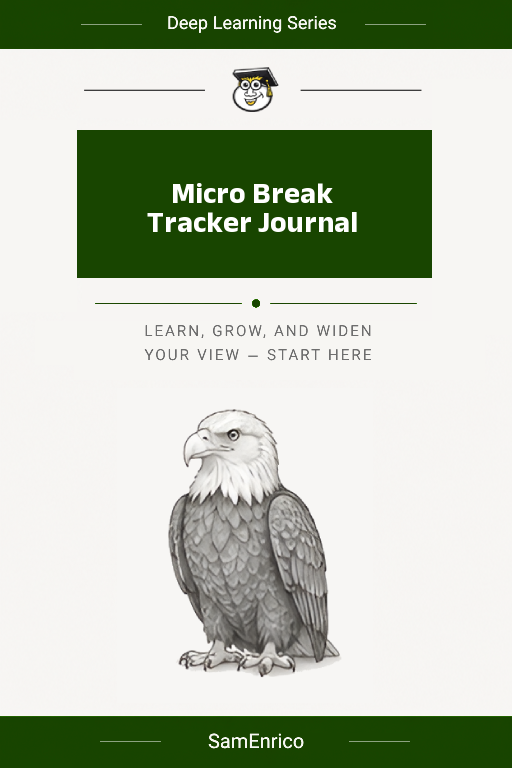
Micro Break Tracker Journal eBook
Tracks nervous system states and micro-break effec
Tracks nervous system states and micro-break effectiveness to identify which 60-second interventions regulate your unique nervous system best.
Formats
Free sample
Chapter 1: The Vacation Illusion...–- On a Tuesday afternoon in March, a senior software engineer named Priya closed her laptop, walked to her kitchen, and stood staring at an empty coffee mug for forty-seven seconds. She wasn't tired in the dramatic sense—no yawning, no heavy eyelids. She was simply… hollow. Her brain felt like a drawer stuffed so full that it could no longer close. She had taken a vacation three weeks earlier—six full days in Costa Rica, complete with a yoga retreat and a sunset photo she had posted with the caption "Recharged." Yet here she was, on a random Tuesday, unable to muster the executive function to rinse a mug.Priya is not broken.
She is not lazy. She is not lacking in resilience or grit. Priya is experiencing what neuroscientists call strain accumulation—the quiet, minute-by-minute build-up of nervous system tension that longer rest periods like weekends and vacations consistently fail to resolve. And she is not alone.The Great Rest Deception We have been sold a seductive lie. The lie says that exhaustion is a debt that can be paid off in large, lump-sum installments.
Work hard for five days, then collapse for two. Grind for eleven months, then escape for one. The lie appears in every "burnout prevention" listicle, every corporate wellness email, every well-meaning friend who says, "You just need a vacation."The data tells a different story.Research on ultradian rhythms—the body's natural 90-to-120-minute activity cycles—reveals that performance, focus, and nervous system regulation follow predictable waves of peak and trough. You are not designed to sustain high-level cognitive or emotional output for four consecutive hours. You are designed to work in pulses, with brief recovery intervals woven between them.
When you ignore these pulses and push through the trough, strain does not disappear. It accumulates. It layers. It compounds like interest on a debt you never authorized.Here is what accumulation looks like in real life: the first missed micro-break costs you nothing noticeable. The second costs you a flicker of concentration.
The tenth costs you patience with your child. The fiftieth costs you sleep. The hundredth costs you the ability to feel genuine pleasure on a Saturday morning. By the time you board a plane for Costa Rica, you are not carrying six days of stress. You are carrying months of accumulated strain that a single vacation was never designed to discharge.This chapter will dismantle the vacation illusion, introduce the radical counterintuitive solution of micro-breaks, and reveal why tracking—not guessing—is the only path out of the accumulation trap.Why Your Last Vacation Didn't Work (And Why That's Not Your Fault)Let us name the betrayal explicitly.
You took the time off. You spent the money. You followed the script. And within three to five days of returning to work, you felt exactly as depleted as before you left. Some of you felt worse—a phenomenon researchers call "post-vacation blues" but which functions more like a withdrawal syndrome from the brief period of safety your nervous system tasted.The problem is not that vacations are worthless.
The problem is that they are the wrong dosage form for the condition you are treating.Consider an analogy: if you spill coffee on your kitchen floor, you grab a paper towel immediately. You do not wait for the weekend to mop the entire house. The spill is acute, local, and requires immediate low-grade intervention. Strain accumulation is the same. Tension in your jaw, shallow breath after a difficult email, the slight upward creep of your shoulders during a tense meeting—these are spills.
A vacation is a deep clean. And while deep cleans are valuable, they cannot undo the damage of a hundred untreated spills that happened while you were waiting for permission to rest.Vacations also suffer from what psychologists call the rebound effect. When you suppress a need for an extended period—in this case, the need for frequent rest—the eventual release often triggers an overcorrection. Your nervous system, starved of safety signals, floods with relaxation so intensely that the contrast upon return feels like violence. Day one back at work after vacation is not a gentle re-entry; it is a whiplash.Finally, vacations fail because they do not teach you to recognize your own early warning signals.
A beach does not train you to notice your own jaw tension. A hiking trail does not coach you to intercept a sympathetic spike before it becomes a full adrenaline dump. You return with a tan and a photo album but with the same blind spots you had when you left. And those blind spots are precisely what this book exists to illuminate.The 60-Second Hypothesis: What Brief, Frequent Breaks Actually Do If vacations are the wrong tool, what is the right one? Enter the micro-break: a deliberate, 60-second or shorter intervention designed to shift your nervous system state.
Not a break from work—a break into regulation.The 60-second hypothesis rests on three pillars of evidence, each drawn from different scientific domains that converge on a single surprising conclusion: very short, very frequent breaks outperform longer, infrequent rest by every measurable metric.Pillar One: Interstitial Recovery Sports physiologists discovered decades ago that elite athletes do not train continuously. They train in intervals separated by brief recovery periods as short as 10 to 30 seconds. These interstitial recoveries allow for the partial clearance of metabolic byproducts, the resetting of neural firing rates, and the maintenance of technique precision. Without them, performance degrades exponentially, not linearly.Your nervous system is no different. The "byproducts" of cognitive and emotional labor—stress hormones like cortisol and adrenaline, inflammatory cytokines, and the neural noise of sustained attention—accumulate in interstitial spaces.
A 60-second micro-break performed every 45 to 90 minutes clears enough of these byproducts to reset your baseline. Not completely, but sufficiently. Think of it as pressing Ctrl+Alt+Delete on a frozen application rather than rebooting the entire computer.Pillar Two: Vagal Tone Maintenance The vagus nerve, the primary information highway between your brain and your body's organs, is not a passive cable. It has tone—a baseline level of activity that predicts your ability to recover from stress. High vagal tone means you shift from sympathetic (fight/flight) back to ventral vagal (safe/social) quickly.
Low vagal tone means you get stuck.Micro-breaks that target specific sensory-motor pathways—breath, movement, temperature, social cues, proprioceptive pressure—act as vagal "reps." Each 60-second intervention is like a single bicep curl for your parasympathetic nervous system. Do one curl, and nothing changes. Do twenty curls over the course of a day, and your baseline tone shifts. The vacation model asks you to lift a very heavy weight once per month. The micro-break model asks you to lift a very light weight dozens of times per day.
Consistency builds tone; intensity does not.Pillar Three: Pattern Interruption Your nervous system is a pattern-matching machine. It learns your routines—including your stress routines—and automates them to save energy. If you habitually respond to email with a sympathetic spike (shoulders up, breath shallow, jaw tight), that response becomes faster and more efficient over time. You are literally training your stress…
This is the end of the free sample. Get the eBook to keep going. Buy now
About this book
Details
- Author
- Hensley Alejandra
- Publisher
- SamEnrico
- Language
- English
- Genre
- Non-Fiction, Mental Wealth, Self Tracking
- Released
- 2026-05-30
- Pages (approx.)
- 142
- Available as
- eBook, Audiobook

Read better in the ZLOADR app
Your eBooks on your phone or tablet. Sign in with your SamEnrico account and start reading.
More by Hensley Alejandra
 Work Addiction and PerfectionismHensley Alejandra$11.99
 FODMAP Reintroduction PhaseHensley Alejandra$11.99
 Internal Comms Issue LogHensley Alejandra$11.99
 Anger for Police OfficersHensley Alejandra$11.99
 The Telemedicine Investment ForecastHensley Alejandra$11.99
 Shadows in the Shadows: The Hunt for the Kenyan Police MoleHensley Alejandra$11.99
 Assistant ControllerHensley Alejandra$11.99
 Cooperative Registration ProcessHensley Alejandra$12.99
 Understanding Spondyloepiphyseal Dysplasia Tarda Progressive ArtHensley Alejandra$17.99
 How to Become a Continuous-towel RollerHensley Alejandra$11.99