
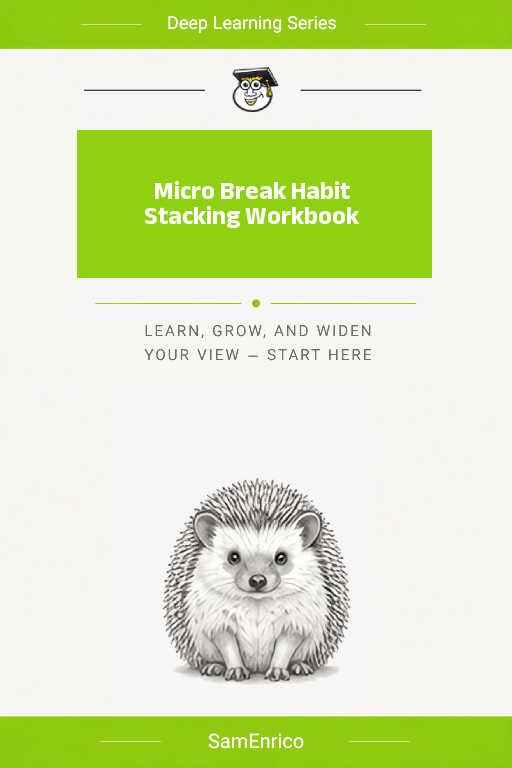
Non-FictionMental WealthHabit Formation
Micro Break Habit Stacking Workbook eBook
Attach nervous system resets to existing habits li
Attach nervous system resets to existing habits like bathroom breaks or coffee refills for automatic regulation.
Formats
Free sample
Chapter 1: The Willpower Trap--Every morning, millions of us do the same thing. We wake up, scroll, sip coffee, and somewhere between the first caffeine hit and the third email, we make a silent promise: Today, I’ll breathe. Today, I’ll calm down. Today, I’ll finally take those five minutes to reset my nervous system.And then, without fail, the day eats those minutes whole.You finish a stressful Zoom call where your boss talked over you for forty-five minutes. Your jaw is clenched.
Your shoulders are somewhere up near your ears. Your breath has been shallow for so long you’ve forgotten what a full inhale feels like. You tell yourself, Okay, now I’ll close my eyes and breathe for five minutes. But before you can even lean back in your chair, a Slack notification pings. Then an email.
Then your coworker appears at your desk with a question. And just like that, the five minutes vanish. By 5 p.m., you haven’t taken a single conscious breath. You’re exhausted, wired, and vaguely ashamed that you couldn’t manage something as simple as breathing.Here’s the thing you need to hear, and you need to hear it now: That failure is not your fault.You didn’t fail because you lack willpower. You didn’t fail because you’re undisciplined or lazy or “bad at self-care.” You failed because you were fighting against the fundamental architecture of your own brain.
And when you fight the architecture, the architecture wins every single time.This chapter is going to show you why willpower is a leaky bucket, why your brain’s autopilot system runs the show 95 percent of the time, and why the most regulated, calm, resilient people you know aren’t trying harder than you. They’ve just stopped fighting their autopilot. They’ve learned to hack it.By the end of this chapter, you’ll understand the single biggest mistake almost everyone makes when trying to regulate their nervous system. More importantly, you’ll understand why the solution isn’t more effort. It’s less.
Much less. And it starts with a toilet flush.The Zoom Call Autopsy: Why “I’ll Do It Later” Never Works Let’s rewind to that Zoom call. You’re not actually reading this book because you’re curious about neuroscience. You’re reading it because you’re tired. Tired of feeling on edge.
Tired of the afternoon crash. Tired of lying in bed at night with a racing heart while your brain replays every slightly awkward thing you said that day.You’ve tried things. Maybe you downloaded a meditation app and used it for three days before the notifications started feeling like another chore. Maybe you tried journaling, but by the time you sat down to write, you couldn’t remember what you were even stressed about. Maybe someone told you to “just breathe,” and you tried, really tried, but five seconds later you were back in your head worrying about dinner or deadlines or whether you remembered to reply to that email.None of these failed because they’re bad practices.
Meditation is good. Journaling is good. Breathing is definitely good. They failed because they rely on one deeply unreliable thing: your memory.Think about it. Every time you tell yourself “I’ll take five minutes to regulate after this call,” you are asking your brain to do two things simultaneously.
First, you’re asking it to stay focused on the present task (the call, the email, the meeting). Second, you’re asking it to remember a future intention (the breathing break). That’s called prospective memory—the ability to remember to do something at a future time—and it is notoriously, laughably bad.Research from the field of cognitive psychology suggests that people forget up to 70 percent of their intended actions within just a few hours. And the more stressed you are, the worse your prospective memory gets. So here’s the cruel irony: the moments when you most need to regulate (after a stressful call, during a chaotic afternoon, right before bed) are the moments when your brain is least capable of remembering to regulate.You’re not failing because you’re weak.
You’re failing because you’re asking your stressed, overwhelmed brain to play a game it was never designed to win.The Default Mode Network: Meet Your Brain’s Autopilot To understand why willpower fails, you need to meet the part of your brain that’s actually running the show most of the time. It’s called the Default Mode Network, or DMN for short. Neuroscientists discovered it in the early 2000s when they noticed that certain brain regions light up like a Christmas tree whenever people are not engaged in a focused task. Daydreaming? DMN.
Waiting in line? DMN. Brushing your teeth, washing your hands, walking to the kitchen, making coffee, sitting down at your desk? DMN, DMN, DMN.The DMN is your brain’s autopilot system. It handles all the routine, habitual, low-effort actions that don’t require conscious thought.
And here’s the staggering part: by some estimates, the DMN is active for roughly 95 percent of your waking life. Only about 5 percent of your day involves focused, conscious, deliberate attention. Everything else—every bathroom break, every coffee refill, every time you sit down or stand up or reach for your phone—is autopilot.Here’s why that matters for stress regulation. When you try to “remember to breathe” after a stressful moment, you are trying to use that tiny 5 percent conscious brain to interrupt the massive 95 percent autopilot brain. You’re a rowboat trying to stop a cruise ship.
It’s not impossible, but it requires enormous effort, and the moment your attention slips—which it will, because attention slips constantly—the cruise ship keeps moving.But what if you stopped trying to stop the cruise ship? What if, instead, you climbed aboard and steered it?That’s what this entire book is about. Instead of fighting your autopilot, you’re going to use it. You’re going to attach nervous system resets to the autopilot moments that are already happening dozens of times a day. You won’t need to remember to regulate.
You’ll just need to wash your hands, pour your coffee, flush the toilet, or sit down at your desk—things you already do without thinking—and the reset will come along for the ride.The 66-Day Myth: Why Duration Doesn’t Matter Before we go any further, we need to kill a myth that has caused more unnecessary guilt than almost any other in the self-help world. You’ve probably heard that it takes 66 days to form a new habit. Maybe you’ve heard 21 days. Or 30. The exact number varies depending on which pop psychology book you read, but the underlying message is always the same: you need to be consistent for a long time, and if you miss a day, you’re back to zero.That message is wrong.
And it’s harmful.The 66-day figure comes from a 2009 study by Phillippa Lally and her colleagues at University College London. The study found that…
This is the end of the free sample. Get the eBook to keep going. Buy now
About this book
Details
- Author
- Baptiste Catarina
- Publisher
- SamEnrico
- Language
- English
- Genre
- Non-Fiction, Mental Wealth, Habit Formation
- Released
- 2026-06-01
- Pages (approx.)
- 118
- Available as
- eBook, Audiobook

Read better in the ZLOADR app
Your eBooks on your phone or tablet. Sign in with your SamEnrico account and start reading.
More by Baptiste Catarina
 Company Rule AbolishedBaptiste Catarina$11.99
 Anger Rumination Stopping GuideBaptiste Catarina$11.99
 Hinton Meeting ProsecutorBaptiste Catarina$11.99
 The Automated Safety Stock SystemBaptiste Catarina$11.99
 Procrastination and Decision FatigueBaptiste Catarina$11.99
 Morphological Analysis GuideBaptiste Catarina$11.99
 Dream Journaling for Weight LossBaptiste Catarina$11.99
 Commonwealth Legacy EmpireBaptiste Catarina$11.99
 The Golden Heist of Mansa Musa: Timbuktu’s Lost TreasureBaptiste Catarina$11.99
 The Golden Court of Queen Tiya: Ethiopia’s Warrior Monarch and Architect of PeaceBaptiste Catarina$11.99
 How to Produce Power Distribution EquipmentBaptiste Catarina$11.99
 Globe Artichoke: Bud HarvestingBaptiste Catarina$11.99
You may also like
 Hong Kong Handover 1997Dunn Johnnie$11.99
 Zumba For Postnatal Recovery CourseNeal Christian$11.99
 Zumba for BeginnersLadner Nikia$11.99
 YouTube Comment Mining GuideHumes Pandora$12.99
 Worry Box MeditationCarlin Rudy$11.99
 Workplace Stress MeditationNguyen Lynn$11.99
 Workplace Stress and Sleep RepairHawley Ivory$11.99
 Workplace Perfectionism CureDelaney Jeffry$11.99
 Workplace Injustice Anger GuideWallen Isabelle$11.99
 Work Addiction and Burnout LinkGreenwood Ester$11.99
 Women in Yoga and WellnessBeattie Galina$11.99
 Women in Stand Up ComedyChun Evangeline$11.99