
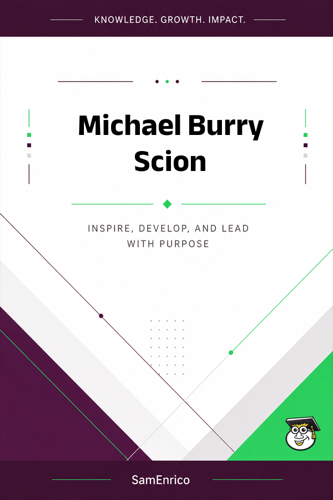
Non-FictionBiographyHedge Fund
Michael Burry Scion eBook
Reveals the physician turned investor who predicte
Reveals the physician turned investor who predicted the housing crash.
Formats
Free sample
Chapter 1: The Unseen Eye...–- The young man in the white coat sat alone in the Stanford Hospital neurology ward, a stack of patient charts on his left and a stack of annual reports on his right. It was three in the morning. The fluorescent lights hummed. Somewhere down the hall, a nurse's shoes squeaked against linoleum. Michael Burry, twenty-six years old, should have been reviewing the CT scan of the stroke patient in Room 412.
Instead, he was reading the footnotes of a small-cap semiconductor company's 10-K filing, his pen moving methodically down the page, circling contingent liabilities, questioning capitalized expenses, calculating free cash flow yields on the back of a prescription pad. He had been a resident for nearly two years. He had also been an investor for nearly four. And in the quiet hours between midnight and dawn, when the hospital slept and the markets of Tokyo and London churned toward the opening bell in New York, Burry knew which profession had won. The realization did not come as a thunderclap.
It came as a slow, cumulative weight, like water seeping through a crack in a dam. He had entered medical school at Vanderbilt with every intention of becoming a neurologist—a diagnostician of the most complex machine in the known universe. He had chosen Stanford for his residency because it was the best. He had studied, published, and impressed his attending physicians with his relentless attention to detail. But somewhere along the way, the numbers had begun to speak louder than the patients.
He found himself calculating the net present value of a pharmaceutical company's drug pipeline while a lecturer droned on about basal ganglia disorders. He caught himself comparing the balance sheets of competing hospital chains during a break in a neurosurgery rotation. He began sneaking into the hospital's computer lab after rounds to check stock prices, his fingers dancing over the keyboard with an urgency he never felt for patient notes. By the spring of 2000, the dam was about to break. The question was not whether Burry would leave medicine.
The question was whether he could survive leaving it.The Eye That Saw Differently To understand Michael Burry, one must first understand the eye he lost. At age two, Burry was diagnosed with retinoblastoma, a rare childhood cancer of the retina. The left eye was surgically removed and replaced with a prosthetic. He grew up in San Jose, California, the son of a father who worked as a materials manager at IBM and a mother who taught piano. The prosthetic eye did not track with the real one.
It sat slightly off-center, a subtle but permanent marker of difference. Other children noticed. They asked questions. Some stared. Burry learned early that he would never be like everyone else, and rather than mourn that fact, he weaponized it.
He retreated into books. He read voraciously, indiscriminately—history, science, literature, finance. He developed what his later doctors would call "an almost pathological capacity for sustained attention." He could sit for eight hours solving a single puzzle, reading a single document, tracing a single thread of logic through a labyrinth of data. He did not need friends to validate him. He did not need social approval to feel whole.
He needed answers.The prosthetic eye became a metaphor for his entire cognitive style: he saw the world from an angle no one else occupied. Where others saw a company's press release, Burry saw the footnotes. Where others saw a stock price moving up, Burry saw the cash flow statement moving down. Where others saw a booming housing market in 2005, Burry saw the exploding teaser rates hidden in the fine print of subprime mortgage prospectuses. He was not born a contrarian.
He was made one, bead by bead, in the crucible of childhood difference. The lesson he carried into adulthood was simple and brutal: the crowd is not your friend. The crowd will not save you. The crowd is usually wrong. If you want to see what others miss, you must be willing to stand where no one else stands, even if that means standing alone.This early adversity did not make him bitter.
It made him precise. Losing an eye meant he could not afford to misjudge distances, misread social cues, or trust his peripheral vision. He learned to look directly at what mattered and ignore the rest. That skill—the ability to filter out noise and focus on signal—would define his career as an investor. While others watched stock tickers, CNBC, and Twitter feeds, Burry watched cash flow statements, debt schedules, and the footnotes that everyone else had skipped.
He was not smarter than the crowd. He was just more willing to look at the things the crowd had decided were not worth seeing.The Double Education Burry's formal education was a study in contradiction. At UCLA, he double-majored in economics and pre-medicine, shuttling between the cold equations of supply and demand and the warm chaos of human biology. He loved both. Economics gave him structure, models, the illusion of predictability.
Medicine gave him urgency, stakes, the smell of antiseptic and the weight of a dying man's hand. He could not choose, so he chose both. He graduated, applied to medical school, and enrolled at Vanderbilt University School of Medicine in 1990. For the next four years, he did what medical students do: he memorized anatomy, learned to read x-rays, practiced lumbar punctures on plastic models, and slept very little. But he also did what medical students were not supposed to do.
He opened a brokerage account. He began buying stocks. He read everything he could find about Warren Buffett, Benjamin Graham, and Philip Fisher.He discovered that the same analytical rigor required to diagnose a patient—to gather disparate symptoms, rule out false leads, and identify the root cause of an illness—could be applied to a company. A balance sheet, he realized, was just a patient chart written in numbers. The footnotes were the symptoms.
The cash flow statement was the vital signs. The management discussion was the patient's own unreliable narrative. And the stock price? The stock price was the market's diagnosis, often wrong, always worth questioning. This insight—the conceptual bridge between medicine and investing—would become the foundation of everything Burry would later achieve.
He was not guessing about stocks. He was diagnosing them.Burry became a voracious reader of SEC filings during his medical training. He would finish a shift, collapse into a chair, and pull out a 10-K. He would read it once, then again, then a third time, each pass revealing new details he had missed. He developed a reputation among his classmates as the guy who knew more about stocks than about medicine.
It was not entirely untrue. By the time he graduated from Vanderbilt in 1994, his portfolio had outperformed the market for three consecutive years. He had never taken a single finance course. He was entirely self-taught, guided by books, SEC filings, and the quiet conviction that the market was a fundamentally inefficient machine waiting to be exploited by anyone willing to do the work.He began his residency at Stanford in neurology, the most competitive field…
This is the end of the free sample. Get the eBook to keep going. Buy now
About this book
Details
- Author
- Marshall Renee
- Publisher
- SamEnrico
- Language
- English
- Genre
- Non-Fiction, Biography, Hedge Fund
- Released
- 2026-06-05
- Pages (approx.)
- 109
- Available as
- eBook, Audiobook

Read better in the ZLOADR app
Your eBooks on your phone or tablet. Sign in with your SamEnrico account and start reading.
More by Marshall Renee
 Forehead Wrinkles and EmotionMarshall Renee$11.99
 The Financial Self Care PlanMarshall Renee$11.99
 Metta for Flying FearMarshall Renee$11.99
 The Self Talk ResetMarshall Renee$11.99
 The Nobel Peace Science LinkMarshall Renee$11.99
 Mindfulness Of Emotions PracticeMarshall Renee$11.99
 Anapanasati for SwimmingMarshall Renee$11.99
 The Baltic Phoenix: Lübeck and the Rise of the Hanseatic LeagueMarshall Renee$11.99
 The Vanishing Diamond: The Heist That Shocked MonacoMarshall Renee$11.99
 Growing CommidendrumMarshall Renee$11.99
 Pet Influencer Comparison TrapMarshall Renee$12.99
 PhD Application Timing Without PapersMarshall Renee$12.99
You may also like
 Hong Kong Handover 1997Dunn Johnnie$11.99
 Zumba For Postnatal Recovery CourseNeal Christian$11.99
 Zumba for BeginnersLadner Nikia$11.99
 YouTube Comment Mining GuideHumes Pandora$12.99
 Worry Box MeditationCarlin Rudy$11.99
 Workplace Stress MeditationNguyen Lynn$11.99
 Workplace Stress and Sleep RepairHawley Ivory$11.99
 Workplace Perfectionism CureDelaney Jeffry$11.99
 Workplace Injustice Anger GuideWallen Isabelle$11.99
 Work Addiction and Burnout LinkGreenwood Ester$11.99
 Women in Yoga and WellnessBeattie Galina$11.99
 Women in Stand Up ComedyChun Evangeline$11.99