
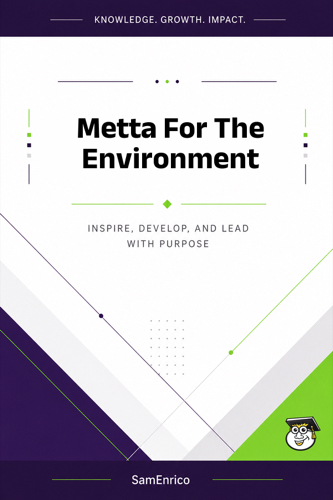
Metta For The Environment eBook
Direct loving-kindness toward nature and the plane
by Mendez Sarah
Direct loving-kindness toward nature and the planet.
Formats
Free sample
Chapter 1: The Guilt Trap--–- Sarah had not recycled in eleven months. She did not announce this decision. There was no ceremony, no manifesto posted to social media, no dramatic cutting of a blue bin into pieces. One Tuesday afternoon, after carrying her trash to the dumpster behind her apartment building, she simply dropped a plastic container into the landfill bin instead of the recycling bin. Then she did it again the next day.
And the next. By the end of the week, she had stopped sorting entirely. When her friend Marcus asked why, she could not explain it at first. "I just... don't care anymore?" she said, but the question mark at the end betrayed her.
She did care. That was precisely the problem.She had cared too much, for too long, with too little to show for it.This is the Guilt Trap, and it is the single greatest obstacle to effective environmental action in the developed world. It is not ignorance. It is not laziness. It is not a lack of concern.
The Guilt Trap is what happens when a person who genuinely loves the living world is repeatedly exposed to information about its destruction without being given a sustainable way to respond. The trap operates like a perfect machine: first comes awareness of a problem (plastic in the ocean, carbon in the atmosphere, insects disappearing from windshields). Then comes the sense of personal responsibility (what have I done? what can I do?). Then comes action (buying a reusable water bottle, switching to LED bulbs, eating less meat).
Then comes the crushing realization that these actions, however sincere, are utterly inadequate relative to the scale of the crisis. Then comes shame. Then comes avoidance. Then comes paralysis. Then comes the quiet dropping of the plastic container into the wrong bin, not because you have stopped caring but because caring has become indistinguishable from self-punishment.Sarah was not broken.
She was not lazy. She was trapped.This book exists because the Guilt Trap has a way out. But the way out is not what you expect. It is not more information. It is not a more efficient recycling system.
It is not a carbon calculator that tracks your every breath. The way out is a complete reorientation of the relationship between the human heart and the living world. It is the ancient practice of Metta—loving-kindness meditation—applied not to abstract "the environment" but to the specific, tangible, breathing, dying, thriving community of beings that actually surrounds you. This chapter dismantles the assumption that environmental action should be driven by guilt and fear. It introduces the central distinction that will guide this entire book: the difference between saving the planet and loving the planet.
And it invites you to take the first, most difficult step of all—releasing the guilt that has been masquerading as virtue.The Science of Eco-Paralysis In 2017, a team of psychologists at the University of California, Irvine, published a study that should have been headline news but was instead ignored, which is itself a symptom of the problem it described. The researchers showed participants a series of news articles about climate change. One group saw articles with solutions-focused framing (renewable energy growth, international agreements, community action). Another group saw articles with threat-focused framing (sea level rise maps, extinction statistics, temperature projections). A third group saw neutral articles about weather patterns.The results were disturbing but utterly predictable.
Participants who saw the threat-focused articles reported significantly higher levels of anxiety immediately afterward. They also reported significantly lower levels of self-efficacy—the belief that their individual actions could make a difference. Most tellingly, when given the opportunity to donate money to an environmental organization or sign a petition, the threat-focused group donated less and signed less frequently than the solutions-focused group. The fear had not motivated them. It had paralyzed them.This is not a failure of character.
It is a failure of neurobiology.The human brain evolved to respond to immediate, local, unambiguous threats. A rustling in the tall grass might be a predator—run. A member of the tribe falls ill with a new sickness—isolate and treat. A child wanders toward a cliff edge—grab them. These are threats with clear causes, clear effects, and clear responses.
Climate change and ecological collapse are the opposite. They are diffuse, global, gradual, and caused by systems so vast that no single person can meaningfully be said to be responsible or capable of solving them. The brain, encountering such a threat, does not know what to do. So it does what it always does when confronted with the unsolvable: it shuts down.Psychologists call this "eco-paralysis." Activists call it "burnout." Spiritual teachers call it "despair." Whatever the name, the symptoms are consistent: avoidance of environmental news, resentment of people who seem to be doing "more," secret relief when you forget your reusable bags because at least you do not have to think about it for one more day, and a low-grade, persistent sense of failure that attaches itself to everything from grocery shopping to voting.You have felt this. I have felt this.
Everyone reading this book has felt this. The question is not whether you have experienced eco-paralysis. The question is whether you are willing to name it and, having named it, to stop treating it as a moral failing.The Difference Between Saving and Loving Here is a sentence that may sound like heresy: you cannot save the planet.Not because the planet is beyond saving—though the scientists among us might debate that—but because the very concept of "saving" implies a relationship that does not exist and never has. To save something, you must be outside it. You must be above it.
You must be the rescuer descending from a position of superior power, knowledge, or virtue. You cannot save your own lungs from a disease. You can only heal them from within. You cannot save your own family from hardship. You can only show up for them, again and again, imperfectly.
You cannot save your own body from aging. You can only care for it, listen to it, and grieve with it when it fails."Saving the planet" positions you as the hero and the planet as the damsel. It is a rescue narrative, and like all rescue narratives, it contains within it the seeds of burnout. The hero cannot rest. The hero cannot fail.
The hero cannot admit that the problem is larger than any one person's ability to fix. And so the hero eventually collapses, and then the guilt for collapsing is added to the original guilt about the problem.Loving the planet is something else entirely.To love something is to be in relationship with it. Love does not require that you fix anything. Love requires that you show up, pay attention, and respond to what you see. You love a child not because you can save them from all harm but because you witness their life and participate in it.
You love a friend not because you can solve their problems but because you sit with them in the midst of those problems. You love your own…
This is the end of the free sample. Get the eBook to keep going. Buy now
About this book
Details
- Author
- Mendez Sarah
- Publisher
- SamEnrico
- Language
- English
- Genre
- Non-Fiction, Self-Help, Eco
- Released
- 2026-06-11
- Pages (approx.)
- 127
- Available as
- eBook, Audiobook

Read better in the ZLOADR app
Your eBooks on your phone or tablet. Sign in with your SamEnrico account and start reading.
More by Mendez Sarah
 Meditation for Anniversary AnxietyMendez Sarah$11.99
 Digital Stress Relationship BoundariesMendez Sarah$11.99
 Polysubstance Abuse HelpMendez Sarah$11.99
 The Dominic System GuideMendez Sarah$11.99
 Self Worth For Sensitive KidsMendez Sarah$11.99
 Exam Week Survival PlanMendez Sarah$11.99
 Loci Station SelectionMendez Sarah$11.99
 Southeast Talent GrowthMendez Sarah$11.99
 The Last Broadcast: The Mysterious Case of Orson Welles and the War of the Worlds PanicMendez Sarah$11.99
 Orpheus: The Song That Defied DeathMendez Sarah$11.99
 The AI Revolution: When Machines Outsmarted HumanityMendez Sarah$11.99
 Identity and Access ManagementMendez Sarah$11.99
You may also like
 Hong Kong Handover 1997Dunn Johnnie$11.99
 Zumba For Postnatal Recovery CourseNeal Christian$11.99
 Zumba for BeginnersLadner Nikia$11.99
 YouTube Comment Mining GuideHumes Pandora$12.99
 Worry Box MeditationCarlin Rudy$11.99
 Workplace Stress MeditationNguyen Lynn$11.99
 Workplace Stress and Sleep RepairHawley Ivory$11.99
 Workplace Perfectionism CureDelaney Jeffry$11.99
 Workplace Injustice Anger GuideWallen Isabelle$11.99
 Work Addiction and Burnout LinkGreenwood Ester$11.99
 Women in Yoga and WellnessBeattie Galina$11.99
 Women in Stand Up ComedyChun Evangeline$11.99