
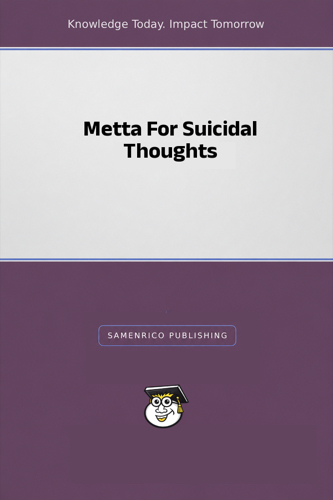
Non-FictionSelf-HelpSuicidal Ideation
Metta For Suicidal Thoughts eBook
Offers loving-kindness when self-harm impulses ari
Offers loving-kindness when self-harm impulses arise.
Formats
Free sample
Chapter 1: The Biology of Betrayal...--Your body has lied to you.Not maliciously. Not with intent. Your body is not your enemy, even though right now it feels like the most dangerous place you have ever lived. Somewhere along the line—perhaps after trauma, after years of chronic stress, after a single catastrophic loss—your nervous system learned a terrible survival strategy. It learned that the way to stop unbearable emotional pain was to propose physical pain.
It learned that the way to silence an aching mind was to threaten the body that houses it.This is the biology of betrayal: the machinery that evolved over millions of years to keep you safe now runs a program that suggests self-harm as a solution. And you have been left wondering what kind of monster you must be to have such thoughts.You are not a monster. You are a person whose brain has been rewired by suffering. And that rewiring can be changed.This chapter has one job: to help you understand, in precise and unflinching detail, where suicidal urges come from in the body. Not as abstract philosophy.
Not as spiritual bypass. As biology. Because once you see the urge as a neurological misfire rather than a moral failing, you take the first step toward disarming it. You cannot hate your way out of a brain problem. But you can understand your way into a solution.The Two Kinds of Darkness Before we talk about the biology of the urge, we need to name something crucial.
There is a difference between wanting to disappear and wanting to destroy. Both are forms of suicidal thinking. Both are terrifying. But they operate through different circuits in the brain, and they require different responses.Passive suicidal ideation sounds like this: I wish I wouldn't wake up. If a bus hit me tomorrow, I wouldn't mind.
I don't want to kill myself, but I don't want to exist either. This is the grey fog. It is exhaustion so profound that continuing to live feels like a burden. Passive ideation is dangerous not because of immediate action but because it erodes the will to stay alive over time. It is the slow starvation of hope.Active self-harm impulses sound like this: I need to cut.
I need to burn. I need to hit myself until something breaks. I have a plan and I am afraid I will follow through. This is the red alert. It is a specific, urgent demand for physical harm.
Active impulses are fueled by a different neurochemical storm—one involving sudden spikes in agitation, shame, and what researchers call "psychache," the unbearable ache of simply being alive.Most people experience both at different times. Some cycle between them. A smaller number live almost exclusively in one camp. Neither is a sign of weakness. Both are treatable.Here is what you need to know for this chapter: passive ideation is often the baseline, the low hum of suffering that becomes background noise.
Active impulses are the crisis. This chapter focuses on the biology of the active urge—the moment when your brain screams for immediate physical release. But everything we cover applies to passive ideation as well, just at a lower volume.The Pain Brain vs. The Healing Brain Your brain is not a single organ with one mood. It is a collection of competing systems, some ancient, some newly evolved.
When it comes to suicidal urges, two systems matter most: the Pain Brain and the Healing Brain. They are always in conversation. In trauma survivors and people with chronic suicidality, the Pain Brain has learned to shout over the Healing Brain.The Pain Brain is centered in three structures:The amygdala is your smoke detector. It scans the environment for threats constantly, even when you are asleep. In a well-regulated nervous system, the amygdala fires only when there is actual danger.
In a traumatized or depressed brain, the amygdala fires for everything—a text message left on read, a memory that drifts by, a tone of voice that might mean rejection. Your smoke detector goes off for toast.The insula is your body's interoceptive map. It tells you what you feel in your physical self: your heartbeat, your stomach, the temperature of your skin. In suicidal individuals, the insula becomes hyperactive, which means you feel everything more intensely. A mild stomachache becomes a catastrophe.
Loneliness becomes a physical wound. The insula amplifies sensation until the body feels like a prison of too much input.The anterior cingulate cortex processes emotional and physical pain simultaneously. This is why heartbreak literally hurts. In people with chronic suicidality, the ACC does not distinguish between social rejection and a burn. Both register as the same intensity of suffering.When these three structures run hot, you experience what researchers call "psychache": a diffuse, overwhelming sense that existence itself is painful.
Your Pain Brain is working overtime, and it has only one vocabulary—the vocabulary of threat, danger, and escape.The Healing Brain is centered in two other structures:The prefrontal cortex is your executive function. It plans, inhibits impulses, and puts emotional experiences into context. When the PFC is online, you can say, "I feel terrible right now, but this feeling will pass." When the PFC is offline (as it often is during high-stress states), you cannot access that perspective. You are pure emotion without a brake pedal.The hippocampus is your memory contextualizer. It tags memories with time and place so you know that a flashback is a memory, not current reality.
In trauma survivors, the hippocampus shrinks. Memories lose their time-stamps. The past becomes the present, which is why a trigger can send you into a full-body re-experiencing of something that happened years ago.Here is the cruel math: in suicidal states, the Pain Brain runs hot and the Healing Brain runs cold. You feel everything too intensely, and you have no perspective to soften it. The urge to self-harm is not a character flaw.
It is a malfunctioning pain-regulation circuit—a smoke detector that has learned that the only way to stop the alarm is to break the building.The Four Fs: How Your Nervous System Gets Stuck You have heard of fight or flight. But the human stress response has four settings, and the last two are particularly relevant to suicidal urges.Fight is the impulse to push back against threat. In suicidality, fight can turn inward—the person you want to fight is yourself. Self-harm as punishment is a form of internalized fight.Flight is the impulse to escape. Suicidal ideation is often flight taken to its logical extreme: if I cannot escape the situation, I will escape existence itself.Freeze is the most common response to inescapable trauma.
The body immobilizes. Dissociation sets in. You feel numb, far away, like you are watching yourself from outside. Freeze states are dangerous because they disconnect you from the physical signals that would normally stop you from harming yourself.Fawn is the least discussed response: appeasement. You try to please the threat to survive.
In suicidal contexts, fawn can look like agreeing with an abuser's voice that has been internalized—"Yes, I deserve to be…
This is the end of the free sample. Get the eBook to keep going. Buy now
About this book
Details
- Author
- Bordelon Cherelle
- Publisher
- SamEnrico
- Language
- English
- Genre
- Non-Fiction, Self-Help, Suicidal Ideation
- Released
- 2026-06-06
- Pages (approx.)
- 128
- Available as
- eBook, Audiobook

Read better in the ZLOADR app
Your eBooks on your phone or tablet. Sign in with your SamEnrico account and start reading.
More by Bordelon Cherelle
 Letting Go Of Shame HandbookBordelon Cherelle$11.99
 Time Zone Friendly Comms GuideBordelon Cherelle$11.99
 The Gaming and Mental Health GuideBordelon Cherelle$11.99
 The Active Listening for HealthcareBordelon Cherelle$11.99
 The Tides of Discovery: John Cabot and the Birth of the Atlantic WorldBordelon Cherelle$11.99
 Toxicity Testing (Off-gassing)Bordelon Cherelle$11.99
 How to Start a Acetylene Gas Generators (wholesale) Business (Beginners Guide)Bordelon Cherelle$11.99
 Author HARO Press GuideBordelon Cherelle$12.99
 Understanding Spastic Paraparesis DeafnessBordelon Cherelle$17.99
You may also like
 Hong Kong Handover 1997Dunn Johnnie$11.99
 Zumba For Postnatal Recovery CourseNeal Christian$11.99
 Zumba for BeginnersLadner Nikia$11.99
 YouTube Comment Mining GuideHumes Pandora$12.99
 Worry Box MeditationCarlin Rudy$11.99
 Workplace Stress MeditationNguyen Lynn$11.99
 Workplace Stress and Sleep RepairHawley Ivory$11.99
 Workplace Perfectionism CureDelaney Jeffry$11.99
 Workplace Injustice Anger GuideWallen Isabelle$11.99
 Work Addiction and Burnout LinkGreenwood Ester$11.99
 Women in Yoga and WellnessBeattie Galina$11.99
 Women in Stand Up ComedyChun Evangeline$11.99