
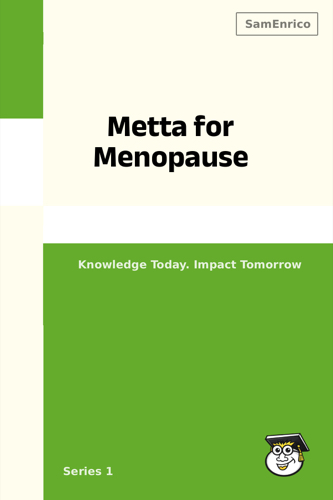
Metta for Menopause eBook
Support hormonal transition with self kindness and
Support hormonal transition with self kindness and patience.
Formats
Free sample
Chapter 1: Winter's Secret Gift...--The waiting room smelled of hand sanitizer and yesterday’s coffee. She had been sitting here for thirty-seven minutes, a paper gown clinging to her thighs, a list of symptoms clutched in her sweaty palm. Hot flashes—eleven last week. Night sweats—every single night. Insomnia—three hours of broken sleep, if she was lucky.
Brain fog so thick she had forgotten her own child’s birthday. Rage so sudden and volcanic that she had screamed at a stranger in the grocery store parking lot for taking “her” spot.The doctor would come in eventually. He would glance at her chart, note her age—forty-nine—and say something like, “Well, these things happen at your stage of life.” He might offer her a prescription for an antidepressant she didn’t want or suggest she try evening primrose oil and “wait it out.” He would not look her in the eye and say, “You are not failing. You are not broken. You are in winter, and winter has its own logic.”This book begins in that waiting room.
It begins with the woman who feels unseen, ashamed, and alone. It begins with the question she cannot bring herself to ask out loud: Is something wrong with me?The answer, which this chapter will spend its pages proving, is no. Nothing is wrong with you. Something is changing—and change, even painful change, is not the same thing as brokenness.The Doom and Gloom Lie For decades—for centuries, really—menopause has been framed as a medical crisis, a decline, a problem to be fixed. This narrative is so pervasive that most women absorb it before they ever experience a single hot flash.
Menopause is “the change of life,” a phrase that sounds vaguely ominous. It is “the end of fertility,” which is presented as a loss rather than a transition. It is “hormonal chaos,” which implies that the female body has betrayed its owner.The “doom and gloom” model is perpetuated by three powerful forces. The first is outdated medicine. Until very recently, menopause was studied as an afterthought, if it was studied at all.
Medical textbooks devoted pages to erectile dysfunction and paragraphs to the hormonal transition that half the human population experiences. The result is a system in which most doctors receive almost no training in menopause care. They know how to prescribe hormone replacement therapy and little else.The second force is pharmaceutical marketing. For decades, drug companies sold hormone replacement therapy as a fountain of youth—something that would keep women “feminine” and “vital.” When the Women’s Health Initiative study in 2002 linked HRT to increased risks of breast cancer and heart disease (a finding that has since been nuanced and recontextualized), the pendulum swung violently in the opposite direction. Women were told to “tough it out” naturally.
Either way, the message was the same: your body is a problem to be managed.The third force is silence. Generations of women were taught not to speak of such things. Your mother didn’t tell you about her hot flashes. Your grandmother certainly didn’t. The result is that most women enter perimenopause with no roadmap, no vocabulary, and no permission to struggle openly.
They feel confused and ashamed—not because anything is wrong with them, but because they have been left alone in the dark.This chapter dismantles that lie. It does not deny the real suffering of menopause—the sleepless nights, the drenched sheets, the moments of rage that frighten even the woman experiencing them. But it insists that suffering is not the same thing as failure. A woman in labor suffers, and no one tells her she is “handling it badly.” A woman grieving a death suffers, and no one suggests her body has betrayed her. Suffering is a signal of transition, not a sign of brokenness.The Four Seasons: A New Way of Seeing This book offers a different metaphor, one that has guided human beings through difficult transitions for millennia: the Four Seasons.In nature, winter is not a punishment.
It is not a design flaw. It is a necessary period of dormancy, a time when the surface appears dead but the underground is intensely alive. Roots grow deeper in winter. Soil rests and replenishes. Seeds wait, viable but unseen, for the conditions that will allow them to sprout.Perimenopause is winter.
The chaos, the withdrawal, the discomfort—these are not signs that you are doing something wrong. They are signs that your body is doing exactly what it needs to do: clearing away the old growth, resting the soil, preparing for a new kind of life on the other side.Think about what happens in a forest during winter. The trees drop their leaves—not because they are dying, but because they are conserving energy. The ground freezes, which actually protects the root systems from extreme temperature swings. Animals hibernate, slowing their metabolisms to survive the scarcity of food.
Everything slows down. Everything withdraws. And then, when the conditions are right, everything explodes into spring.Menopause follows the same logic. The hormonal chaos of perimenopause is the soil being turned. The hot flashes are the ground thawing.
The exhaustion is the necessary dormancy of a system that is doing massive underground work. The rage and grief are the old growth being cleared away to make room for something new.This reframing is not just poetic. It is practical. When you understand that winter is not a mistake, you stop fighting it. You stop trying to force yourself to feel like summer in the middle of December.
You give yourself permission to rest, to withdraw, to prepare. You begin to see the chaos not as a crisis but as a process.The remaining chapters of this book will follow the seasons. Part I is Winter—the foundation of understanding. Part II is Early Spring—the messy, unpredictable thaw. Part III is Late Spring—the emergence of tender new growth that needs protection.
Part IV is Summer—the full bloom of purpose, joy, and integration. Post-menopause, which most books ignore entirely, is not an ending but a harvest—the fruit of everything that came before.The Cultural Silence and What It Costs Let us speak plainly about what the silence around menopause costs women.It costs them their peace of mind. A woman who does not know that brain fog is a normal symptom of perimenopause will spend months convinced she has early-onset Alzheimer’s. She will lie awake at night, terrified, googling symptoms, imagining the worst. She will not know that estrogen is a neuroprotectant, that her brain is rewiring itself, that the forgetfulness is temporary and not a sign of cognitive decline.It costs them their relationships.
A woman who does not know that rage is a common symptom of hormonal fluctuation will believe she has become a monster. She will apologize for everything and nothing. She will withdraw from her partner, convinced that she is no longer lovable. She will not know that the rage is often accumulated exhaustion—decades of people-pleasing and emotional labor finally breaking through a hormonal door that can no longer hold it shut.It…
This is the end of the free sample. Get the eBook to keep going. Buy now
About this book
Details
- Author
- Hollins Maxima
- Publisher
- SamEnrico
- Language
- English
- Genre
- Non-Fiction, Self-Help, Menopause
- Released
- 2026-06-06
- Pages (approx.)
- 122
- Available as
- eBook, Audiobook

Read better in the ZLOADR app
Your eBooks on your phone or tablet. Sign in with your SamEnrico account and start reading.
More by Hollins Maxima
 Backdoor Roth IRA StrategyHollins Maxima$11.99
 Waterfall Healing VisualizationHollins Maxima$11.99
 From Booth to StardomHollins Maxima$11.99
 The Infant Loss Memory Making GuideHollins Maxima$11.99
 Blood on the Silk Road: The Unsolved Murder of Marco Polo’s Lost BrotherHollins Maxima$11.99
 Understanding Nemaline Myopathy, Type 1Hollins Maxima$17.99
 Accelerated Promotion FrameworkHollins Maxima$12.99
 Excel Tables for Economics DataHollins Maxima$12.99
 Ferry Terminal AttendantHollins Maxima$11.99
 How to Start a Outfitting of Caravans Business (Beginners Guide)Hollins Maxima$11.99
You may also like
 Hong Kong Handover 1997Dunn Johnnie$11.99
 Zumba For Postnatal Recovery CourseNeal Christian$11.99
 Zumba for BeginnersLadner Nikia$11.99
 YouTube Comment Mining GuideHumes Pandora$12.99
 Worry Box MeditationCarlin Rudy$11.99
 Workplace Stress MeditationNguyen Lynn$11.99
 Workplace Stress and Sleep RepairHawley Ivory$11.99
 Workplace Perfectionism CureDelaney Jeffry$11.99
 Workplace Injustice Anger GuideWallen Isabelle$11.99
 Work Addiction and Burnout LinkGreenwood Ester$11.99
 Women in Yoga and WellnessBeattie Galina$11.99
 Women in Stand Up ComedyChun Evangeline$11.99