
Non-FictionSelf-HelpDecision Making
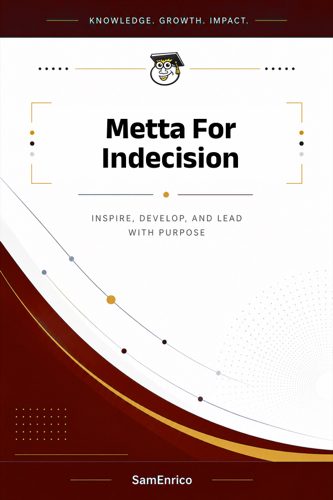
Metta For Indecision eBook
Hold your wavering self with compassion.
Hold your wavering self with compassion.
Formats
Free sample
Chapter 1: The Decisiveness Trap--–- The first time I realized I had a problem with indecision, I wasn’t standing at a crossroads between two job offers or trying to decide whether to end a relationship. I was standing in the pasta aisle of a grocery store, holding two boxes of penne, and I had been there for eleven minutes. Eleven minutes. Two boxes. Same brand.
Same price. One was organic. The other was “artisanal.” I stood there as if the fate of my entire bloodline depended on this choice. An elderly woman reached around me for her own pasta, gave me a look that was equal parts pity and irritation, and said, “Honey, it’s just noodles.”I laughed. I bought both.
And then I sat in my car and cried.Not because I was sad about the pasta. But because I realized, in that fluorescent-lit moment, that I had built an entire identity around the belief that if I could just gather enough information, weigh every variable, and protect myself from every possible regret, I could avoid making a mistake. And here I was, defeated by macaroni. The pasta aisle was not an anomaly. It was a metaphor.
My entire life had become a series of pasta aisles.If you picked up this book, I suspect you know exactly what I mean. You are not lazy. You are not stupid. You are not broken. You are, quite possibly, one of the most sensitive, thoughtful, and morally serious people you know.
And that is precisely why you cannot decide what to eat for dinner, whether to reply to that email, or if you should finally leave the city you’ve hated for six years. Your indecision is not a failure of will. It is a failure of our culture’s story about what it means to be decisive. And in this chapter, we are going to tear that story apart.The Lie We’ve All Swallowed Let me name the lie directly: Decisiveness is a moral virtue, and indecisiveness is a character flaw.We have been taught this lie from every direction. In business, the decisive leader is celebrated while the cautious one is fired.
In relationships, the person who “knows what they want” is sexy, and the person who is still figuring it out is called “emotionally unavailable.” In self-help books—the very genre that claims to liberate us—the message is almost uniform: set a goal, make a plan, take action, don’t look back. Decisiveness is framed as courage. Indecision is framed as fear.But here is the truth that no bestseller wants to admit: decisiveness is often just numbness dressed up in a suit.Consider the most “decisive” people you know. The ones who never agonize, never second-guess, never pause. Are they wise?
Or are they simply disconnected from the complexity of their own experience? Research in neuropsychology suggests that people who make decisions with unusual speed are often relying on heuristics—mental shortcuts that bypass genuine discernment. They are not seeing more options; they are ignoring them. They are not braver; they are less sensitive to nuance. In the most extreme cases, what looks like decisiveness is actually a form of dissociation: the mind races past uncertainty because it cannot tolerate sitting in the discomfort of not knowing.I am not arguing that all decisive people are dissociated.
I am arguing that our culture has confused speed with wisdom, and that confusion has pathologized one of the most intelligent responses a human being can have: hesitation.The Linear Path Myth Every self-help book I have ever read operates on the same implicit model. I call it the Linear Path Myth. It looks like this:Problem → Analysis → Decision → Action → Result → Happiness.It is a straight line. Clean. Efficient.
Masculine, in the worst sense of that word. The Linear Path Myth assumes that life is a spreadsheet, that the future is predictable, that cause and effect operate like billiard balls, and that the only thing standing between you and happiness is your own unwillingness to pull the trigger.This model is not just wrong. It is dangerous.Why? Because life does not move in straight lines. Relationships loop back on themselves.
Careers change direction mid-stream. What seemed like the “right” decision at twenty-two becomes the “wrong” decision at thirty, and then the “necessary” decision at forty-five. The linear model forces you to pretend that you can know, in advance, the full chain of consequences of any choice. And when you can’t—when your brain honestly acknowledges that the future is a fog—the model says there is something wrong with you.There is not. There is something wrong with the map.Black-and-white thinking—the insistence that options are either good or bad, right or wrong, smart or stupid—triggers a well-documented neurological response called analysis paralysis.
When the brain is forced to choose between binary options without sufficient data, the anterior cingulate cortex (the part responsible for conflict monitoring) goes into overdrive. You don’t feel that as a physiological event. You feel it as a knot in your stomach, a racing heart, and the overwhelming urge to do nothing at all. The brain freezes because it is being asked to do something evolutionarily unnatural: commit to a single path when multiple paths are still viable.In the wild, that freeze response kept you alive. A saber-toothed tiger could be behind either bush.
Not deciding which bush to approach was safer than guessing wrong. Your indecision is not a bug. It is a survival adaptation.The Metta Principle: Impermanence So where does Metta—loving-kindness—enter a conversation about frozen brains and pasta aisles?Metta is the practice of offering unconditional well-wishing to oneself and others. It is not sentimental. It is not passive.
It is a radical act of reframing. And the first Metta principle we need to apply to indecision is the Buddhist teaching of anicca, or impermanence.Here is the principle in plain English: Everything changes. Every condition shifts. Every decision you make will eventually be revised, reversed, or rendered irrelevant by time.That sounds bleak only if you are still clinging to the Linear Path Myth. If, instead, you accept impermanence as a fact—not a philosophical abstraction but a practical reality—then the weight of any single decision drops dramatically.
You are not deciding where you will live for the rest of your life. You are deciding where you will live for now. You are not choosing your forever career. You are choosing your next chapter. You are not marrying the wrong person with no escape.
You are entering a commitment that you can, if necessary, leave—with grief, with cost, but with life still intact.I want to pause here because a sharp reader will notice something. If impermanence means everything changes, then the grief of a lost path—the sadness of the road not taken—might seem trivial. Why mourn something that was never permanent anyway? This is a real contradiction, and we need to resolve it now, or the rest of the book will feel like it is pulling in two directions.Here is the resolution: Decisions are temporary in their consequences but…
This is the end of the free sample. Get the eBook to keep going. Buy now
About this book
Details
- Author
- Lemons Leandra
- Publisher
- SamEnrico
- Language
- English
- Genre
- Non-Fiction, Self-Help, Decision Making
- Released
- 2026-06-06
- Pages (approx.)
- 142
- Available as
- eBook, Audiobook

Read better in the ZLOADR app
Your eBooks on your phone or tablet. Sign in with your SamEnrico account and start reading.
More by Lemons Leandra
 Loci for Cooking RecipesLemons Leandra$11.99
 The Single Parent StudentLemons Leandra$11.99
 Medication for NightmaresLemons Leandra$11.99
 EQ For Teachers And EducatorsLemons Leandra$11.99
 Drug Dependency Success StoriesLemons Leandra$11.99
 Mindfulness Meditation for Addiction RecoveryLemons Leandra$11.99
 Memory Palace PodcastsLemons Leandra$11.99
 Sendwave Remittance ExitLemons Leandra$12.99
 Self Worth And WorkaholismLemons Leandra$11.99
 The Silk and the Spy: A Love Affair That Changed HistoryLemons Leandra$11.99
 The Last Whisper of the Nightingale: The Enigmatic Tale of the Vanishing SongbirdsLemons Leandra$11.99
 The Janes: Abortion on TrialLemons Leandra$11.99
You may also like
 Hong Kong Handover 1997Dunn Johnnie$11.99
 Zumba For Postnatal Recovery CourseNeal Christian$11.99
 Zumba for BeginnersLadner Nikia$11.99
 YouTube Comment Mining GuideHumes Pandora$12.99
 Worry Box MeditationCarlin Rudy$11.99
 Workplace Stress MeditationNguyen Lynn$11.99
 Workplace Stress and Sleep RepairHawley Ivory$11.99
 Workplace Perfectionism CureDelaney Jeffry$11.99
 Workplace Injustice Anger GuideWallen Isabelle$11.99
 Work Addiction and Burnout LinkGreenwood Ester$11.99
 Women in Yoga and WellnessBeattie Galina$11.99
 Women in Stand Up ComedyChun Evangeline$11.99