
Non-FictionSelf-HelpDisability
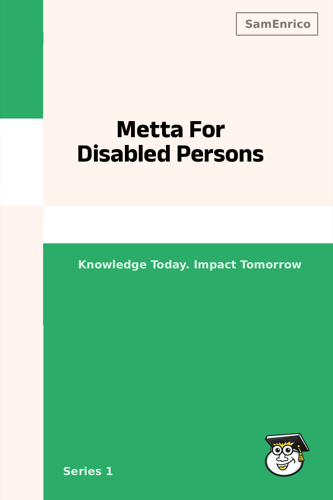
Metta For Disabled Persons eBook
Extend loving kindness to those with disabilities
by Cline Tracey
Extend loving kindness to those with disabilities facing barriers.
Formats
Free sample
Chapter 1: The Enough Body...-- For seven years, Janet had been a dedicated meditator. She had sat on countless cushions, attended three silent retreats, and could recite the Metta Sutta from memory. Every morning, she would place her hands on her heart and repeat the phrases she had been taught: "May I be healthy. May I be strong. May I be free from suffering.
May I live with ease."Then came the diagnosis. Multiple sclerosis, progressive form. Within eighteen months, Janet had traded her meditation cushion for a reclining chair she could not leave without help. Her left hand no longer opened fully. Fatigue was not a feeling but a landscape she lived inside.
And the phrases that had once brought her peace now arrived each morning like tiny acts of self-harm."May I be healthy." Her body was, by medical definition, unhealthy. She was repeating a wish against reality."May I be strong." She could not lift a cup of tea without her right hand shaking."May I be free from suffering." She was not free. She might never be free."May I live with ease." Nothing about her life was easy.Janet did what many dedicated meditators do when a practice stops working: she assumed she was the problem. She tried harder. She whispered the phrases more intensely.
She added extra repetitions. She read books about how pain was an illusion. She attended a retreat where the teacher told her that "disability is just a story you are telling yourself."She left that retreat and did not meditate again for two years.Janet is not alone. She is not broken. And she was not wrong to walk away.
What failed Janet was not her commitment or her faith. What failed Janet was a version of Metta that had never been designed for bodies like hers—bodies that do not improve, that do not heal, that do not become "healthy" by any standard the traditional phrases recognize.This chapter is for everyone who has ever felt wounded by the word "health." It is for the person with a degenerative condition who flinches at "May you be strong." It is for the chronically ill meditator who has learned to dread the phrase "May you be free from pain." It is for anyone who has ever wondered: What if loving-kindness toward my body does not mean wishing it were different? What if it means accepting it exactly as it is?We are going to dismantle something that has gone unexamined in Buddhist-derived meditation for far too long. We are going to name the tyranny of health. And then, finally, we are going to offer an alternative.The Unspoken Hierarchy of Bodies Let us name what traditional Metta phrases quietly assume.
When you repeat "May I be healthy," you are implicitly ranking bodies. You are suggesting that a healthy body is more deserving of loving-kindness than a sick one—or at least that loving-kindness is fulfilled when sickness transforms into health. The phrase contains within it a tiny, almost invisible arrow pointing toward a future state: not this, but that.For someone with a temporary illness—a flu, a broken bone, a surgical recovery—that arrow points toward a plausible future. The body will likely heal. The phrase "May I be healthy" is a hopeful nudge in a direction gravity already favors.But for someone with a degenerative condition, a permanent disability, or a chronic illness that medicine cannot cure, that arrow points toward an impossibility.
The body will not become healthy by the standard the phrase implies. And so the phrase does not arrive as hope. It arrives as a weekly, daily, hourly reminder of failure.This is not a small problem. This is a structural flaw in how Metta has been taught.Consider the language of the traditional phrases across multiple Buddhist traditions. The Pali canon includes "Abyapajjho homi" (may I be free from disease) and "Sukhi attanam pariharami" (may I live happily).
The Tibetan tradition includes "Nad med cing" (free from sickness). These are not neutral wishes. They carry the full weight of a culture that associates sickness with misfortune, disability with deficit, and health with virtue.The unspoken hierarchy works like this: healthy bodies are good bodies. Sick bodies are bodies in waiting. Disabled bodies are bodies that have failed to become healthy.And Metta, as traditionally taught, asks you to wish yourself from the bottom of that hierarchy to the top.But what if you cannot move?
What if your body is not in waiting? What if this—right here, right now, with the pain and the fatigue and the limitation—is not a pit stop on the way to health but the actual terrain of your life?Then the traditional phrases become not a practice but a punishment.The Problem with "Strength"Let us be specific about one particularly harmful word: strength.Traditional Metta phrases often include wishes for strength, for vigor, for the absence of weakness. In practice settings, teachers elaborate: "May you be strong enough to meet your challenges." "May your body support your practice." "May you have the energy to sit."For someone with a degenerative neuromuscular condition, "strength" is not a neutral aspiration. It is the very thing they are losing. Each repetition of "May I be strong" lands like a measurement against a shrinking ruler.
Yesterday I could hold a spoon. Today I cannot. The phrase does not comfort; it chronicles decline.One student with muscular dystrophy described it this way: "Every time I said 'May I be strong,' a voice in my head would answer, 'But you're not. And you're never going to be again.' The Metta practice became an argument I could not win."This is not a failure of the student's mindset. This is a failure of the tool.
You cannot use a wish for strength as a spiritual practice when your condition is defined by the predictable, unstoppable loss of strength. You are not being asked to accept reality. You are being asked to argue with it.And arguing with reality is not loving-kindness. It is the opposite. It is the refusal to make peace with what is.The Buddhist tradition has another word for that refusal: tanha—craving, thirst, the relentless reaching for things to be other than they are.
The traditional Metta phrase "May I be strong" does not lead away from craving. In a degenerative body, it is craving. It is the craving for a body you do not have, dressed up in spiritual language and called a practice.The Violence of "May You Be Free from Suffering"This phrase requires the most careful attention because it sounds so innocent. What could be wrong with wishing someone freedom from suffering?The problem is not the wish. The problem is what the wish implies about suffering itself.When you say "May you be free from suffering" to someone with a chronic pain condition, you are not wishing them a temporary reprieve.
The phrase is structured as a complete liberation, an absence. You are wishing them a state they may never achieve. And because Metta is traditionally practiced as a repetition—five, ten, twenty minutes…
This is the end of the free sample. Get the eBook to keep going. Buy now
About this book
Details
- Author
- Cline Tracey
- Publisher
- SamEnrico
- Language
- English
- Genre
- Non-Fiction, Self-Help, Disability
- Released
- 2026-06-08
- Pages (approx.)
- 148
- Available as
- eBook, Audiobook

Read better in the ZLOADR app
Your eBooks on your phone or tablet. Sign in with your SamEnrico account and start reading.
More by Cline Tracey
 Road Rage In Carpool LanesCline Tracey$11.99
 The Spanish Inquisition ManualCline Tracey$11.99
 The Assertiveness for Actors GuideCline Tracey$11.99
 Slack Message Rage GuideCline Tracey$11.99
 The Pillars of Heaven: The Gothic Cathedral BuildersCline Tracey$11.99
 Understanding PhthiriophobiaCline Tracey$17.99
 AI-Driven Marketing AutomationCline Tracey$11.99
 Quantum Computing MapCline Tracey$12.99
 VA Training Manual TemplatesCline Tracey$12.99
 How to Start a Buttons Made of Glass Business (Beginners Guide)Cline Tracey$11.99
You may also like
 Hong Kong Handover 1997Dunn Johnnie$11.99
 Zumba For Postnatal Recovery CourseNeal Christian$11.99
 Zumba for BeginnersLadner Nikia$11.99
 YouTube Comment Mining GuideHumes Pandora$12.99
 Worry Box MeditationCarlin Rudy$11.99
 Workplace Stress MeditationNguyen Lynn$11.99
 Workplace Stress and Sleep RepairHawley Ivory$11.99
 Workplace Perfectionism CureDelaney Jeffry$11.99
 Workplace Injustice Anger GuideWallen Isabelle$11.99
 Work Addiction and Burnout LinkGreenwood Ester$11.99
 Women in Yoga and WellnessBeattie Galina$11.99
 Women in Stand Up ComedyChun Evangeline$11.99