
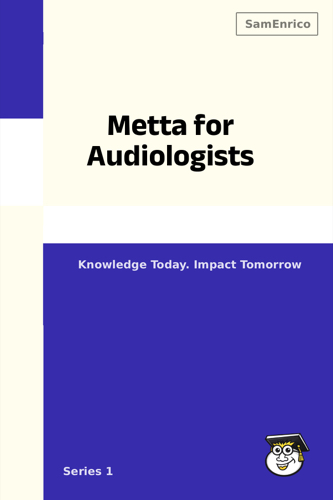
Metta for Audiologists eBook
Extend kindness to hearing health professionals.
by Broome Zetta
Extend kindness to hearing health professionals.
Formats
Free sample
Chapter 1: The Unheard Listener...–- Dr. Sarah Chen had been an audiologist for fourteen years. She could diagnose a rare retrocochlear pathology from three subtle signs that other clinicians missed. She could program a hearing aid to within a decibel of theoretical perfection. She could counsel a family through the grief of a child’s congenital hearing loss with a warmth that made parents weep with gratitude.
She was, by every objective measure, exceptional at her job. But on a gray Wednesday in March, sitting in her sound booth between patients, Sarah realized she could not remember the last time she had genuinely smiled.Not the professional smile—the one that said I am competent and caring and you are in good hands. That smile she performed fifty times a day, effortlessly. She meant a real smile. The kind that rises unbidden from somewhere deep in the chest.
The kind that accompanies true warmth, not clinical rapport. She sat in the dim glow of the audiometer, the familiar beeps still echoing in her memory, and tried to recall the last time she had felt joy in this room. She could not. The absence was not a void—it was simply a fact, like the temperature of the room or the brand of otoscope on the counter. Joy does not occur here, she thought.
And then she stood up, walked to the door, and greeted her next patient with the professional smile.This chapter is about that absence. It is about the specific, often invisible burden carried by hearing health professionals—a burden that is not merely the fatigue of a demanding career but a deeper kind of erosion. Audiologists spend their days teaching others how to listen, how to connect, how to communicate across the barrier of silence. Yet in that very act of teaching, they often lose the ability to listen to the most important person in the room: themselves. I call this phenomenon the unheard listener, and it is the central paradox of the hearing healer.The Paradox Defined The unheard listener is not a failure of technical competence.
Sarah Chen, like the vast majority of audiologists, was exquisitely skilled at her craft. She could read an audiogram the way a conductor reads a score—hearing the music of hearing loss in the patterns on the page. She could troubleshoot feedback issues with surgical precision. She knew the literature on cochlear implants better than most ENTs. But when it came to reading her own internal audiogram—the subtle shifts in her emotional state, the early warning signs of depletion, the quiet voice that said I cannot do this one more time today—she was functionally illiterate.This paradox has a name in the research literature.
Psychologists call it the empathy-practice gap: the curious and well-documented finding that professionals trained to understand the inner worlds of others often have the poorest insight into their own. For audiologists, this gap is particularly pronounced because the very structure of the work requires constant, active suppression of one’s own internal state. You cannot show frustration when a patient mishears you for the twelfth time. You cannot sigh when a cognitively impaired older adult cannot remember how to insert a hearing aid. You cannot cry when a tinnitus patient describes the relentless, maddening sound that has stolen years of sleep.
So you do what Sarah did: you smile, you repeat, you endure. And over time, the act of suppression becomes so automatic that you lose the ability to detect what you are suppressing in the first place.The unheard listener, then, is not a character flaw or a sign of weakness. It is a learned skill—one that audiology training explicitly rewards. Consider the typical graduate program: students spend hundreds of hours in clinical placements where they are evaluated on their ability to remain calm, patient, and professional under pressure. No one asks them, “And how did you feel during that difficult interaction?” No one gives them a grade for emotional self-awareness.
No one teaches them that the flatness they feel after the fiftieth patient of the week is not a personal failure but a biological signal. They learn, implicitly, that the mark of a good audiologist is the ability to disappear—to become a transparent conduit for diagnostic information and technical expertise, with no messy human feelings getting in the way.The Hidden Curriculum of Audiology Training Let me be precise about what I mean by the unheard listener. It is not simply that audiologists are overworked—though many are. It is not simply that the job is emotionally demanding—though it certainly is. The unheard listener is a specific kind of perceptual atrophy: the gradual loss of the ability to notice one’s own internal state because one has been trained, day after day, to direct all attention outward.In the sound booth, this outward attention is essential.
You must listen for the faintest response, watch for the slightest shift in the patient’s expression, monitor the equipment, track the timing, adjust the instructions, manage the anxiety. There is no room for introspection. The audiologist’s attention is a scarce resource, and the patient claims every bit of it. This is not a criticism of audiology training—it is simply a fact of the work. But facts have consequences.
When you spend forty hours a week directing your attention entirely outward, the muscles of inward attention atrophy. You stop noticing how your shoulders feel. You stop registering the tightness in your jaw. You stop hearing the quiet voice that says I need a break because that voice has been silenced so many times that it has learned to be quiet.Sarah Chen told me a story during an interview for this book. (All names and identifying details in this book have been changed to protect privacy, but the emotional truth of every story is preserved.) Early in her career, she had a patient—a young woman in her twenties with sudden sensorineural hearing loss in one ear.
The woman was terrified, disoriented, and convinced she was going deaf entirely. Sarah spent an hour with her, running tests, explaining results, offering reassurance. At the end, the woman hugged her, cried, and said, “Thank you. No one has ever listened to me like that before.”Sarah walked to her car that evening and realized she could not remember the drive home. She had no memory of the traffic, the radio, or even which route she had taken.
She had been, in her words, “completely checked out.” And the terrifying thing was not that it had happened—it was that she could not recall the last time she had remembered a drive home. The absence had become so ordinary that she had stopped noticing it.This is the unheard listener in its most insidious form: not a crisis but a quiet erosion. You do not wake up one day unable to feel. You drift, slowly, imperceptibly, until one day you realize that the color has drained from your emotional world and you cannot remember when it started to fade.The Specific Emotional Labor of Audiology To understand the unheard listener, we must understand the specific shape…
This is the end of the free sample. Get the eBook to keep going. Buy now
About this book
Details
- Author
- Broome Zetta
- Publisher
- SamEnrico
- Language
- English
- Genre
- Non-Fiction, Self-Help, Audiology
- Released
- 2026-06-06
- Pages (approx.)
- 127
- Available as
- eBook, Audiobook

Read better in the ZLOADR app
Your eBooks on your phone or tablet. Sign in with your SamEnrico account and start reading.
More by Broome Zetta
 Macros for Thyroid HealthBroome Zetta$11.99
 Outbreak Succession Emergency PlanBroome Zetta$11.99
 Foster Care Hair MemoriesBroome Zetta$11.99
 Mindfulness of Thoughts GuideBroome Zetta$11.99
 Nobel Laureates in Economic InequalityBroome Zetta$11.99
 Grief and Self Care After SpouseBroome Zetta$11.99
 Fiverr SEO Gig RankingBroome Zetta$11.99
 Dragonblood and the Nine Immortals' GambitBroome Zetta$11.99
 The Comeback Kid: How a Broken Body Built the First British Boxing Video GameBroome Zetta$11.99
 Service Providers Guide to Web HostingBroome Zetta$11.99
 How to Start a Figured Glass Business (Beginners Guide)Broome Zetta$11.99
 BPO Knowledge Management SystemsBroome Zetta$12.99
You may also like
 Hong Kong Handover 1997Dunn Johnnie$11.99
 Zumba For Postnatal Recovery CourseNeal Christian$11.99
 Zumba for BeginnersLadner Nikia$11.99
 YouTube Comment Mining GuideHumes Pandora$12.99
 Worry Box MeditationCarlin Rudy$11.99
 Workplace Stress MeditationNguyen Lynn$11.99
 Workplace Stress and Sleep RepairHawley Ivory$11.99
 Workplace Perfectionism CureDelaney Jeffry$11.99
 Workplace Injustice Anger GuideWallen Isabelle$11.99
 Work Addiction and Burnout LinkGreenwood Ester$11.99
 Women in Yoga and WellnessBeattie Galina$11.99
 Women in Stand Up ComedyChun Evangeline$11.99