
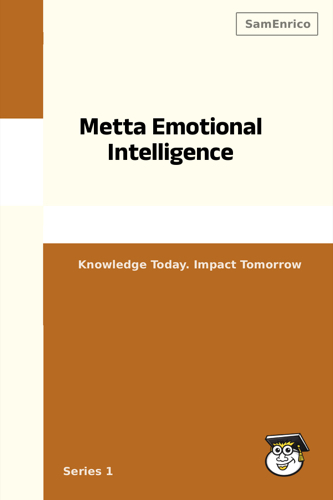
Metta Emotional Intelligence eBook
Use loving-kindness to develop empathy, self-regul
Use loving-kindness to develop empathy, self-regulation, and social skills.
Formats
Free sample
Chapter 1: The Friendliness Revolution--–- Every morning, millions of professionals around the world wake up already exhausted. They check their email before their heartbeat regulates. They review their calendar before they review their own breath. They step into meetings armed with emotional intelligence frameworks they have memorized but cannot feel—active listening scripts, conflict resolution templates, and the ever-present mandate to “manage” their emotions as if feelings were inventory to be optimized. And yet, despite all this training, burnout rates have tripled in the last decade.
Compassion fatigue is now classified as an occupational hazard for nurses, teachers, and social workers. Leaders report feeling more disconnected from their teams than ever before. Something is fundamentally wrong with how we have been taught to handle the human heart.The problem is not that emotional intelligence is useless. The problem is that the version of emotional intelligence sold to corporations, schools, and self-help readers over the past twenty-five years has been sterile. It has been stripped of its original warmth, reduced to a set of calculable competencies: self-awareness (score yourself), self-regulation (control yourself), empathy (analyze the other person), and social skills (influence the room).
These are not bad goals. But the methods offered to achieve them are almost universally cold. They ask you to monitor your emotions like a security camera. They ask you to reappraise your anger as if it were an accounting error. They ask you to feel for others without ever teaching you how to replenish the well of your own caring.
The result is what researchers now call “pseudo-EQ” —the outward performance of emotional skill without the inward experience of emotional safety.This book makes a radical claim: you cannot develop genuine emotional intelligence by treating your own emotions as problems to be solved. You can only develop it by treating your emotions as guests to be welcomed. And the only sustainable way to welcome anything—especially the difficult, messy, embarrassing parts of your inner life—is with mettā.The Word That Changes Everything Mettā (pronounced MAY-tah) is a Pali word that has no perfect English equivalent. It is often translated as “loving-kindness,” but that phrase has become so cluttered with sentimental associations that it barely scratches the surface. Some scholars prefer “unconditional friendliness.” Others say “benevolence.” But the closest I have found comes from the Thai forest master Ajahn Chah, who once said: “Mettā is the willingness to say ‘welcome’ to whatever arises—without wanting it to be different, and without wanting it to stay.”Let that sink in.
Mettā is not about feeling warm and fuzzy. It is not about liking someone or something. It is about the radical stance of non-violence toward experience itself. When you practice mettā, you stop fighting your own anxiety. You stop suppressing your own grief.
You stop judging your own jealousy. Instead, you greet each emotion as it arrives at the door of your awareness, not as an enemy to be defeated but as a confused guest who needs a place to sit down.Now contrast this with the standard emotional intelligence training you have likely received. If you have ever been through a corporate EQ workshop, you have probably been taught to “reframe negative thoughts” (which is just thought suppression dressed in cognitive-behavioral clothing) or to “practice active listening” (which often means pretending to listen while secretly preparing your response). These techniques are not wrong. They are simply incomplete.
They address the architecture of behavior without addressing the ecology of the heart. You can learn to paraphrase someone’s complaint perfectly while secretly wishing they would stop talking. You can learn to label your emotion as “anger” on a mood meter while silently hating yourself for feeling angry. That is not emotional intelligence. That is emotional performance.Mettā offers something different.
It offers a way of relating to your inner world that does not require you to become a manager, a controller, or a performer. It asks you to become a friend. And as any good therapist will tell you, the most powerful agent of change in a human life is not a technique—it is a relationship. When you become friends with your own fear, your fear stops needing to scream for attention. When you become friends with your own shame, your shame stops driving you to perfectionism.
When you become friends with your own grief, your grief stops turning into depression. The relationship is the medicine. The mettā is the relationship.The Sterile EQ Epidemic Let me be more specific about what I call Sterile EQ. In 1995, Daniel Goleman published Emotional Intelligence, and the world fell in love with the idea that soft skills matter as much as IQ. By 2005, 75 percent of Fortune 500 companies were offering EQ training.
By 2015, emotional intelligence had become a billion-dollar industry. And by 2025, despite all that spending, employee engagement scores had barely budged, and burnout had become the number one reason for voluntary turnover.What happened? The same thing that always happens when a profound human capacity gets commercialized: it got stripped of its soul. The original research on emotional intelligence was rooted in the work of psychologists like Peter Salovey and John Mayer, who understood that emotions carry information and that skillfully attending to that information requires genuine curiosity and care. But when EQ entered the corporate training market, the warmth was bleached out.
Curiosity became “assessment.” Care became “metrics.” And the actual experience of sitting with another person’s suffering—or your own—was replaced by Power Point slides and role-play scripts.Consider the most popular EQ assessment tool in the world, the Emotional and Social Competence Inventory (ESCI). It measures four domains: Self-Awareness, Self-Management, Social Awareness, and Relationship Management. These are useful categories. But the assessment itself asks questions like: “I accurately describe how others perceive my actions” and “I stay calm under pressure.” Notice what is missing? There is no question about whether you like yourself.
There is no question about whether you feel friendliness toward your own failures. There is no question about whether you can hold someone else’s pain without drowning in it. The assessment measures performance, not presence. It measures what you do, not how you hold what you feel.This is Sterile EQ: emotionally intelligent behavior performed by an emotionally disconnected person. It looks good on the outside.
It gets you promoted. It helps you navigate office politics. But it does not protect you from burnout. It does not deepen your relationships. And it certainly does not make you happier.
In fact, research from the University of London found that people who score high on traditional EQ assessments but low on self-compassion are actually more likely to experience emotional exhaustion than people with low EQ and high self-compassion. Why? Because they are performing emotional skill without the inner resource to sustain it. They are running on empty, but their training has taught them to hide it.The Neural Plasticity of Friendliness You might be thinking: this all sounds very nice, but where is the science? Is there any evidence that “friendliness toward experience” actually changes the brain in ways that improve real-world emotional intelligence?
The answer is yes, and the evidence is stunning.Over the past twenty years, neuroscientists have discovered that the brain is…
This is the end of the free sample. Get the eBook to keep going. Buy now
About this book
Details
- Author
- Mcgregor Crista
- Publisher
- SamEnrico
- Language
- English
- Genre
- Non-Fiction, Self-Help, EQ
- Released
- 2026-06-08
- Pages (approx.)
- 138
- Available as
- eBook, Audiobook

Read better in the ZLOADR app
Your eBooks on your phone or tablet. Sign in with your SamEnrico account and start reading.
More by Mcgregor Crista
 Bacillus Coagulans GuideMcgregor Crista$11.99
 The Nun Who Never AgedMcgregor Crista$11.99
 Step Eleven Prayer GuideMcgregor Crista$11.99
 Passive To Assertive ShiftMcgregor Crista$11.99
 Reformation Swiss Civil War GuideMcgregor Crista$11.99
 Prime Day Urge CopingMcgregor Crista$11.99
 Caregiver Anticipatory BurnoutMcgregor Crista$11.99
 The Jade Phoenix's Last Flight: A Tale of Love and BetrayalMcgregor Crista$11.99
 The Iron Samurai: Japan's First Robot Rescue MissionMcgregor Crista$11.99
 The Lost Tapes of Studio 54: Secrets Behind the Velvet RopeMcgregor Crista$11.99
 UX Writing and Content DesignMcgregor Crista$11.99
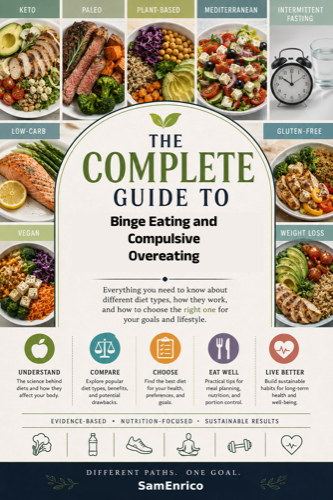 The Complete Guide to Binge Eating and Compulsive OvereatingMcgregor Crista$11.99
You may also like
 Hong Kong Handover 1997Dunn Johnnie$11.99
 Zumba For Postnatal Recovery CourseNeal Christian$11.99
 Zumba for BeginnersLadner Nikia$11.99
 YouTube Comment Mining GuideHumes Pandora$12.99
 Worry Box MeditationCarlin Rudy$11.99
 Workplace Stress MeditationNguyen Lynn$11.99
 Workplace Stress and Sleep RepairHawley Ivory$11.99
 Workplace Perfectionism CureDelaney Jeffry$11.99
 Workplace Injustice Anger GuideWallen Isabelle$11.99
 Work Addiction and Burnout LinkGreenwood Ester$11.99
 Women in Yoga and WellnessBeattie Galina$11.99
 Women in Stand Up ComedyChun Evangeline$11.99