
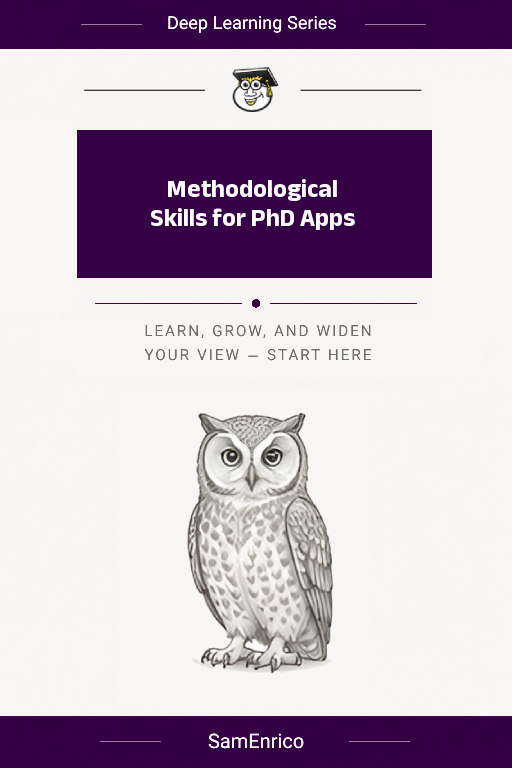
Non-FictionStudent's ShortcutSkills
Methodological Skills for PhD Apps eBook
Emphasize technical skills like programming, stati
Emphasize technical skills like programming, statistics, microscopy, or synthesis as research readiness.
Formats
Free sample
Chapter 1: The Obsolete Resume--The email arrived on a Tuesday in late March, and Maria read it seven times before she believed it. "We regret to inform you..." Nine times. Nine rejections from nine Ph D programs. She had a 3.97 GPA in molecular biology from a respectable state university. She had scored in the 92nd percentile on the GRE.
She had three glowing letters of recommendation from professors who called her "one of the most promising students in a decade." And she had nothing. No offers. No waitlists. No explanation.Across the country, James was celebrating. He had a 3.4 GPA—respectable but unexceptional.
He had never taken the GRE because the programs he applied to had dropped the requirement. His letters were solid but not gushing. Yet he had received offers from three top-twenty Ph D programs in materials science, including his dream lab at MIT. When Maria and James compared notes later (they met at a conference years afterward, both having eventually landed somewhere), the difference became painfully clear. James had not been a better student than Maria.
He had been a better applicant. And the distinction between those two things is the subject of this entire book.What did James have that Maria lacked? He had not a higher GPA but a different kind of evidence. While Maria had spent her undergraduate years collecting credentials—grades, test scores, certificates of attendance at research symposia—James had spent his collecting technical artifacts. He had a Git Hub repository containing the code for a weather station he had built from a twenty-dollar Arduino kit.
He had a two-page "methods card" listing every instrument he had touched in his materials characterization class, complete with model numbers and calibration protocols. He had a Jupyter notebook analyzing public data on battery degradation that he had written over a summer when he was bored. These artifacts were not assigned. No professor had graded them. They were simply proof—proof that James could do the work that Ph D programs actually require.This chapter dismantles the traditional Ph D application playbook that failed Maria and elevates the technical-first framework that succeeded for James.
If you have been told that good grades and test scores are enough, that research experience is something you can only get after you are admitted, or that the personal statement is where you pour your heart out about your childhood love of science—you have been given advice that is at best incomplete and at worst actively harmful. The admissions landscape has shifted beneath your feet, and most pre-graduate advisors have not noticed.The Great Disconnect: What Professors Actually Want vs. What Students Think They Want To understand why Maria failed and James succeeded, you must first understand the fundamental asymmetry between the undergraduate mindset and the professorial mindset. Undergraduates are trained—conditioned, really—to believe that academic success is a matter of consumption. You consume lectures.
You consume textbooks. You consume problem sets. Then you are tested on your consumption, and the results are translated into a grade point average. This is a perfectly functional system for its intended purpose: sorting students by their ability to follow instructions and absorb established knowledge.But a Ph D is not about consumption. It is about production.
You are not applying to consume more knowledge; you are applying to produce new knowledge. And professors evaluating your application are not looking for evidence that you can sit quietly and absorb. They are looking for evidence that you can do. They want to know: if we admit you, can you design an experiment, troubleshoot a protocol, write code that runs, analyze data without p-hacking, and write a paper that passes peer review?Here is the brutal truth that no undergraduate advisor will tell you: A 4.0 GPA is weak evidence of research readiness. It is evidence of conscientiousness, yes.
It is evidence of test-taking ability. But it is not evidence that you can handle the messy, failing, ambiguous work of actual research. In fact, some admissions committee members privately confess that extremely high GPAs can be a negative signal—suggesting a student who has optimized for classroom success rather than intellectual risk-taking.Consider what a professor actually reads when they open your file. They have three hundred applications and three weeks. They spend, on average, three to five minutes on each file before making an initial "keep or discard" decision.
In those three minutes, they are not calculating your GPA to the third decimal place. They are scanning for specific technical markers. They are asking one question: "Has this person done anything that looks like real research?"The Research Readiness Dataset: Reframing Everything You Have Already Done The core innovation of this book—and the concept that will transform your application from "student file" to "junior colleague file"—is what I call the Research Readiness Dataset. The idea is simple: every activity you have completed during your undergraduate career contains hidden methodological evidence. The problem is not that you lack experience.
The problem is that you have been describing your experience in the language of assignments completed rather than the language of skills demonstrated.Let me show you what I mean. Take a standard biology lab course. You performed a series of prescribed experiments: a DNA extraction, a polymerase chain reaction, a gel electrophoresis. Your lab report described the protocol and the results. You received an A.
On your resume, you wrote: "Completed advanced molecular biology laboratory course with distinction."This description is noise. It tells the admissions committee nothing about what you can actually do. Now watch what happens when you reframe the same experience as a Research Readiness Dataset:"Executed phenol-chloroform DNA extraction protocol achieving 50-100 ng/μL yield (Nanodrop quantification). Troubleshot PCR contamination via negative control analysis, identifying primer-dimer formation and adjusting annealing temperature from 55°C to 62°C. Performed agarose gel electrophoresis with SYBR Safe staining, documenting band visualization at expected 800bp target.
Maintained electronic lab notebook (Benchling) with timestamped entries for all reagent lot numbers and thermal cycler settings."Every single sentence in that reframed description is a technical marker—a piece of evidence that a professor scanning your file will recognize as genuine methodological competence. Notice what changed: vague claims ("completed a course") became specific claims ("executed DNA extraction protocol with quantified yield"). Passive learning became active doing ("troubleshot PCR contamination"). The professor no longer has to guess whether you actually touched a pipette; you have told them exactly what you did, what went wrong, and how you fixed it.This reframing works for every course, project, or activity you have ever done. Did you write a literature review?
That is not a paper; it is "evidence of systematic literature searching across Pub Med and Web of Science databases." Did you give a class presentation? That is "experience communicating technical findings to peer audience with Q&A response." Did you work as a tutor? That is "diagnosis of student misconceptions and adaptive explanation strategies."The Research Readiness Dataset is not about inflating your credentials. It is about translating your existing credentials into the language that admissions committees actually speak. You have been speaking Student.
It is time to learn Professor.The Two Problems: Presentation vs. Generation Before we go further, I need you to perform…
This is the end of the free sample. Get the eBook to keep going. Buy now
About this book
Details
- Author
- Pinkerton Mirta
- Publisher
- SamEnrico
- Language
- English
- Genre
- Non-Fiction, Student's Shortcut, Skills
- Released
- 2026-06-01
- Pages (approx.)
- 142
- Available as
- eBook, Audiobook

Read better in the ZLOADR app
Your eBooks on your phone or tablet. Sign in with your SamEnrico account and start reading.
More by Pinkerton Mirta
 The Imposter To Expert TransitionPinkerton Mirta$11.99
 Meeting Reduction ProtocolsPinkerton Mirta$11.99
 Fibromyalgia and Restless Leg SyndromePinkerton Mirta$11.99
 From Soldier to Buddhist MonkPinkerton Mirta$11.99
 The Pet Portrait GuidePinkerton Mirta$11.99
 Teen Sibling Comparison GuidePinkerton Mirta$11.99
 Interruption TriggersPinkerton Mirta$11.99
 Madeleine Albright PinPinkerton Mirta$11.99
 Image Rehearsal Therapy GuidePinkerton Mirta$11.99
 The Elven Forge of Valinor’s ShadowPinkerton Mirta$11.99
 The Mariner Kings: Portugal’s Golden FleetPinkerton Mirta$11.99
 The Complete Guide to the 400 Calorie Fix DietPinkerton Mirta$11.99
You may also like
 Hong Kong Handover 1997Dunn Johnnie$11.99
 Zumba For Postnatal Recovery CourseNeal Christian$11.99
 Zumba for BeginnersLadner Nikia$11.99
 YouTube Comment Mining GuideHumes Pandora$12.99
 Worry Box MeditationCarlin Rudy$11.99
 Workplace Stress MeditationNguyen Lynn$11.99
 Workplace Stress and Sleep RepairHawley Ivory$11.99
 Workplace Perfectionism CureDelaney Jeffry$11.99
 Workplace Injustice Anger GuideWallen Isabelle$11.99
 Work Addiction and Burnout LinkGreenwood Ester$11.99
 Women in Yoga and WellnessBeattie Galina$11.99
 Women in Stand Up ComedyChun Evangeline$11.99