
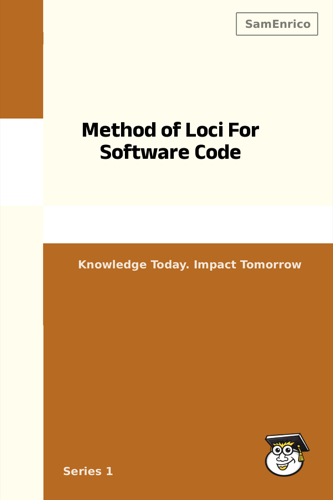
Non-FictionSelf-HelpProgramming
Method of Loci For Software Code eBook
Memorizes syntax, functions, and algorithms using
by Stine Alva
Memorizes syntax, functions, and algorithms using code palaces.
Formats
Free sample
Chapter 1: The Tab-Complete Trap--–- You have been programming for years. You understand Big O notation, can debug a race condition in your sleep, and have strong opinions about tabs versus spaces. Yet right now, you are staring at your screen, finger hovering over the keyboard, unable to recall whether Python’s list.sort() returns a new list or modifies the original in place. You have used this method hundreds of times. You could recognize the correct answer instantly if you saw it in a multiple-choice quiz.
But on a blank page, with no autocomplete and no documentation tab, your mind draws a blank.This is not a sign of low intelligence, weak technical ability, or impending impostor syndrome—though it may feel like all three. This is the Tab-Complete Trap, and nearly every modern programmer has fallen into it. The trap is sprung by the very tools designed to help you: integrated development environments with intelligent autocomplete, Copilot that suggests entire functions before you finish typing, and documentation tabs that sit perpetually open in your browser. These tools have transformed programming from a discipline of recall into a discipline of recognition. You no longer need to remember that Array.slice() returns a shallow copy and does not modify the original—you just type arr.slice( and the IDE shows you the return type.
But what happens when the IDE is not there? What happens during a technical interview on a whiteboard, a coding assessment in a plain text editor, or an emergency deploy when your internet fails and Copilot goes dark?The gap between what you can recognize and what you can recall is the single largest inefficiency in modern software development. And the solution is not to use your tools less—they are powerful and here to stay. The solution is to train your biological memory with the same rigor you train your logical reasoning. This book introduces a method that has survived for over two thousand years, used by Greek orators, Roman senators, and world memory champions.
It is called the Method of Loci, and when adapted for software code, it transforms abstract syntax, functions, and algorithms into vivid, unforgettable spatial journeys.The Recognition-Recall Divide To understand why you forget code you have seen hundreds of times, you must first understand a fundamental distinction in cognitive psychology. Recognition and recall are not the same thing, and they use different neural pathways. Recognition is the ability to identify something as familiar when you see it. This is why multiple-choice tests feel easier than essay tests—your brain only needs to match an existing pattern, not generate it from scratch. Recall is the ability to produce information from memory without any external cues.
This is what you need when you sit down to write code from scratch, when you are debugging without documentation, or when you are explaining a concept to a colleague.Modern programming tools have made recognition almost effortless. You type a few characters, and the IDE shows you a dropdown of possibilities. You glance at the documentation, and your brain says, "Yes, that looks correct." But recognition does not strengthen recall. In fact, research in cognitive science suggests that over-reliance on recognition can actually weaken recall pathways, because your brain learns that it does not need to store the information deeply—it can always look it up. This is the Tab-Complete Trap in action.Consider a simple experiment.
Without looking it up, write down the exact syntax for a for loop in your primary programming language. Include the parentheses, braces, and semicolons in the correct order. Now check your answer against documentation. If you got it right, congratulations—you are in the minority. If you got it wrong or left something out, you are normal.
The average programmer, even one with five years of experience, makes at least one error in this exercise. Not because they are bad programmers, but because their tools have done the recalling for them for so long that their own recall muscles have atrophied.The Performance Gap The consequences of the recognition-recall divide go far beyond minor syntax errors. Let me introduce a concept called the Performance Gap. This is the difference between what you can do given unlimited access to documentation, search, and autocomplete versus what you can do with only your mind. For most programmers, this gap is enormous.
You might spend forty percent of your coding time looking up information you have already seen before. Forty percent. That is nearly half of your productive time spent re-finding answers to questions you have already answered.This is not an exaggeration. Studies of software engineering productivity have consistently found that context switching and information lookups are among the largest drains on developer time. Every time you tab over to documentation, every time you type a query into Stack Overflow, every time you wait for Copilot to generate a suggestion, you are paying the tax of weak recall.
The tax compounds. Each lookup breaks your flow, resets your mental context, and takes far longer than the few seconds the lookup itself requires. The true cost is measured in lost momentum, fragmented concentration, and the slow erosion of your mental model of the codebase.But the Performance Gap is not inevitable. It is not a fixed limitation of human biology. It is a training gap.
Your logical reasoning—your ability to solve novel problems, design algorithms, and debug complex systems—is already strong. You have trained it through years of practice. But your recall has been outsourced to your tools. This book is designed to bring recall back under your control, using a technique that works with your brain’s natural architecture rather than against it.The Method of Loci: A Two-Thousand-Year-Old Solution The Method of Loci, also known as the Memory Palace technique, predates the Roman Empire. It was developed by Greek poets and orators who needed to deliver hours-long speeches without notes.
In a time when writing materials were scarce and printing did not exist, a speaker’s career depended entirely on their ability to remember. The Method of Loci was their secret weapon.The technique is deceptively simple. You choose a physical space you know intimately—your childhood home, your current apartment, your office floor plan. In your mind, you walk through that space and place the things you want to remember at specific locations, or loci. When you need to recall the information, you walk the same path in your imagination, and the objects you placed at each locus come back to you.
The Greek poet Simonides of Ceos is credited with discovering the method after a building collapse killed everyone at a banquet. He was able to identify the bodies because he remembered where each person had been sitting. The spatial arrangement of the room had encoded the guests in his memory.Why does this work? Your brain evolved to remember places, paths, and objects. Your ancestors who could remember which cave had water, which path had predators, and which tree had fruit survived to pass on their genes.
Your ancestors who could remember abstract symbols without spatial anchors did not survive, because abstract symbols did not exist for…
This is the end of the free sample. Get the eBook to keep going. Buy now
About this book
Details
- Author
- Stine Alva
- Publisher
- SamEnrico
- Language
- English
- Genre
- Non-Fiction, Self-Help, Programming
- Released
- 2026-06-10
- Pages (approx.)
- 134
- Available as
- eBook, Audiobook

Read better in the ZLOADR app
Your eBooks on your phone or tablet. Sign in with your SamEnrico account and start reading.
More by Stine Alva
 Stress Reduction Memory AgingStine Alva$11.99
 Ectopic Pregnancy GriefStine Alva$11.99
 Lineup Procedure FlawsStine Alva$11.99
 Low Carb Snacking Survival KitStine Alva$11.99
 Quit Smoking for AthletesStine Alva$11.99
 Micronutrient Testing GuideStine Alva$11.99
 Fear of Failure Support GroupsStine Alva$11.99
 Whispers of the Marid: The Djinn Who Commanded the TidesStine Alva$11.99
 The Iron Duke and the Siege of Badajoz: Wellington's Bloodiest TriumphStine Alva$11.99
 How to Produce Textured GlazeStine Alva$11.99
 How to Produce SpacersStine Alva$11.99
 A Collector's Handbook to the Daf 46Stine Alva$11.99
You may also like
 Hong Kong Handover 1997Dunn Johnnie$11.99
 Zumba For Postnatal Recovery CourseNeal Christian$11.99
 Zumba for BeginnersLadner Nikia$11.99
 YouTube Comment Mining GuideHumes Pandora$12.99
 Worry Box MeditationCarlin Rudy$11.99
 Workplace Stress MeditationNguyen Lynn$11.99
 Workplace Stress and Sleep RepairHawley Ivory$11.99
 Workplace Perfectionism CureDelaney Jeffry$11.99
 Workplace Injustice Anger GuideWallen Isabelle$11.99
 Work Addiction and Burnout LinkGreenwood Ester$11.99
 Women in Yoga and WellnessBeattie Galina$11.99
 Women in Stand Up ComedyChun Evangeline$11.99