
Non-FictionSelf-HelpTime-Based Prevention
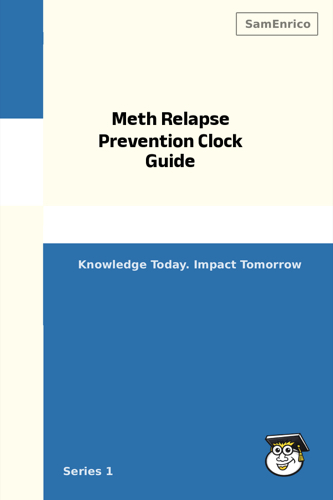
Meth Relapse Prevention Clock Guide eBook
Map high-risk times of day, week, and month, then
Map high-risk times of day, week, and month, then schedule protective activities and check-ins during those predictable danger windows.
Formats
Free sample
Chapter 1: The 3 AM Demon---– The phone lights up on the nightstand. It’s 3:14 AM. You’ve been staring at the ceiling for two hours. Your skin feels like it’s crawling off your bones. Your mouth is dry.
Your chest is tight. And somewhere, in a drawer, in a jacket pocket, or at a dealer’s house five minutes away, there’s a pipe. You told yourself yesterday that you were done. You meant it. But now, at 3:14 AM, with no one awake, no one watching, and no reason not to except a promise you made to a version of yourself that no longer exists in this hour—the demon whispers.
Just this once. Just to sleep. Just to stop feeling like this.This is the moment most relapse prevention programs fail you.Not because they’re wrong. Not because you’re weak. But because they don’t understand what 3:14 AM does to the human brain.
They give you advice for 2 PM—go to a meeting, call your sponsor, take a walk. But at 3:14 AM, there are no meetings. Your sponsor is asleep. And walking alone in the dark is how people get arrested or worse. The standard recovery playbook was written for daylight.
Meth relapse happens in the hours the playbook forgot.This chapter is about those hours. Not in theory. In practice.By the time you finish reading, you will understand exactly why 12 AM to 5 AM is the most dangerous block on your recovery clock. You will know what happens in your brain during those hours—not pop psychology, but real chronobiology. And most importantly, you will have a concrete, step-by-step protocol for surviving the 3 AM demon without using.
This is not about willpower. Willpower sleeps at 3 AM. This is about architecture—building a environment and a set of automatic responses that work even when your prefrontal cortex has clocked out for the night.Let’s begin with what actually happens to your brain in the dark.The Chronobiology of Midnight Relapse Your brain runs on a master clock called the suprachiasmatic nucleus. It’s a tiny cluster of neurons no bigger than a grain of rice, sitting deep in your hypothalamus. Every day, it orchestrates a symphony of hormones, body temperature fluctuations, and neural activity patterns.
Methamphetamine does not just damage your dopamine system—it smashes your master clock with a sledgehammer.Here is what research from the National Institute on Drug Abuse and multiple chronobiology labs has established about meth and the circadian system.First, meth use flips your natural sleep-wake cycle. During active use, you stay up for two, three, sometimes five days straight. Your master clock tries to compensate by releasing melatonin at the wrong times, suppressing core body temperature during the day, and elevating it at night. Even after you stop using, this inverted cycle can persist for weeks. You find yourself wide awake at 2 AM and exhausted at 2 PM.
This is not a character flaw. This is brain damage to your clock genes—the actual DNA that controls your 24-hour rhythm.Second, the prefrontal cortex—the part of your brain responsible for impulse control, future planning, and resisting temptation—follows a natural circadian rhythm. It performs best in the late morning and early afternoon. It performs worst between midnight and 5 AM. Functional MRI studies show that prefrontal cortex activity drops by nearly 30 percent during these hours in healthy individuals.
In meth users with disrupted circadian rhythms, the drop can be 50 percent or more.This means that at 3 AM, you are trying to make good decisions with half a brain. Literally.Third, the amygdala—your brain’s alarm system and craving center—shows the opposite pattern. It becomes hyperactive at night. This is an evolutionary holdover from when humans needed to be alert to predators in the dark. But for someone in meth recovery, a hyperactive amygdala at 3 AM means every small trigger feels like a life-threatening emergency.
A text from an ex. A creak in the house. The memory of a pipe. Your brain treats these as survival threats and floods your system with craving signals.So here is what you are fighting between 12 AM and 5 AM: a half-asleep prefrontal cortex, a screaming amygdala, a shattered master clock, and a dopamine system that has forgotten how to feel pleasure from anything except meth. This is not a fair fight.
This is why you have relapsed at 3 AM before. This is why you will relapse again—unless you build a clock that works in the dark.The Unified Danger Window: Why 12 AM to 5 AMYou will notice that this book uses a single, unified high-risk window for nighttime hours: 12 AM to 5 AM. Some recovery resources claim the window is 1 AM to 5 AM. Others say 2 AM to 6 AM. After reviewing the chronobiology research and clinical data from meth treatment programs, we have consolidated on 12 AM to 5 AM for three reasons.First, the melatonin rise that begins around 9 PM reaches its peak at approximately 12 AM in most adults, triggering the sharpest drop in alertness and impulse control.
By 12 AM, your prefrontal cortex is already significantly compromised.Second, the period between 12 AM and 2 AM is when most meth users who are trying to sleep experience the most intense “hypnic jerks” and sleep-onset insomnia—the body jolting awake just as it begins to drift off. These jolts are often misinterpreted as withdrawal symptoms or cravings, leading to relapse.Third, the period between 4 AM and 5 AM is when the master clock begins its slow ramp toward morning. Cortisol starts rising. Body temperature begins increasing. For many recovering users, this transition period produces a spike in anxiety and agitation that feels identical to the early stages of a meth come-down.
The result is a conditioned craving that peaks around 4:30 AM.Rather than asking you to remember different windows for different chapters, we have standardized on 12 AM to 5 AM as the red zone for all nighttime protocols in this book. When you see “the red zone” or “nighttime danger window” in any future chapter, this is what it means.There is one exception to this rule: the first 72 hours after last use, which we cover in Appendix A’s survival card. During acute withdrawal, the red zone may extend to 6 AM due to severe sleep deprivation and paranoia. But for the purposes of your master clock and the protocols in this chapter, 12 AM to 5 AM is your target.Why Your Phone Is the Enemy (And How to Disarm It)Before we get to the survival protocol, we need to talk about the single biggest threat to your recovery during nighttime hours. It is not your dealer.
It is not your using friends. It is the device in your pocket or on your nightstand.Your phone is a relapse machine between 12 AM and 5 AM. Here is why.First, every dealer you have ever used with is three text messages away. At 3 AM, when your prefrontal cortex is offline, sending that first text feels like a small thing. Just asking.
Just seeing if they’re up. By the fourth text, you have a meeting location and an excuse.Second, social media and dating apps are designed to trigger dopamine releases. When you are already dopamine-depleted…
This is the end of the free sample. Get the eBook to keep going. Buy now
About this book
Details
- Author
- Thomsen Monika
- Publisher
- SamEnrico
- Language
- English
- Genre
- Non-Fiction, Self-Help, Time-Based Prevention
- Released
- 2026-06-09
- Pages (approx.)
- 154
- Available as
- eBook, Audiobook

Read better in the ZLOADR app
Your eBooks on your phone or tablet. Sign in with your SamEnrico account and start reading.
More by Thomsen Monika
 Aromatherapy for Menstrual CrampsThomsen Monika$11.99
 Async Performance Review CourseThomsen Monika$11.99
 Pregnancy Announcement ComparisonThomsen Monika$11.99
 Hypnotic Drug Free Birth GuideThomsen Monika$11.99
 Neutrinos: Ghosts in the Quantum MachineThomsen Monika$11.99
 The Ghosts of Chernobyl: Voices from the Exclusion ZoneThomsen Monika$11.99
 Google Australia Ad PolicyThomsen Monika$12.99Google Australia Ad PolicyThomsen Monika$12.99
 Hundred Dollar Shopify LaunchThomsen Monika$12.99
 Battery Replacement for DisplaysThomsen Monika$11.99
 Understanding Cormier–rustin–munnich SyndromeThomsen Monika$17.99
 How to Start a Mould for Foundry Business (Beginners Guide)Thomsen Monika$11.99
You may also like
 Hong Kong Handover 1997Dunn Johnnie$11.99
 Zumba For Postnatal Recovery CourseNeal Christian$11.99
 Zumba for BeginnersLadner Nikia$11.99
 YouTube Comment Mining GuideHumes Pandora$12.99
 Worry Box MeditationCarlin Rudy$11.99
 Workplace Stress MeditationNguyen Lynn$11.99
 Workplace Stress and Sleep RepairHawley Ivory$11.99
 Workplace Perfectionism CureDelaney Jeffry$11.99
 Workplace Injustice Anger GuideWallen Isabelle$11.99
 Work Addiction and Burnout LinkGreenwood Ester$11.99
 Women in Yoga and WellnessBeattie Galina$11.99
 Women in Stand Up ComedyChun Evangeline$11.99