
Non-FictionHealth & WellnessPsychosis
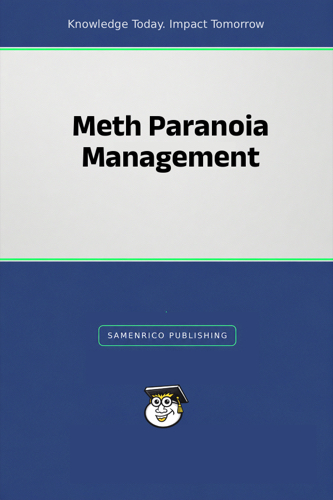
Meth Paranoia Management eBook
Reduce suspicious thoughts and fear of surveillanc
Reduce suspicious thoughts and fear of surveillance during recovery.
Formats
Free sample
Chapter 1: The Ghost in the Machine--The first time you saw a shadow person, you probably told yourself it was nothing. A trick of the light. Your eyes playing games because you hadn't slept in three days. But then the shadow moved. It turned toward you.
It had no face, but you felt it looking. And in that moment, your chest tightened, your breath stopped, and a voice inside you whispered a terrifying possibility: What if it's real? What if they've been real all along?If you are reading this book, that voice has grown louder. Louder still in recovery, when the drug is gone but the fear remains. You may have accused your partner of poisoning your food.
You may have torn apart your apartment looking for cameras. You may have stopped answering your phone because you believe it's tapped. You may have spent hours staring out a window, watching for cars that circle too slowly, neighbors who look too long, strangers who seem to know your name.This chapter is not going to tell you that your fears are imaginary. That would be insulting and, more importantly, untrue. Your fear is real.
Your body is producing real adrenaline, real cortisol, real physical symptoms of terror. The question is not whether you are afraid. The question is whether the target of your fear exists outside your own brain.Here is the truth that will guide everything in this book: Meth-induced paranoia is a biological echo of drug use, not evidence of conspiracy. It is not a sign that you have gone permanently insane. It is not proof that you were right all along about being watched.
It is a predictable, well-documented neurochemical consequence of flooding your brain with a drug that was never designed for human beings to consume in the amounts and patterns that meth encourages.This chapter will explain exactly how meth creates paranoia, why sleep deprivation makes it exponentially worse, and why stopping the drug often makes the paranoia temporarily increase—a terrifying paradox that drives many people back to using. By the end of this chapter, you will understand what is happening inside your skull. And understanding, as you will learn, is the first and most powerful weapon against the shadows.The Neurochemistry of Terror: Why Meth Doesn't Just Make You High Methamphetamine is not like other stimulants. Coffee keeps you awake. Adderall focuses your attention.
Cocaine produces a brief, intense rush. Meth does all of these things, but it also does something else: it systematically dismantles your brain's ability to distinguish between signal and noise, between threat and safety, between reality and delusion.To understand why, you need to know about two chemicals in your brain: dopamine and norepinephrine. These are not "bad" chemicals. You need them to survive. Dopamine helps you pay attention to what matters.
It says, This is important. Remember this. Norepinephrine is your alertness chemical. It says, Something is happening. Pay attention.Under normal conditions, these chemicals work together beautifully.
You hear a strange noise at night. Your norepinephrine rises, making you alert. Your dopamine helps you focus on the noise, trying to identify it. Is it the wind? A branch?
An intruder? Once you determine it's just the wind, your brain releases GABA—the braking system—which tells your amygdala (the fear center) to stand down. The threat is gone. You go back to sleep.Meth destroys this elegant system.When you use meth, your brain is flooded with so much dopamine that it cannot possibly process it all. Every neutral stimulus suddenly seems significant.
The hum of the refrigerator is no longer just a hum—it might be a camera. The car outside is no longer just a neighbor coming home—it might be surveillance. Your brain is screaming at you: PAY ATTENTION. THIS IS IMPORTANT. EVERYTHING IS IMPORTANT.At the same time, meth floods your brain with norepinephrine.
Your heart races. Your pupils dilate. Your muscles tense. You are in full fight-or-flight mode, but there is no bear, no attacker, no emergency. Your body is preparing for a threat that does not exist.
And because there is no actual threat to resolve, your body stays in that state. For hours. For days.Over time, repeated meth use burns out your brain's braking system. GABA—the chemical that tells your amygdala to calm down—becomes depleted. Your fear center is stuck in the "on" position, like a smoke alarm that has been triggered and cannot be reset.
Even when you are not using, even when you are days or weeks into recovery, your amygdala remains hyperactive. It is looking for threats that are not there and sounding the alarm every time it thinks it finds one.This is not a moral failure. This is not a sign that you are weak or crazy. This is brain chemistry. And brain chemistry can be understood, managed, and ultimately healed.The Hallucination Threshold: Why Sleep Deprivation Creates Monsters If dopamine and norepinephrine are the fuel of meth paranoia, sleep deprivation is the accelerant.The human brain is not designed to stay awake for more than sixteen to eighteen hours at a stretch.
When you push past that limit, your brain begins to take shortcuts. It fills in missing information with guesses. Most of those guesses are wrong. And because your amygdala is already hyperactive, the guesses tend to be threatening.Here is what happens inside a sleep-deprived brain: the thalamus, which normally filters sensory information before sending it to the cortex, begins to fail. Unfiltered data pours in.
The cortex, overwhelmed, starts making rapid, low-quality predictions about what that data means. A shadow on the wall is not processed as "absence of light" but as "a person standing there." A creaking pipe is not processed as "thermal expansion" but as "someone walking upstairs."This is called the hallucination threshold—the point at which your brain can no longer reliably distinguish between internal signals (thoughts, memories, fears) and external reality. For a well-rested brain with normal dopamine levels, the hallucination threshold is very high. You would need to stay awake for five to seven days before you started seeing things that aren't there.Meth lowers that threshold dramatically.With meth in your system, your hallucination threshold drops. You might start seeing shadow people after just two or three days awake instead of five.
And here is where the kindling effect—which we will explore in depth—makes everything worse. Every time you experience a psychotic episode, the threshold drops further. A person who has had ten meth-induced psychoses might start seeing shadow people after just one sleepless night. Or even while fully rested, if the kindling is severe enough.This is why you might be reading this book while sober, days or weeks into recovery, and still seeing shadows out of the corner of your eye. Your brain has been kindled.
The pathway to paranoia has been worn smooth, like a trail through a forest that has been walked so many times it has become a road. Your brain takes that road automatically now, even when there is no meth in your system, even when you have slept.The good news—and there is good…
This is the end of the free sample. Get the eBook to keep going. Buy now
About this book
Details
- Author
- Jose Lizabeth
- Publisher
- SamEnrico
- Language
- English
- Genre
- Non-Fiction, Health & Wellness, Psychosis
- Released
- 2026-06-07
- Pages (approx.)
- 150
- Available as
- eBook, Audiobook

Read better in the ZLOADR app
Your eBooks on your phone or tablet. Sign in with your SamEnrico account and start reading.
More by Jose Lizabeth
 Last Mile Delivery Driver Safety Programs CourseJose Lizabeth$11.99
 Disability Body Image AcceptanceJose Lizabeth$11.99
 Supervised Consumption For TherapyJose Lizabeth$11.99
 The Babylonian Stargazers: How Ancient Astronomers Mapped the HeavensJose Lizabeth$11.99
 Silicon Shadows: The AI Cold War You Never Heard OfJose Lizabeth$11.99
 How to Become a Tree-trimmer HelperJose Lizabeth$11.99
 Artificial Intelligence ROI 2026-2030Jose Lizabeth$12.99
 Mailchimp Analytics HandbookJose Lizabeth$12.99
 Understanding High ScapulaJose Lizabeth$17.99
 Ecommerce and Integration ManagerJose Lizabeth$11.99
You may also like
 Hong Kong Handover 1997Dunn Johnnie$11.99
 Zumba For Postnatal Recovery CourseNeal Christian$11.99
 Zumba for BeginnersLadner Nikia$11.99
 YouTube Comment Mining GuideHumes Pandora$12.99
 Worry Box MeditationCarlin Rudy$11.99
 Workplace Stress MeditationNguyen Lynn$11.99
 Workplace Stress and Sleep RepairHawley Ivory$11.99
 Workplace Perfectionism CureDelaney Jeffry$11.99
 Workplace Injustice Anger GuideWallen Isabelle$11.99
 Work Addiction and Burnout LinkGreenwood Ester$11.99
 Women in Yoga and WellnessBeattie Galina$11.99
 Women in Stand Up ComedyChun Evangeline$11.99