
Non-FictionInformativeEducational
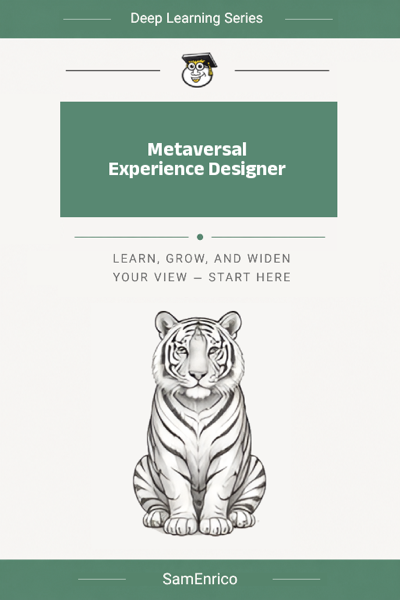
Metaversal Experience Designer eBook
A Coursebook on Metaversal Experience Designer
by Fite Elke
A Coursebook on Metaversal Experience Designer
Formats
Free sample
Chapter 1: The Habitat Shift...--The internet, as you know it, is a lie. Not a malicious lie, but a useful fiction that has outlived its purpose. For thirty years, we have described digital spaces using the language of print: we browse pages, follow links, open windows, and scroll through feeds. This metaphor was ingenious in 1994, when screens were flat and bodies were irrelevant. It made the unfamiliar feel familiar.
But today, that metaphor is actively harming your ability to design for the next generation of digital experience.You are about to design for a medium that has no pages. No scroll bars. No back buttons. No bookmarks in the traditional sense. You are designing for habitats.This chapter dismantles the page metaphor and replaces it with something older, stranger, and far more powerful: the environment.
By the time you finish reading, you will understand why a metaverse is not a website you visit but a world you inhabit. You will learn three foundational concepts that will appear in every subsequent chapter. And you will begin the long shift from thinking like an app designer to thinking like an architect of daily life.The difference between these two mindsets is the difference between mailing someone a photograph of a garden and handing them a shovel.The Death of the Page Let us begin with an experiment. Close your eyes for ten seconds and imagine your morning routine. Not the actions themselves, but the spaces you move through.
Your bedroom. The hallway. The kitchen. The bathroom mirror. The coffee maker.
Now open your eyes.Notice something peculiar. You did not imagine a series of discrete screens. You did not imagine clicking through a sequence of pages. You imagined a continuous, three-dimensional space that you navigate using your body. You turned your head.
You reached for objects. You stepped around obstacles. You experienced presence, embodiment, and agency without thinking about any of those terms.That is a habitat.Now imagine checking your email. What do you see? Probably a list of messages.
A sidebar. A toolbar. A compose button. These are not spatial affordances; they are document affordances inherited from paper-based office work. The email interface is a filing cabinet with a search bar.
The web browser is a stack of pages with a navigation history. The smartphone home screen is a tray of icons representing applications, each of which is a separate room you enter and exit.These metaphors were brilliant adaptations to technological constraints. Early computers had no graphics, so we used text and lists. Screens had low resolution, so we used windows to layer information. Bandwidth was expensive, so we delivered content in discrete pages.
But the constraints have changed. The metaphors have not.The metaverse is not an extension of the page metaphor. It is a rejection of it. When you put on a virtual reality headset, there are no pages. There is only space.
When you use augmented reality glasses, there are no windows. There are only objects anchored to the physical world. When you navigate a persistent digital twin of a city block, there is no scroll bar. There is only your feet, real or virtual, carrying you through an environment that exists whether you are looking at it or not.This shift is not incremental. It is foundational.
You cannot design for habitats using the tools and mental models of page design. User experience designers who excelled at optimizing conversion funnels will find themselves lost in a world where there is no funnel, only a horizon. Game designers who excelled at crafting linear narratives will find themselves frustrated by a medium where users refuse to follow the script. Architects, stage designers, and urban planners—professionals who have been ignored by the digital design world for decades—will suddenly find themselves in high demand.The page is dead. Long live the habitat.Three Pillars of Habitation Before we go any further, we need a shared language.
The rest of this book rests on three concepts that you must internalize so deeply that they become instinctive. Each of these concepts will be explored in depth in later chapters, but here we establish their core meanings and their relationships to one another.Presence is the sensation of being somewhere. Not looking at somewhere. Not thinking about somewhere. Being somewhere.
When you are reading a novel and lose track of time, you are experiencing a mild form of presence—the story has transported you. When you are playing a competitive video game and you flinch at an enemy attack, your body is responding as if the threat were real. When you walk through a well-designed museum and forget that you are wearing a bulky VR headset, you are experiencing full sensory presence.Presence is not a binary state. It is a continuum, and it is fragile. The neuroscientists we will meet in Chapter 3 have shown that presence requires consistency across multiple sensory channels.
If the visuals say you are moving forward but your inner ear says you are stationary, presence shatters and nausea rushes in. If the audio places a conversation to your left but the visuals place it to your right, your brain will spend cognitive energy resolving the conflict instead of inhabiting the space.Presence is the foundation. Without it, nothing else matters.Embodiment is the feeling of owning a body in that space. Not controlling a cursor. Not manipulating a puppet.
Owning. When you look down in virtual reality and see a chest, arms, and hands where your real chest, arms, and hands should be, embodiment is what makes you feel that those virtual limbs belong to you.Embodiment is stranger than presence because it involves the most intimate of illusions: the self. Your brain maintains a constantly updated model of your body—where its boundaries are, what positions its joints are in, what sensations are arising from its surface. That model is surprisingly plastic. With the right sensory inputs, your brain can be convinced that a rubber hand is your real hand, that a virtual body is your real body, or that your body extends into tools you are holding.For the Metaversal Experience Designer, embodiment is the primary interface.
Not buttons. Not menus. Not voice commands. The user's body, extended and transformed. When you design an avatar system, you are not designing a character.
You are designing a new body that someone will wear. That responsibility is profound, and most designers currently fail at it—as we will see in Chapter 5's exploration of why cartoon avatars with responsive movement beat photorealistic avatars with stiff movement.Agency is the ability to meaningfully act within the environment. This definition has been deliberately broadened beyond the original narrow formulation of "altering the environment" because agency takes many forms in a habitat.There is physical agency: picking up a cup, opening a door, throwing a ball. These actions change the state of objects in the world. Chapter 7 will explore how affordances—the visual clues that tell you what an object can do—make physical agency feel intuitive or frustrating.There is navigational agency: choosing where to go, how to get there, and at what pace.
You exercise navigational agency every time you decide to take a shortcut through a park instead of walking the long…
This is the end of the free sample. Get the eBook to keep going. Buy now
About this book
Details
- Author
- Fite Elke
- Publisher
- SamEnrico
- Language
- English
- Genre
- Non-Fiction, Informative, Educational
- Released
- 2026-05-11
- Pages (approx.)
- 158
- Available as
- eBook, Audiobook

Read better in the ZLOADR app
Your eBooks on your phone or tablet. Sign in with your SamEnrico account and start reading.
More by Fite Elke
 Work Life Balance LongevityFite Elke$11.99
 Walking Meditation For Veterans With AmputationFite Elke$11.99
 ABCDE For Decluttering HomeFite Elke$11.99
 Eisenhower Matrix for Digital DetoxFite Elke$11.99
 The Arthritis Weight Management GuideFite Elke$11.99
 The Compass and the Cosmos: How the West Charted the UnknownFite Elke$11.99
 Understanding Right Ventricle HypoplasiaFite Elke$17.99
 VAT Software Solutions GuideFite Elke$12.99
 Data Science ACE RwandaFite Elke$12.99
 How to Become a PluggerFite Elke$11.99
You may also like
 Hong Kong Handover 1997Dunn Johnnie$11.99
 Zumba For Postnatal Recovery CourseNeal Christian$11.99
 Zumba for BeginnersLadner Nikia$11.99
 YouTube Comment Mining GuideHumes Pandora$12.99
 Worry Box MeditationCarlin Rudy$11.99
 Workplace Stress MeditationNguyen Lynn$11.99
 Workplace Stress and Sleep RepairHawley Ivory$11.99
 Workplace Perfectionism CureDelaney Jeffry$11.99
 Workplace Injustice Anger GuideWallen Isabelle$11.99
 Work Addiction and Burnout LinkGreenwood Ester$11.99
 Women in Yoga and WellnessBeattie Galina$11.99
 Women in Stand Up ComedyChun Evangeline$11.99