
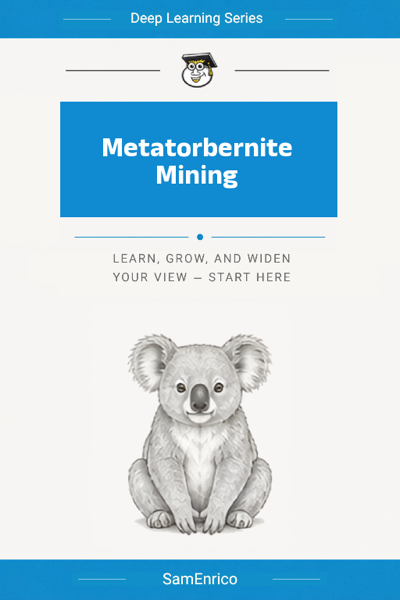
Non-FictionInformativeEducational
Metatorbernite Mining eBook
A Coursebook on Metatorbernite Mining
A Coursebook on Metatorbernite Mining
Formats
Free sample
Chapter 1: The Green Treasure...--The first problem with metatorbernite is that most geologists walk right past it. They see the grass-green flakes scattered across a fractured granite outcrop, note the slight pearly luster, and call it copper stain. Some even scrape a sample into their palm, feel the soft, almost soapy texture, and toss it aside as weathered chlorite. They are looking for the dark, heavy flash of uraninite, the primary uranium ore that built the atomic age. They do not realize that the green crust beneath their boots is richer in uranium than almost any other mineral on Earth.
This book exists because that mistake has cost the mining industry billions of dollars in overlooked value and because the global energy transition is about to make secondary uranium phosphates like metatorbernite suddenly, urgently relevant.For most of the twentieth century, uranium mining meant chasing primary ores—pitchblende, uraninite, coffinite—in deep, high-temperature hydrothermal veins or in sandstone roll-front deposits. Those deposits are still important, but they are expensive to find, dangerous to mine, and increasingly controversial to permit. Metatorbernite offers a different path. It sits at the surface. It is visible.
Its bright green color screams its presence across an outcrop. And when you calculate its theoretical uranium content, the numbers are staggering: 57.6 percent uranium oxide by weight. Pound for pound, pure metatorbernite contains more uranium than almost any other secondary mineral on the planet. But the green treasure is not without its complications. It is soft, unstable, and easily mistaken for less valuable minerals.
It dehydrates in the sun and rehydrates in the rain, changing its weight and chemistry with the weather. Its copper content, which gives it that distinctive emerald hue, complicates leaching and creates environmental risks that primary uranium ores do not pose. And because it has never been mined at industrial scale, almost no one has written down the rules for finding it, extracting it, and processing it profitably.This chapter is the first set of rules. It will teach you what metatorbernite is, why it matters in the twenty-first century, how to distinguish it from its chemical cousins, where it came from historically, what the great mining districts of the past can teach us about finding it today, and how to think about its economic potential without falling into the grade trap that has caught so many explorers before. By the end of this chapter, you will never walk past a green stain on a granite outcrop again.What Is Metatorbernite and Why Should You Care?Metatorbernite is a hydrous copper uranyl phosphate mineral with the chemical formula Cu(UO₂)₂(PO₄)₂·8H₂O.
That string of symbols tells a story. The uranium, locked in the uranyl ion (UO₂²⁺), is what gives the mineral its radioactivity and its economic value. The copper provides the distinctive green color and offers a potential by-product credit that, as we will see throughout this book, can make the difference between a profitable project and a failure. The phosphate binds the structure together but complicates leaching, requiring careful attention to acid consumption and solution chemistry. And the eight water molecules, sitting between the crystal sheets, make the mineral physically soft and chemically metastable, creating challenges for sampling, assaying, and long-term tailings management.The "meta" prefix is not merely descriptive.
It signals a specific dehydration state. Metatorbernite is the lower-hydrate form of torbernite, which contains twelve water molecules. When torbernite loses four water molecules—through mild heating or simply prolonged exposure to dry air—it transforms into metatorbernite. The reaction is reversible under natural conditions: add water at surface temperatures, and metatorbernite slowly reverts to torbernite. This hydration-dehydration cycle is one of the most important and most frustrating properties of the mineral, and it will appear throughout this book as a challenge for sampling, assaying, and processing.
Understanding this cycle is the first step toward mastering metatorbernite mining.So why should a mining engineer, a geologist, an investor, or a student care about this obscure green mineral? Three reasons: grade, accessibility, and timing.Grade. The theoretical uranium oxide content of pure metatorbernite is 57.6 percent UO₂. To put that in perspective, the average grade of a commercial primary uranium mine is between 0.1 and 0.5 percent U₃O₈. A high-grade primary uranium vein might run 2 to 5 percent U₃O₈.
Metatorbernite, in its pure form, is two orders of magnitude richer than typical ore. Of course, pure metatorbernite does not exist in nature. It is always mixed with gangue minerals—quartz, feldspar, limonite, clay. But even at ten percent purity, a metatorbernite occurrence would assay approximately 5.8 percent UO₂, which would rank among the highest-grade uranium deposits ever mined. A hand sample the size of a fist, if it is mostly metatorbernite, contains grams of uranium oxide.
A pickup truck load could be worth tens of thousands of dollars at current prices. However, this is where the first and most persistent confusion about metatorbernite must be cleared up. The 57.6 percent figure is the theoretical composition of the pure mineral, not the grade of an ore deposit. Ore grade is always lower because of dilution by gangue. A realistic ore grade for a selectively mined metatorbernite deposit might be 1 to 10 percent UO₂.
That is still extraordinarily high by uranium industry standards, but it is not 57 percent. Throughout this book, when we speak of grade, we mean ore grade unless we specifically say "mineral purity."Accessibility. Unlike primary uranium ores, which typically occur at depths of hundreds of meters in hard rock, metatorbernite forms in the supergene zone—the near-surface region where oxygen-rich groundwater weathers primary sulfide minerals. It is an oxidation product. That means it is found at the surface or within the first few tens of meters of the ground.
No deep shafts. No expensive decline tunnels. In many cases, metatorbernite can be mined with little more than an excavator and a front-end loader. The capital costs are a fraction of those required for a conventional underground uranium mine. This accessibility also means lower development risk.
You do not need to drill hundreds of meters to confirm a deposit. You can see it, sample it, and start planning extraction with a level of geological confidence that deep exploration cannot match.Timing. The global energy transition is creating unprecedented demand for both uranium and copper. Uranium is the fuel for nuclear reactors, which provide reliable, carbon-free baseload power. Despite the setbacks of Fukushima and the long phase-out in Germany, nuclear energy is experiencing a renaissance.
China is building dozens of reactors. India is expanding its fleet. Even Japan, after years of post-tsunami shutdowns, is restarting its nuclear plants. The International Atomic Energy Agency projects a doubling of nuclear capacity by 2050 in its high-growth scenario. That means uranium demand will increase, not decrease.
Copper is the metal of electrification, used in everything from wind turbine generators to electric vehicle wiring harnesses to grid-scale battery storage. A single electric vehicle contains four times as much copper as a conventional car. The transition from fossil fuels to electricity will consume more copper in the next twenty years than has been mined in all of human history.Metatorbernite contains both uranium and copper. A metatorbernite mine is not just a uranium mine…
This is the end of the free sample. Get the eBook to keep going. Buy now
About this book
Details
- Author
- Cota Bernardine
- Publisher
- SamEnrico
- Language
- English
- Genre
- Non-Fiction, Informative, Educational
- Released
- 2026-06-02
- Pages (approx.)
- 158
- Available as
- eBook, Audiobook

Read better in the ZLOADR app
Your eBooks on your phone or tablet. Sign in with your SamEnrico account and start reading.
More by Cota Bernardine
 Twitch Streaming ComparisonCota Bernardine$12.99
 Fighting Fair With Self RespectCota Bernardine$11.99
 Black Dahlia Mutilation MethodCota Bernardine$11.99
 Mindful Commuting GuideCota Bernardine$11.99
 Martha Swope's PhotographsCota Bernardine$11.99
 The Lion of Leningrad: Zhukov's Unbreakable StandCota Bernardine$11.99
 How to Produce Beer Pong EquipmentCota Bernardine$11.99Twitch Streaming ComparisonCota Bernardine$12.99
 How to Start a Bible Paper Business (Beginners Guide)Cota Bernardine$11.99
You may also like
 Hong Kong Handover 1997Dunn Johnnie$11.99
 Zumba For Postnatal Recovery CourseNeal Christian$11.99
 Zumba for BeginnersLadner Nikia$11.99
 YouTube Comment Mining GuideHumes Pandora$12.99
 Worry Box MeditationCarlin Rudy$11.99
 Workplace Stress MeditationNguyen Lynn$11.99
 Workplace Stress and Sleep RepairHawley Ivory$11.99
 Workplace Perfectionism CureDelaney Jeffry$11.99
 Workplace Injustice Anger GuideWallen Isabelle$11.99
 Work Addiction and Burnout LinkGreenwood Ester$11.99
 Women in Yoga and WellnessBeattie Galina$11.99
 Women in Stand Up ComedyChun Evangeline$11.99