
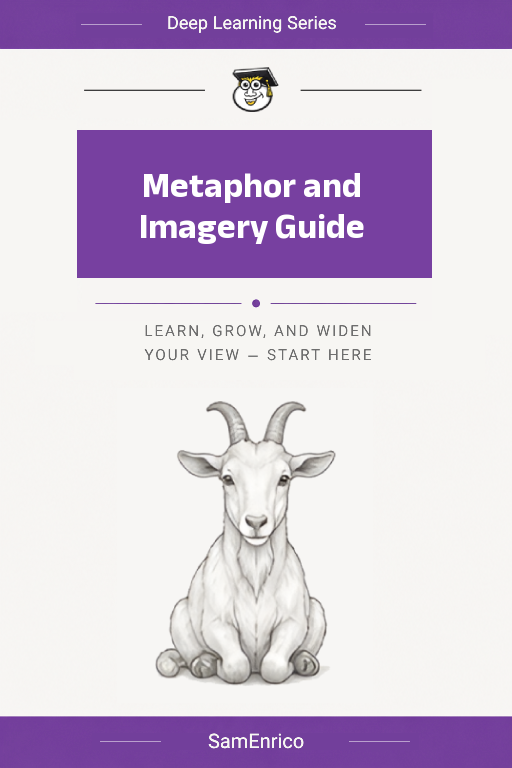
Non-FictionStudent's ShortcutLiterary Devices
Metaphor and Imagery Guide
Use figurative language that illuminates your stor
Use figurative language that illuminates your story without confusing or overwhelming the reader.
Formats
About this book
Free sample
Chapter 1: The Speed Bump...--–- Her grief was a dark ocean, but also a crumbling castle, and also a howling wind.You read that sentence—the one above—and something happened inside your brain. You did not glide through it. You did not feel the grief. Instead, you felt a small, almost imperceptible jolt. A deceleration.
A moment of what cognitive scientists call processing load. Your brain received the first image (dark ocean) and began constructing a mental model: vast, deep, cold, uncontrollable. Then you hit the second image (crumbling castle) and your brain had to delete the ocean and rebuild: stone, decay, history, collapse. Then the third image (howling wind) forced another deletion and another rebuild: air, force, directionless noise. Three images.
Three restarts. One sentence that should have conveyed overwhelming grief instead conveyed overwhelming confusion.That sentence is not real—I invented it to make a point. But you have written its equivalent. Every writer has. The sentence where you tried so hard to capture the complexity of an emotion that you stacked metaphor on top of metaphor, hoping that more would mean more.
But more does not mean more. More means less. More means the reader stops feeling and starts decoding. More means the reader closes the book.This chapter is about why that happens and what to do about it. But before we get to solutions, we need to understand the problem at a deeper level than most writing guides ever attempt.
Because the problem with bad figurative language is not that it is unpoetic or unsophisticated. The problem is that it violates the fundamental contract between writer and reader—a contract written into the architecture of the human brain.The Cognitive Contract Let us start with a strange fact about how your mind works. You cannot think about abstract concepts directly. Try it right now. Try to think about "justice" without picturing anything—no scales, no courtroom, no image of a balanced scale or a judge's gavel.
Try to think about "time" without imagining a line, a river, a clock, or a path stretching into the distance.…
This is the end of the free sample. Get the eBook to keep going. Buy now
Contents
- Chapter 1
- Chapter 2
- Chapter 3
- Chapter 4
- Chapter 5
- Chapter 6
- Chapter 7
- Chapter 8
- Chapter 9
- Chapter 10
- Chapter 11
- Chapter 12
Details
- Author
- Knight Steven
- Publisher
- SamEnrico
- Language
- English
- Genre
- Non-Fiction, Student's Shortcut, Literary Devices
- Released
- 2026-06-01
- Pages (approx.)
- 148
- Available as
- eBook, Audiobook

Read better in the ZLOADR app
Your eBooks on your phone or tablet. Sign in with your SamEnrico account and start reading.
More by Knight Steven
 Reconstruction of Mass Disaster ScenesKnight Steven$11.99
 Imposter Sabbatical ReturnKnight Steven$11.99
 Hypnosis Audio for Different GoalsKnight Steven$11.99
 Sign Language Recognition FightKnight Steven$11.99
 Losing Spouse to CancerKnight Steven$11.99
 Pomodoro for CaregiversKnight Steven$11.99
 Memory Palace For Cooking RecipesKnight Steven$11.99
 Freddie Highmore Good DoctorKnight Steven$11.99
 The Butler Who Knew Too Much: The Untold Story of Eugene AllenKnight Steven$11.99
 The London Ledger Scandal: The First Great Financial Cyber HeistKnight Steven$11.99
 How to Produce Pos SystemsKnight Steven$11.99
 How to Produce a DressingKnight Steven$11.99
You may also like
 Hong Kong Handover 1997Dunn Johnnie$11.99
 Zumba For Postnatal Recovery CourseNeal Christian$11.99
 Zumba for BeginnersLadner Nikia$11.99
 YouTube Comment Mining GuideHumes Pandora$12.99
 Worry Box MeditationCarlin Rudy$11.99
 Workplace Stress MeditationNguyen Lynn$11.99
 Workplace Stress and Sleep RepairHawley Ivory$11.99
 Workplace Perfectionism CureDelaney Jeffry$11.99
 Workplace Injustice Anger GuideWallen Isabelle$11.99
 Work Addiction and Burnout LinkGreenwood Ester$11.99
 Women in Yoga and WellnessBeattie Galina$11.99
 Women in Stand Up ComedyChun Evangeline$11.99