
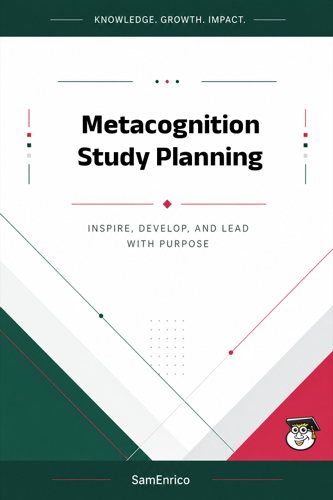
Non-FictionSelf-HelpMetacognition
Metacognition Study Planning eBook
Monitor your understanding and adjust study strate
by Fong Rona
Monitor your understanding and adjust study strategies based on self-assessment.
Formats
Free sample
Chapter 1: The Silent Saboteur--–- You have been lied to about studying.The lie is not malicious. It is whispered by well-meaning teachers, repeated in popular study guides, and reinforced by your own brain’s deceptive chemistry. The lie sounds like this: If you are struggling to learn, you simply need to work harder. Put in more hours. Highlight more text.
Read the chapter again.This lie has convinced millions of intelligent, motivated students that their difficulties stem from insufficient effort rather than invisible errors in how they monitor their own understanding. It has produced generations of graduates who can recognize terms but cannot explain concepts, who can follow worked examples but cannot solve novel problems, who feel confident before exams and confused when they see their scores.The truth is both simpler and more uncomfortable: Most students do not know when they do not know. They mistake familiarity for mastery, recognition for recall, and fluency for understanding. They close the textbook feeling prepared, only to discover during the test that their brain contains nothing but the ghost of recently seen words.This chapter reveals why this happens, why it happens to nearly everyone, and how you can escape the trap before your next study session.The Most Common Scene in Every University Library Walk through any academic library during midterm week and you will witness a ritual repeated millions of times per day. A student sits at a desk with a textbook, a highlighter, and a notebook.
She reads a paragraph. She highlights several sentences. She reads the next paragraph. She highlights more. After an hour, she has covered forty pages in bright yellow and filled three notebook pages with neatly copied definitions.She closes the book, feels a pleasant sense of accomplishment, and believes she has learned.She has not.The following day, when she tries to recall the key concepts from those forty pages, she will remember less than thirty percent of what she highlighted.
A week later, less than fifteen percent. The effort she expended—the hours of reading, the careful highlighting, the dutiful note-taking—produced almost no lasting learning. She confused exposure with education.This student is not lazy. She is not unintelligent. She is not unmotivated.
She has simply fallen into the most common and most destructive trap in all of academic study: the fluency illusion. Her brain mistook the ease of rereading for the depth of understanding. Because the text felt familiar on the second pass, she assumed she knew it. Because the definitions looked recognizable, she assumed she could recall them.The fluency illusion is not a character flaw. It is a feature of how human memory operates—and until you learn to override it, no amount of effort will produce the results you deserve.The Neuroscience of Self-Deception To understand why the fluency illusion is so powerful—and why it deceives even the most diligent students—you need a basic map of how memory actually works.Your brain possesses two separate memory systems that serve different purposes and produce different subjective experiences.
Recognition memory is the system that allows you to know you have seen something before. When you look at a list of terms and one of them was in your textbook, your recognition memory lights up with a feeling of familiarity. This system is fast, automatic, and metabolically cheap. It evolved to help you navigate familiar environments without having to relearn everything each day.Recall memory is the system that allows you to produce information from scratch, without cues. When someone asks you for your phone number and you say it without looking, that is recall.
When you are asked to define a term on a blank exam page, that is recall. This system is slower, effortful, and metabolically expensive. It requires the active reconstruction of information from scattered neural traces.Here is the critical problem: recognition feels good, and recall feels hard. When you reread a textbook passage, the words activate your recognition memory. They feel familiar, and that familiarity produces a small hit of satisfaction.
Your brain interprets that satisfaction as learning. But recognition does not produce recall. You can recognize a face without being able to describe it. You can recognize a song without being able to hum it. You can recognize a term without being able to define it.The students who highlight and reread are training their recognition memory exclusively.
They are becoming excellent at recognizing the material—but exams almost never test recognition. Exams test recall. The gap between recognition and recall is where the fluency illusion does its damage.Why Your Confidence Is Probably Wrong Psychologists have studied the gap between perceived and actual knowledge for decades, and their findings are sobering. In study after study, students who have just finished reading a chapter or attending a lecture dramatically overestimate how much they will remember the following day. They predict scores that are often thirty to fifty percentage points higher than their actual performance.This overconfidence is not evenly distributed.
The students who perform worst are often the most overconfident, a phenomenon known as the Dunning-Kruger effect. Students who lack metacognitive skill also lack the ability to recognize their own deficits. They do not know what they do not know, and they have no mechanism for finding out. They walk into exams genuinely believing they are prepared, and they walk out genuinely confused about what went wrong.The Dunning-Kruger effect explains a pattern every professor has observed: the students who ask for grade appeals are rarely the ones who actually deserve them. The students who complain that the exam was unfair are rarely the ones who studied effectively.
The students who are most confident are often the least accurate, and the students who are most accurate are often plagued by doubt.There is a paradox here. The more you learn about metacognition, the more you become aware of the gaps in your knowledge. This can feel like you are getting worse—you are noticing more errors, more confusion, more uncertainty. But you are not getting worse. You are getting more accurate.
The uncomfortable feeling of "I don't actually know this as well as I thought" is not a sign of failure. It is the first sign of genuine metacognitive awareness.The Seven Deadly Study Sins The fluency illusion manifests through specific study behaviors that appear productive but actually undermine learning. Synthesizing research from the top metacognition texts, we can identify seven common practices that students believe are helping but that cognitive science has repeatedly shown to be ineffective or actively harmful.Sin 1: Rereading. Rereading a textbook chapter or your lecture notes is the most common study technique in existence, and it is among the least effective. Each reread produces diminishing returns.
The second read feels easier than the first, but that ease is deceptive. You are not understanding more deeply. You are simply increasing fluency—and fluency is not learning.Sin 2: Highlighting. Highlighting feels active because your hand is moving. But research consistently shows that highlighting produces no measurable benefit over simply reading the same material.
Students who highlight and students who do not perform identically on subsequent tests. The color coding creates an illusion of…
This is the end of the free sample. Get the eBook to keep going. Buy now
About this book
Details
- Author
- Fong Rona
- Publisher
- SamEnrico
- Language
- English
- Genre
- Non-Fiction, Self-Help, Metacognition
- Released
- 2026-06-08
- Pages (approx.)
- 154
- Available as
- eBook, Audiobook

Read better in the ZLOADR app
Your eBooks on your phone or tablet. Sign in with your SamEnrico account and start reading.
More by Fong Rona
 Uber Driver Destination Filter GuideFong Rona$11.99
 Trinity and Beyond: Atomic Bomb PhysicsFong Rona$11.99
 Assertive Text Messaging GuideFong Rona$11.99
 Citation Rules for Group Projects CourseFong Rona$11.99
 MDD Psychotherapy ApproachesFong Rona$11.99
 Cognitive Restructuring For StressFong Rona$11.99
 Carnegie HallFong Rona$11.99
 World War II Fighter AceFong Rona$11.99
 The Sun King’s Grandeur: Versailles and the Birth of Modern DiplomacyFong Rona$11.99
 The Storm Chasers of the Ancient Monsoons: Decoding Southeast Asia's Prehistoric Weather MysteriesFong Rona$11.99
 How to Start a Container Made of Plastic for Closed Transit Business (Beginners Guide)Fong Rona$11.99
 Cost Plus Pricing GuideFong Rona$12.99
You may also like
 Hong Kong Handover 1997Dunn Johnnie$11.99
 Zumba For Postnatal Recovery CourseNeal Christian$11.99
 Zumba for BeginnersLadner Nikia$11.99
 YouTube Comment Mining GuideHumes Pandora$12.99
 Worry Box MeditationCarlin Rudy$11.99
 Workplace Stress MeditationNguyen Lynn$11.99
 Workplace Stress and Sleep RepairHawley Ivory$11.99
 Workplace Perfectionism CureDelaney Jeffry$11.99
 Workplace Injustice Anger GuideWallen Isabelle$11.99
 Work Addiction and Burnout LinkGreenwood Ester$11.99
 Women in Yoga and WellnessBeattie Galina$11.99
 Women in Stand Up ComedyChun Evangeline$11.99