
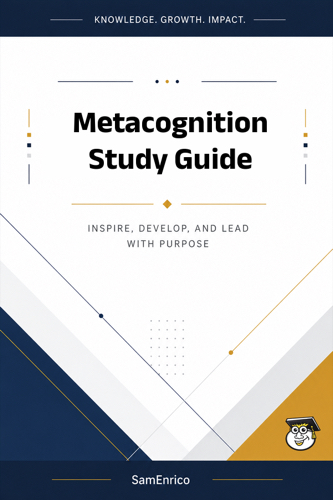
Non-FictionSelf-HelpMetacognition
Metacognition Study Guide eBook
Thinks about your own thinking to improve learning
Thinks about your own thinking to improve learning.
Formats
Free sample
Chapter 1: The Learning Paradox--–- Maria was a diligent student. She spent ten hours each week reviewing her psychology textbook, meticulously highlighting every important sentence, rereading chapters until the words blurred, and color-coding her notes with the precision of a museum curator. She felt productive. She felt prepared. And then she sat for the exam and scored a 72.
Her classmate David studied for two hours the night before, using a method that looked almost lazy by comparison—he simply closed the book, took out a blank sheet of paper, and tried to write down everything he remembered. He scored a 94.This opening vignette is not a hypothetical exercise in creative writing. It is a composite drawn from hundreds of classroom observations, tutoring center records, and cognitive psychology experiments conducted over four decades. The pattern is so consistent that researchers have given it a name: the illusion of competence. Maria fell victim to it.
David, perhaps accidentally, sidestepped it. The difference between them was not raw intelligence, not hours logged, not even motivation. The difference was something more fundamental and, as you will learn in this chapter, entirely trainable. The difference was metacognition.If you have picked up this book, you have likely experienced your own version of Maria's frustration. You have stared at a textbook for hours, only to draw a blank during the exam.
You have reread a chapter three times, convinced you understood it, only to discover that you could not explain it to anyone else. You have highlighted entire pages in yellow, only to realize later that you could not recall a single highlighted sentence. These are not signs of low intelligence or poor work ethic. They are signs of a specific kind of blindness—a blindness to your own cognitive processes. You did not know what you did not know.
This book is designed to cure that blindness.This chapter will accomplish four things. First, it will define metacognition clearly and precisely, moving past the buzzword status the term has unfortunately acquired. Second, it will introduce the Metacognitive Loop—a simple but powerful three-step cycle that will serve as the backbone for every strategy in this book. Third, it will demolish several common misconceptions about what metacognition is and is not. And fourth, it will guide you through an initial Learning Habits Audit, a diagnostic tool that will establish your baseline before you begin implementing any of the techniques in later chapters.
By the end of this chapter, you will understand why Maria failed and David succeeded, and more importantly, you will understand how to ensure that you are never Maria again.The Core Question: Why Effort Does Not Always Equal Outcome Let us begin with an uncomfortable truth that most study guides dance around: hard work and good grades are not as tightly correlated as we want to believe. This is not an argument against effort. It is an argument against misplaced effort. The education system rewards visible activity—highlighting, note-taking, rereading, spending hours at a desk. These activities look like learning.
They feel like learning. But looking like learning and being learning are two entirely different things.Consider the research. In a landmark study published in the journal Memory & Cognition, researchers asked students to study a text using one of two methods. The first group reread the text four times. The second group read the text once and then practiced retrieving the information from memory three times.
One week later, the rereading group remembered approximately 40 percent of the material. The retrieval practice group remembered approximately 80 percent. Both groups spent the same amount of time studying. The only difference was how they spent that time.This finding has been replicated across dozens of studies, across different age groups, across different subjects, and across different formats. Rereading and highlighting produce what cognitive psychologists call fluency—the subjective feeling that information is familiar and easy to process.
Fluency feels like understanding, but it is a liar. It is the brain's shortcut, a heuristic that confuses recognition with recall. You recognize a highlighted sentence when you see it again, so you assume you have learned it. But recognition is not recall. And exams almost never test recognition.
They test recall, application, synthesis, and analysis—all of which require a different cognitive muscle entirely.This brings us back to Maria and David. Maria spent her ten hours on activities that produced high fluency and low retention. She felt productive because her brain was constantly telling her, "Yes, this is familiar. Yes, you have seen this before." David spent his two hours on retrieval practice, which is uncomfortable, effortful, and often frustrating. The first time he tried to write down everything he remembered from a chapter, he probably stared at a nearly blank page.
That feeling of struggle is the feeling of actual learning. Maria avoided struggle. David embraced it. That is why David scored higher with one-fifth the study time.The core question of this book, then, is not "How can I study more?" It is "How can I study smarter?" And the answer, as you have probably guessed, lies in understanding the difference between the feeling of learning and the reality of learning. That difference is the domain of metacognition.Defining the Beast: What Metacognition Actually Is The term "metacognition" was first introduced by developmental psychologist John Flavell in the 1970s.
Flavell was studying how children develop the ability to monitor and control their own cognitive processes, and he needed a word to describe what he was observing. He combined the Greek prefix meta- (meaning beyond or about) with cognition (thinking). Metacognition, therefore, is thinking about thinking. But this definition, while accurate, is too simple to be useful. It is like defining a car as "a thing that moves." True, but not helpful.Flavell proposed a more nuanced model that divides metacognition into two interrelated components: metacognitive knowledge and metacognitive regulation.
These two components will appear throughout this book, so it is worth understanding them clearly from the start.Metacognitive knowledge is what you know about your own learning processes. This includes declarative knowledge (knowing what—for example, "I know that I struggle with multiple-choice questions"), procedural knowledge (knowing how—for example, "I know how to use the Feynman Technique"), and conditional knowledge (knowing when and why—for example, "I know that retrieval practice is more effective than rereading for long-term retention, but only if I wait at least a day before testing myself"). Chapter 2 will explore these three types of knowledge in depth.Metacognitive regulation is what you do with that knowledge. It is the real-time control you exercise over your learning. When you pause during a study session to ask yourself, "Am I actually understanding this, or am I just recognizing the words?" you are engaging in regulation.
When you notice that your attention has drifted and you deliberately redirect it, you are regulating. When you finish a practice test, review your errors, and adjust your study strategy accordingly, you are regulating. Chapter 3 will dive into the mechanics of regulation.Here is the critical insight that most people miss: metacognitive knowledge without metacognitive regulation is useless. You can know everything about how learning works and still…
This is the end of the free sample. Get the eBook to keep going. Buy now
About this book
Details
- Author
- Hibbard Kitty
- Publisher
- SamEnrico
- Language
- English
- Genre
- Non-Fiction, Self-Help, Metacognition
- Released
- 2026-06-07
- Pages (approx.)
- 157
- Available as
- eBook, Audiobook

Read better in the ZLOADR app
Your eBooks on your phone or tablet. Sign in with your SamEnrico account and start reading.
More by Hibbard Kitty
 NVC Apology TechniqueHibbard Kitty$11.99
 Continuing Care Contract AnalysisHibbard Kitty$11.99
 Franchising Your Local Brand Across Borders Advisory CouncilsHibbard Kitty$11.99
 Child Missing from CampsiteHibbard Kitty$11.99
 The Future Pacing Opener GuideHibbard Kitty$11.99
 Stimulant Bipolar ComorbidityHibbard Kitty$11.99
 Omega 3 Sperm HealthHibbard Kitty$11.99
 The Mountie’s Millions: Canada’s Greatest Police Fraud ScandalHibbard Kitty$11.99
 Baba Yaga’s Bone Cottage: The Witch’s Unseen RulesHibbard Kitty$11.99
 Mastering The Art of Canarian WrestlingHibbard Kitty$11.99
 How to Produce SqueegeesHibbard Kitty$11.99
 How to Produce a Gravity WagonHibbard Kitty$11.99
You may also like
 Hong Kong Handover 1997Dunn Johnnie$11.99
 Zumba For Postnatal Recovery CourseNeal Christian$11.99
 Zumba for BeginnersLadner Nikia$11.99
 YouTube Comment Mining GuideHumes Pandora$12.99
 Worry Box MeditationCarlin Rudy$11.99
 Workplace Stress MeditationNguyen Lynn$11.99
 Workplace Stress and Sleep RepairHawley Ivory$11.99
 Workplace Perfectionism CureDelaney Jeffry$11.99
 Workplace Injustice Anger GuideWallen Isabelle$11.99
 Work Addiction and Burnout LinkGreenwood Ester$11.99
 Women in Yoga and WellnessBeattie Galina$11.99
 Women in Stand Up ComedyChun Evangeline$11.99