
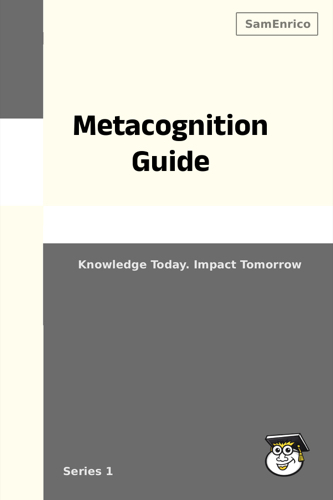
Metacognition Guide Audiobook
undefined
undefined
Formats
Free sample
Chapter 1: The Invisible Gap–- Sarah had always been a good student. She showed up to class, took meticulous notes, highlighted her textbooks in three colors, and re-read every chapter the night before an exam. By all external measures, she was doing everything right. But halfway through her first semester of medical school, she found herself staring at an anatomy midterm with a sinking feeling in her stomach. She had studied for twelve hours straight.
She knew she had studied. She could feel the fatigue behind her eyes. And yet, as she read the first question — "Describe the anatomical relationship between the thyroid gland and the recurrent laryngeal nerve" — her mind went completely blank.She had read that chapter. She had highlighted it. She had even said the words out loud to herself in the library.
So where was the information?Sarah's story is not unusual. It is, in fact, the most common learning story in the world. Millions of students, professionals, and lifelong learners do exactly what Sarah did: they mistake the feeling of familiarity for the fact of understanding. They sit through lectures, re-read chapters, and watch You Tube tutorials, and then they are baffled when they cannot recall or apply what they just studied. They were paying attention.
They were working hard. So why didn't it stick?The answer is not a lack of intelligence. It is not a lack of effort. It is a lack of something most people have never been taught: metacognition.This book exists because of a simple, uncomfortable truth: our education system teaches us what to think but almost never teaches us how to think about our own thinking. We spend twelve to twenty years learning facts, formulas, dates, and theories, but we spend approximately zero hours learning how to monitor our own understanding, how to predict whether we will remember something tomorrow, or how to diagnose why a strategy is failing.
We are like carpenters who have been given a thousand tools but never shown how to read a blueprint.Sarah did not fail because she was stupid. She failed because she was using a strategy — re-reading and highlighting — that feels productive but is demonstrably one of the least effective ways to learn. She had no way of knowing that, because no one had ever taught her how to distinguish between the feeling of learning and the fact of learning.This…
This is the end of the free sample. Get the Audiobook to keep going. Buy now
About this book
Details
- Author
- Cummings Heather
- Publisher
- SamEnrico
- Language
- English
- Genre
- Non-Fiction, Self-Help
- Released
- 2026-06-06
- Pages (approx.)
- 141
- Available as
- eBook, Audiobook

Listen in the VoxFlicks app
Audiobooks and audio dramas wherever you go. Sign in with your SamEnrico account and press play.
More by Cummings Heather
 Listening In Coaching GuideCummings Heather$11.99
 The Quiet Stress HandbookCummings Heather$11.99
 The Farmer's DaughterCummings Heather$11.99
 Gamer Distraction Management GuideCummings Heather$11.99
 The Quit Smoking Life InsuranceCummings Heather$11.99
 Bipolar Advance DirectiveCummings Heather$11.99
 Mental Health in Refugee CampsCummings Heather$11.99
 EQ for Retirement AdjustmentCummings Heather$11.99
 Caesar vs. Pompey: The Clash of Titans That Shattered RomeCummings Heather$11.99
 Silk and Splendor: The Byzantine Fashion RevolutionCummings Heather$11.99
 The Ghost of Flight 447: The Black Box ConspiracyCummings Heather$11.99
 Sprinkler System Accidental TriggeringCummings Heather$12.99
You may also like
 Hong Kong Handover 1997Dunn Johnnie$11.99
 Zumba For Postnatal Recovery CourseNeal Christian$11.99
 Zumba for BeginnersLadner Nikia$11.99
 YouTube Comment Mining GuideHumes Pandora$12.99
 Worry Box MeditationCarlin Rudy$11.99
 Workplace Stress MeditationNguyen Lynn$11.99
 Workplace Stress and Sleep RepairHawley Ivory$11.99
 Workplace Perfectionism CureDelaney Jeffry$11.99
 Workplace Injustice Anger GuideWallen Isabelle$11.99
 Work Addiction and Burnout LinkGreenwood Ester$11.99
 Women in Yoga and WellnessBeattie Galina$11.99
 Women in Stand Up ComedyChun Evangeline$11.99