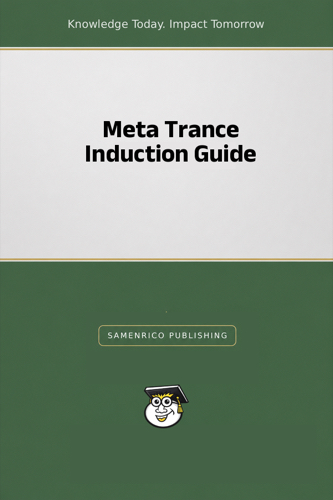
Meta Trance Induction Guide eBook
Uses trance within trance for exponential deepenin
by Edgar Elmer
Uses trance within trance for exponential deepening effects.
Formats
Free sample
Chapter 1: The Map Steals the Territory--–- You are reading these words right now in a trance. Not a deep trance, not a stage hypnotist’s trance, not the kind where someone waves a pocket watch and you cluck like a chicken. But a trance nonetheless. The proof is simple: look up from this page for exactly five seconds. Look at the wall, the window, the back of your hand.
Now come back. What happened? For those five seconds, you were no longer reading. The voice in your head that narrates these words went silent. You were not thinking about hypnosis, trance, or the meaning of the word “meta.” You were simply looking.
And in that looking, you were more awake than you have been since you opened this book. Then you returned here, and the trance resumed. The voice started again. The interpretation machine whirred back to life. This is the first and most important secret of Meta Trance Induction: you are already in trance right now.
The only question is whether you will continue to let the trance run you, or whether you will learn to run the trance.The Most Dangerous Lie About Hypnosis Most people believe that hypnosis is something done to them. A stage performer says “Sleep!” and a volunteer slumps over. A therapist swings a pendulum and says “You are getting very sleepy.” A You Tube video plays binaural beats and promises to “rewire your brain in ten minutes.” These are all variations of the same lie: that trance is an external force, a magic spell, a state imposed from outside.That lie is not harmless. It makes you a passive recipient of your own experience. It teaches you to look for saviors, scripts, and gurus.
It convinces you that you cannot enter deep trance without someone else’s voice guiding you. And most insidiously, it blinds you to the fact that you have been entering and exiting trances your entire life without any help at all.Here is the truth that flips that lie upside down: Trance is not something that happens to you. Trance is something you do.Every time you have driven a familiar route and realized you don’t remember the last three miles—that was a trance you induced. Every time you have lost yourself in a movie, a video game, or a good book—that was a trance you induced. Every time you have worried so intensely about a future conversation that you felt the anxiety in your body as if it were already happening—that was a trance you induced.
Every time you have fallen in love, or felt a song in your bones, or prayed, or meditated, or cried at a commercial—trance, trance, trance, trance, trance.You have been a master hypnotist your entire life. The only problem is that you have been hypnotizing yourself into states you did not choose.The Two Kinds of Trance (And Why Mixing Them Up Ruins Everything)If you have read any hypnosis literature before, you have encountered a fundamental confusion. One set of books tells you to “go deeper,” to relax, to let go, to sink into a peaceful void. Another set tells you to “focus,” to concentrate, to narrow your attention, to become hyper-aware. These seem like opposites.
Relaxation vs. focus. Letting go vs. zeroing in. Void vs.
pinpoint.Both groups are correct. And both groups are wrong. They are correct about the phenomenon they are describing. They are wrong to treat their phenomenon as the only kind of trance. The confusion disappears once you understand that there are two fundamentally different types of trance, with different brain mechanisms, different subjective experiences, and different practical applications.Constructive Trance is what happens when you actively build layers of meaning inside your own mind.
You hold one state (say, relaxation) and then you bring another state (say, curiosity) to bear on that relaxation. “As I feel this relaxation, I wonder what it would be like to feel even more relaxed.” That wondering is a second state applied to the first. You can keep doing this, stacking states like bricks: relaxation → curiosity about relaxation → appreciation for that curiosity → courage to explore further. Each new state is a higher logical level, a thought about a thought. This is constructive because you are building something—an internal architecture of increasing complexity.
Your meta-mind (the part that watches and comments on your experience) is highly active in Constructive Trance. You are not “zoned out.” You are zoned in.Dissolved Trance is the opposite. Here, you let go of the meta-mind entirely. You stop watching yourself. You stop commenting.
You stop evaluating. This is the state athletes call “the zone,” artists call “flow,” and mystics call “absorption.” There is no stack of states. There is no layering. There is simply immersion. Time disappears.
Self-consciousness vanishes. Performance becomes effortless because the inner critic has finally shut up. In Dissolved Trance, you are not building anything. You are being something.Here is the critical point that most books miss, and that early drafts of this very book got wrong: You cannot be in both at the same time. The moment you activate your meta-mind to observe or construct, you have left the dissolved state.
The moment you release into pure absorption, you have stopped constructing. This is not a bug. It is a feature. The two types of trance are like inhaling and exhaling. Both are necessary.
Both are valuable. But trying to do both at once is a fast path to frustration.The question “Which trance is deeper?” is meaningless. A Constructive Trance can be incredibly intense—layering curiosity, wonder, courage, and intentionality into a skyscraper of meaning. A Dissolved Trance can be incredibly intense—complete self-forgetfulness, time distortion, effortless action. They are not on the same scale.
Apples and oranges. Breathing in and breathing out. The rest of this book will teach you both, and more importantly, will teach you when to use which.Why “Deepening” Is a Trap (And What to Do Instead)Traditional hypnosis uses the metaphor of “going down.” Deeper and deeper. Counting backwards from ten to one. A staircase with ten steps, then twenty, then a hundred.
The elevator to the basement. The warm, heavy, sinking feeling.There is nothing wrong with this metaphor. It works beautifully for Dissolved Trance, for relaxation, for letting go. But it fails utterly for Constructive Trance. You cannot “go down” into more meaning.
You cannot descend into greater complexity. You cannot sink into higher logical levels.The solution is not to reject the depth metaphor. That would be throwing the baby out with the bathwater. The solution is to add a second metaphor: ascent for Constructive Trance, descent for Dissolved Trance. Think of a spiral staircase.
Moving down the staircase relaxes you, deepens physical comfort, releases muscular tension, dissolves self-awareness. Moving up the staircase builds layers of meaning, adds states to states, intensifies focus, sharpens attention. Both movements spiral around the same central axis. Both are “deepening” in the sense of increased involvement. But one moves toward the body, the other moves toward the mind.Throughout this book, you will learn specific techniques for both…
This is the end of the free sample. Get the eBook to keep going. Buy now
About this book
Details
- Author
- Edgar Elmer
- Publisher
- SamEnrico
- Language
- English
- Genre
- Non-Fiction, Self-Help, Advanced
- Released
- 2026-06-08
- Pages (approx.)
- 158
- Available as
- eBook, Audiobook

Read better in the ZLOADR app
Your eBooks on your phone or tablet. Sign in with your SamEnrico account and start reading.
More by Edgar Elmer
 Student Housing REITsEdgar Elmer$11.99
 Back Pain SuggestionEdgar Elmer$11.99
 The Empathy and Active ListeningEdgar Elmer$11.99
 Exposure Therapy Phobia GuideEdgar Elmer$11.99
 Men Medication for DepressionEdgar Elmer$11.99
 Parental Stress Medication GuideEdgar Elmer$11.99
 ED Therapy OptionsEdgar Elmer$11.99
 The Love Letters of Ada and Babbage: A Computational RomanceEdgar Elmer$11.99
 Tangaroa’s Shadow: The Spy Who Drowned the SkyEdgar Elmer$11.99
 How to Start a Projector (photographic or Cinematographic) Business (Beginners Guide)Edgar Elmer$11.99
 How to Produce Feminine Sanitary SuppliesEdgar Elmer$11.99
 Pinterest VA Client Retention PlaybookEdgar Elmer$12.99