
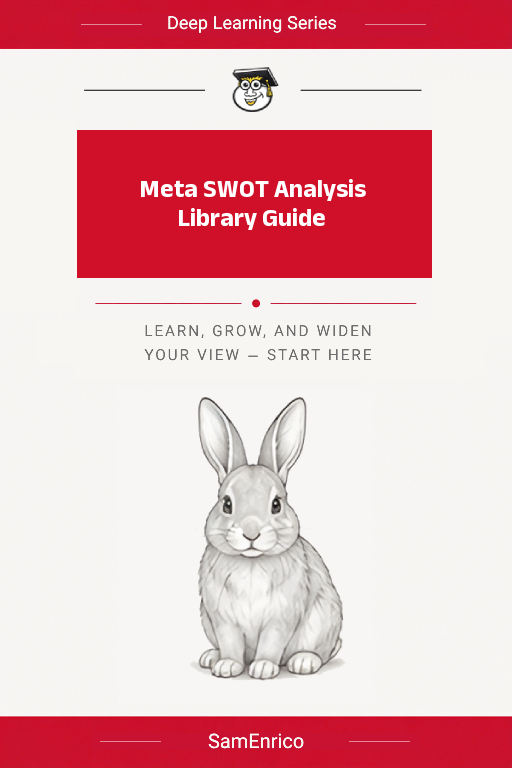
Non-FictionStrategic AtlasSocial Media
Meta SWOT Analysis Library Guide eBook
Assess social media network effects, advertising r
Assess social media network effects, advertising recovery, metaverse investment drag, and youth attrition.
Formats
Free sample
Chapter 1: The Two Faces of AI...--–- On October 28, 2021, Mark Zuckerberg stood before a virtual audience of millions and announced that Facebook was changing its name to Meta. The rebrand was supposed to signal a new era—a shift from a company that connected friends to a company that would build the next computing platform. But something strange happened in the months that followed. Wall Street yawned. Then it panicked.
Over the next twelve months, Meta's stock price cratered by nearly 75%, wiping out over $600 billion in market capitalization. Investors fled. Employees resigned. And teenagers, already abandoning Facebook in droves, mocked the metaverse pivot as the death rattle of a company that had lost its way.But here is the question that neither the bulls nor the bears have answered satisfactorily: Is Meta a broken company being held together by AI duct tape, or is it a misunderstood giant quietly rebuilding its engine for a post-smartphone world?The answer, as this book will demonstrate, is both. And neither.
Meta is not one company. It is three companies wearing a single stock ticker. The first company—Facebook proper—is a decaying social network sustained by older users who remember when it was cool. The second company—Whats App and Messenger—is a sleeping giant that has barely begun to monetize its two billion users. The third company—Reality Labs—is a $40 billion bonfire of cash that may either become the next i OS or the next Google Glass.
Each of these companies has its own trajectory, its own economics, and its own timeline for success or failure. To understand Meta, you must first unlearn the habit of treating it as a monolith.This chapter establishes the foundational framework for the entire book: the critical distinction between two artificial intelligence systems that most analysts mistakenly treat as one. That distinction will determine whether you see Meta as a recovery story, a meltdown in slow motion, or a speculative bet on a future that may never arrive.The Great AI Confusion Walk into any Silicon Valley boardroom and mention "artificial intelligence," and executives will nod knowingly. But underneath that single term lurk two entirely different technologies that serve opposite purposes, optimize for different outcomes, and produce different effects on Meta's business. Most investors—and, embarrassingly, most technology journalists—use "AI" as a catchall phrase that obscures more than it reveals.The first type of AI is Consumer AI.
This is the algorithm that decides what appears in your Facebook Feed, your Instagram Explore page, and your Reels queue. Consumer AI asks one question: What content will keep this user on the platform for the longest possible time? It does not care whether that content is true, kind, informative, or socially beneficial. It cares about engagement measured in milliseconds. The result is a feed optimized for outrage, anxiety, and voyeurism—the emotional states that produce the most compulsive scrolling behavior.The second type of AI is Advertising AI.
This is the algorithm that decides which ads to show you and, crucially, how much an advertiser should bid to reach you. Advertising AI asks a different question: What is the probability that this user will purchase this product within the next 72 hours? It does not care whether you enjoy the ad or find it intrusive. It cares about conversion rates measured in basis points. The result is a targeting engine that has become dramatically more sophisticated since Apple destroyed Meta's ability to track users across the web.These two AI systems are not siblings.
They are not even cousins. They are built by different engineering teams, trained on different data sets, optimized for different metrics, and housed in different parts of the organizational chart. Yet in nearly every public analysis of Meta, they are conflated. An analyst will say, "Meta's AI is improving," as if that single statement meant something coherent. It does not.Why Consumer AI Is Meta's Greatest Weakness Let us begin with the ugly truth that Meta executives will never state publicly: the Consumer AI that powers Facebook and Instagram is systematically destroying the social value of those platforms.To understand why, you must remember what Facebook was before the algorithmic feed.
In 2009, when the platform introduced the "Like" button but before it abandoned the chronological timeline, your feed was simple. It showed you what your friends had posted, in reverse chronological order. If your friend shared a photo of their new puppy, you saw it. If your friend checked in at a restaurant, you saw it. The content was boring, mundane, and authentically human.
And users loved it because it served a clear purpose: staying connected with people you actually knew.The algorithmic feed changed everything. Starting in 2011 and accelerating dramatically after 2016, Meta's Consumer AI began filtering, sorting, and ranking content based on predicted engagement. The problem is that the most engaging content is rarely the most authentic content. Studies consistently show that content containing moral outrage generates 3-4x more comments and shares than neutral content. Content that triggers anxiety about missing out (FOMO) generates 2-3x more clicks.
Content that confirms existing biases generates the highest retention rates of all.The Consumer AI learned these patterns quickly. It began surfacing political content that made users angry, because angry users comment. It began surfacing celebrity gossip that made users feel inadequate, because inadequate users scroll longer. It began surfacing conspiracy theories that confirmed users' worst fears, because fearful users return more frequently. The algorithm was not malevolent.
It was simply optimized for the wrong metric.The result, as documented in Max Fisher's The Chaos Machine and Jaron Lanier's Ten Arguments for Deleting Your Social Media Accounts, is a platform where organic posts from friends have been buried beneath an avalanche of suggested content from strangers, brands, and outrage merchants. The typical Facebook user today sees fewer than five posts from actual friends per hundred items in their feed. The rest is a slurry of recommended videos, sponsored content, and "you might also like" suggestions generated by Consumer AI.This is not a bug. It is a feature. And it is destroying the platform's value proposition.Consider the language users now employ to describe their Facebook experience.
"Doom-scrolling" has entered the lexicon as a term for the compulsive, joyless consumption of bad news. "Rage-bait" describes content designed specifically to provoke anger. "The digital graveyard" is how teenagers refer to Facebook—a place where old people post about old grievances. No user has ever described their Facebook experience as "connecting with friends" since approximately 2014.The consumer-facing AI has transformed Meta's flagship product from a social network into a passive entertainment medium. But unlike Netflix or You Tube, which are honest about being entertainment platforms, Facebook still pretends to be about social connection.
This pretense creates a constant sense of disappointment. Users arrive hoping to see what their friends are doing. They leave having spent forty minutes watching videos of strangers they will never meet.Why Advertising AI Is Meta's Hidden Strength Now let us turn to the other AI—the one that does not ruin user experience but instead saves the company's financial future.In April 2021, Apple dropped a bomb on the digital advertising…
This is the end of the free sample. Get the eBook to keep going. Buy now
About this book
Details
- Author
- Anderson Dexter
- Publisher
- SamEnrico
- Language
- English
- Genre
- Non-Fiction, Strategic Atlas, Social Media
- Released
- 2026-06-01
- Pages (approx.)
- 139
- Available as
- eBook, Audiobook

Read better in the ZLOADR app
Your eBooks on your phone or tablet. Sign in with your SamEnrico account and start reading.
More by Anderson Dexter
 Senior Forgiveness Esteem GuideAnderson Dexter$11.99
 EQ for Decision Making GuideAnderson Dexter$11.99
 Medical Debt FamilyAnderson Dexter$11.99
 The Joy of MusicAnderson Dexter$11.99
 The Walking Meditation PrimerAnderson Dexter$11.99
 The Shadow of Cairo: The Forgotten Noir That Shook EgyptAnderson Dexter$11.99
 BannermakerAnderson Dexter$11.99
 Accounting Formulas for QuickBooks UsersAnderson Dexter$12.99
 Understanding Myoclonic DystoniaAnderson Dexter$17.99
 How to Start a Musical Instrument and Supplies Store BusinessAnderson Dexter$11.99
You may also like
 Hong Kong Handover 1997Dunn Johnnie$11.99
 Zumba For Postnatal Recovery CourseNeal Christian$11.99
 Zumba for BeginnersLadner Nikia$11.99
 YouTube Comment Mining GuideHumes Pandora$12.99
 Worry Box MeditationCarlin Rudy$11.99
 Workplace Stress MeditationNguyen Lynn$11.99
 Workplace Stress and Sleep RepairHawley Ivory$11.99
 Workplace Perfectionism CureDelaney Jeffry$11.99
 Workplace Injustice Anger GuideWallen Isabelle$11.99
 Work Addiction and Burnout LinkGreenwood Ester$11.99
 Women in Yoga and WellnessBeattie Galina$11.99
 Women in Stand Up ComedyChun Evangeline$11.99