
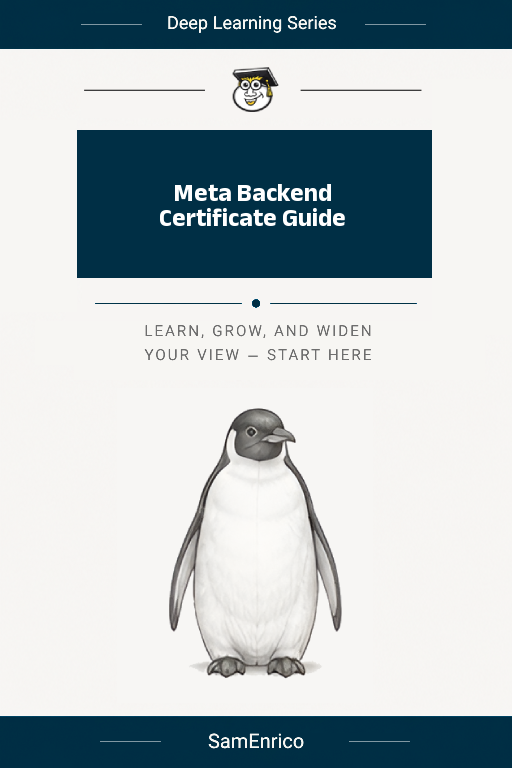
Non-FictionStudent's ShortcutMeta
Meta Backend Certificate Guide eBook
Earn Meta's Backend, Frontend, iOS, or Android Dev
Earn Meta's Backend, Frontend, iOS, or Android Developer certificates recognized by tech employers.
Formats
Free sample
Chapter 1: The Resume Lie--You have been told a lie. It is a well-intentioned lie, repeated by career counselors, bootcamp sales pages, and well-meaning senior developers who entered the industry a decade ago. The lie sounds like this: "Get a degree, build a portfolio, apply to a hundred jobs, and someone will eventually say yes."The truth is uglier and more liberating. In 2025, the technology hiring market processes over 15 million applications for approximately 400,000 entry-level developer positions in North America alone. That means for every junior role, thirty-seven qualified people will be rejected.
Not because they cannot code. Not because they are not smart enough. Not because they lack potential. But because the traditional filtering mechanisms—degrees, years of experience, personal networks—have collapsed under their own weight.Something else has risen in their place.Over the past four years, Meta (formerly Facebook) has quietly built the most effective skills-based credentialing system for developers that is not a four-year degree. It is not a bootcamp certificate that any unaccredited company can print.
It is not a MOOC completion badge that takes forty-eight hours to earn. It is a proctored, multi-hour examination that tests real-world backend development using Python, Django, My SQL, Git, and REST APIs. And unlike almost every other certificate on the market, Meta publishes the names of companies that actively recruit credential holders: IBM, Accenture, Deloitte, Cognizant, and more than two hundred others.This book exists because of a simple observation: thousands of people start Meta's backend certificate on Coursera each month, but most do not finish. Of those who finish, most do not pass the final exam on their first attempt. Of those who pass, most do not effectively translate that credential into a job offer.
And of those who get offers, most leave money on the table during salary negotiation.You are here to become the exception at every single stage.This chapter is not a technical deep dive. It is a strategic briefing. By the time you finish reading these pages, you will understand exactly why Meta's certificate matters in the current job market, how it compares to competing credentials from Google and AWS, which of Meta's four certificate tracks offers the highest return on your time investment, and—most critically—the realistic odds of turning a certificate into a paycheck. You will also learn the "Three-Pass Method" that structures this entire book, a learning framework designed for people who have jobs, families, or other obligations and cannot afford to waste a single hour on irrelevant material.Let us begin with the market reality that most career guides refuse to acknowledge.The Death of the Degree-Only Filter Between 2010 and 2020, most technology companies operated on a simple assumption: a bachelor's degree in computer science was the minimum viable credential for an entry-level engineering role. Recruiters used degree requirements as the first filter, eliminating anyone without "BS Computer Science" or equivalent on their resume before a human ever saw the application.That era is over for three converging reasons.First, the cost of a four-year degree has outpaced inflation by nearly three hundred percent since 1990, forcing a generation of talented developers to seek alternative paths.
Self-taught programmers, bootcamp graduates, and career-changers now represent an estimated forty-three percent of new entry-level hires at Fortune 500 technology companies, according to Burning Glass Institute data from 2024.Second, the technical interview has become the great equalizer. A graduate from Stanford and a self-taught developer from rural Mississippi both face the same whiteboarding challenge: implement a function, analyze its time complexity, and explain your trade-offs. The degree opens the door to the interview room, but it does not help you solve the problem once you are inside.Third, and most important for your purposes, technology vendors have entered the credentialing market with unprecedented force. Meta, Google, Amazon, and Microsoft now offer professional certificates that are co-designed with their own engineering teams and updated quarterly to reflect current tooling and practices. These certificates are not academic.
They are vocational. They teach exactly what you need to know to be productive in an entry-level role at a modern tech company.A 2024 study by the Society for Human Resource Management found that seventy-two percent of hiring managers now view vendor-specific technology certificates as equivalent to or more valuable than a computer science degree for entry-level backend roles. The key phrase is "vendor-specific." Generic "Python Programming" certificates from no-name providers are worthless. Certificates branded by Meta, Google, or AWS carry weight because those companies have reputational skin in the game. If Meta's certificate produced incompetent developers, employers would stop recruiting from the program.
Meta knows this. The exam is difficult for a reason.This brings us to the uncomfortable statistic mentioned earlier. Only twelve percent of Meta certificate holders receive a job offer within ninety days of completing the credential. That number sounds low. It is low.
But consider the baseline: among all applicants to entry-level backend roles without any certificate, the ninety-day offer rate is approximately four percent. The certificate triples your odds. It does not guarantee a job. Nothing does. But moving from a four percent chance to a twelve percent chance is the difference between playing the lottery and playing a game of skill.Throughout this book, especially in Chapter 12, you will learn how to be in the twelve percent.
The certificate is the ticket. Your interview preparation, portfolio presentation, and negotiation strategy are the vehicle.The Four Tracks: Which One Pays Off?Meta currently offers four developer certificates: Backend, Frontend, i OS, and Android. Each requires between one hundred and sixty to two hundred and forty hours of study. Each costs approximately forty-nine dollars per month for the Coursera subscription plus a proctored exam fee of roughly one hundred and fifty dollars. But the return on investment varies dramatically across tracks.Backend Certificate (This Book's Focus): Average time to completion is one hundred and eighty hours.
Median starting salary for certificate holders who land roles is eighty-five thousand dollars. Highest reported offer from the 2024 graduate survey was one hundred and fifteen thousand dollars at a mid-sized fintech company. The backend track produces the highest absolute salary because backend engineering skills—database design, API architecture, authentication, performance optimization—scale directly to revenue-generating systems. A company can survive a buggy button. It cannot survive a database leak or a payment processing outage.Frontend Certificate: Average completion time is one hundred and forty hours (fastest track).
Median starting salary is seventy-two thousand dollars. The frontend market is more saturated because the barrier to entry is lower; visual feedback makes learning more accessible. However, frontend roles also have the highest remote-work availability. If location flexibility is your priority over salary, frontend is defensible.i OS Certificate: Average completion time is two hundred hours. Median starting salary is seventy-eight thousand dollars.
i OS development requires a Mac computer (minimum one thousand dollars), which raises the effective cost. The market is smaller than backend or frontend, but so is the talent pool. i OS specialists often find roles faster because fewer candidates apply.Android Certificate: Average completion time is two hundred hours. Median starting salary is seventy-five thousand dollars. Android development can be done on Windows, Mac, or Linux, lowering the hardware…
This is the end of the free sample. Get the eBook to keep going. Buy now
About this book
Details
- Author
- Larry Barbera
- Publisher
- SamEnrico
- Language
- English
- Genre
- Non-Fiction, Student's Shortcut, Meta
- Released
- 2026-06-01
- Pages (approx.)
- 130
- Available as
- eBook, Audiobook

Read better in the ZLOADR app
Your eBooks on your phone or tablet. Sign in with your SamEnrico account and start reading.
More by Larry Barbera
 Mexican Copper Canyon GuideLarry Barbera$11.99
 Self Esteem Through Sleep And Rest GuideLarry Barbera$11.99
 Pilot Duty Hours LimitsLarry Barbera$11.99
 Fear of Flying Comprehensive TreatmentLarry Barbera$11.99
 Body Scan For ClaustrophobiaLarry Barbera$11.99
 Personalization Anger GuideLarry Barbera$11.99
 Creative Confidence for Non ArtistsLarry Barbera$11.99
 American Idol DreamsLarry Barbera$11.99
 Travis Scott: Atmosphere Over OrderLarry Barbera$11.99
 Kenichi Ebina: The Stand-Up Revolution That Shook JapanLarry Barbera$11.99
 Hippocrates and the Birth of Rational Medicine: Healing Through ReasonLarry Barbera$11.99
 Growing Cycas (Cycad, Sago "Palm")Larry Barbera$11.99
You may also like
 Hong Kong Handover 1997Dunn Johnnie$11.99
 Zumba For Postnatal Recovery CourseNeal Christian$11.99
 Zumba for BeginnersLadner Nikia$11.99
 YouTube Comment Mining GuideHumes Pandora$12.99
 Worry Box MeditationCarlin Rudy$11.99
 Workplace Stress MeditationNguyen Lynn$11.99
 Workplace Stress and Sleep RepairHawley Ivory$11.99
 Workplace Perfectionism CureDelaney Jeffry$11.99
 Workplace Injustice Anger GuideWallen Isabelle$11.99
 Work Addiction and Burnout LinkGreenwood Ester$11.99
 Women in Yoga and WellnessBeattie Galina$11.99
 Women in Stand Up ComedyChun Evangeline$11.99