
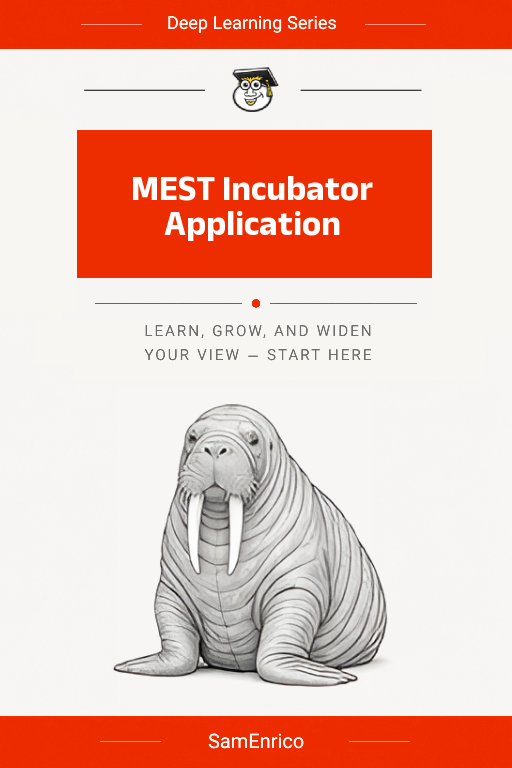
Non-FictionStartup GuideIncubator ApplicationMEST
MEST Incubator Application eBook
Apply to Meltwater Entrepreneurial School of Techn
Apply to Meltwater Entrepreneurial School of Technology for seed funding and training.
Formats
Free sample
Chapter 1: The Venture Mindset--–- Most applicants fail before they even open the application form. Not because they lack talent, not because their idea is bad, and certainly not because they aren't smart enough. They fail because they show up as students when MEST is looking for founders. This single misunderstanding—this fundamental framing error—eliminates over ninety percent of aspirants before the first round of interviews even begins.Let me tell you about two people. Both were brilliant.
Both were passionate. Both desperately wanted to get into MEST. Only one succeeded.Kofi was a gifted software engineer from Kumasi, Ghana. He had built three mobile apps, contributed to open-source projects, and taught himself machine learning through You Tube tutorials. When he heard about MEST, he did what any reasonable person would do: he researched the program, found out it was called the "Meltwater Entrepreneurial School of Technology," and assumed he needed to be an exemplary student.
He polished his transcripts, wrote a letter explaining how much he wanted to learn, and highlighted his academic achievements. He talked about his passion for education and his eagerness to sit in MEST's classrooms. Kofi was rejected within two weeks.Then there is Adaeze. Adaeze had built a scrappy Whats App chatbot that helped farmers in her village check crop prices before traveling to market. The code was messy.
The user interface was ugly. She had never taken a computer science course. But she had something Kofi did not: she had paying users. Forty-three farmers had sent her mobile money to keep the bot running. When Adaeze applied to MEST, she did not talk about what she wanted to learn.
She talked about what she had already built, who was using it, and how she planned to use MEST's resources to scale from forty-three users to forty-three thousand. She showed screenshots of the mobile money transactions. She named the farmers who depended on her service. Adaeze was accepted.The difference between Kofi and Adaeze was not talent. It was mindset.
Kofi approached MEST as a school. Adaeze approached it as a venture partner. This single distinction—the difference between a student mindset and what I call the Venture Mindset—determines who gets in and who gets rejected.This chapter will rewire how you see MEST. Not as an educational institution, but as what it actually is in 2026: a venture studio that invests one hundred thousand dollars in founders who demonstrate builder momentum. By the end of this chapter, you will understand why MEST made the radical shift from a two-year generalist program to an eleven-month AI-focused venture sprint, how the equity model actually works compared to other accelerators, and most importantly, how to reframe every single part of your application—from your video to your portfolio to your interview answers—as a pitch to investors, not an application to professors.The Great Misunderstanding: Why "School" Is in the Name but Not in the Game The Meltwater Entrepreneurial School of Technology was founded in 2008 with a noble mission: train a generation of software entrepreneurs who would build the digital backbone of Africa.
For its first decade and a half, the program looked like a school. There were classrooms, syllabi, exams, and a two-year curriculum. Students received training in software development, business fundamentals, and leadership. The word "school" accurately described the experience.That changed in 2024 when MEST announced a sweeping reorganization. The old model produced generalists—well-rounded graduates who understood both code and commerce but often left the program without a functioning company.
According to internal MEST data from that era, fewer than thirty percent of graduates launched ventures that survived beyond twelve months. The program was producing excellent learners but not enough successful founders.The new model, launched fully in 2026, produces founders with funded ventures. The shift was not incremental. It was foundational. The program was cut from twenty-four months to eleven.
The curriculum was rebuilt entirely around artificial intelligence. The faculty were replaced with former founders, engineers from Google and Meta, and investment professionals. The measure of success changed from graduation rates to venture survival rates.The 2026 program is structured as eleven months, not twenty-four. Seven months of intensive AI-focused sprint training, followed by four months of paid incubation. You do not "graduate." You either launch or you do not.
You do not receive a certificate. You receive a term sheet. The people guiding you are not professors. They are investors who have put one hundred thousand dollars of Meltwater's money into your company. They expect a return.Yet the name remains.
"Meltwater Entrepreneurial School of Technology." This is the great misunderstanding. Thousands of applicants each year read those words and unconsciously assume they are applying to learn. They write essays about their passion for education. They ask questions about class schedules and grading rubrics. They prepare portfolios that showcase homework assignments rather than real-world products.
These applicants are filtered out almost immediately, often within the first thirty seconds of the application review.Consider the numbers. MEST receives approximately five thousand applications annually for sixty spots. That is a two percent acceptance rate—more selective than Harvard Business School, more selective than Y Combinator, more selective than any mainstream accelerator you have heard of. Of those five thousand applicants, the first round eliminates roughly eighty percent based on the initial application and technical assessment alone. The selection committee, which includes leaders from Open AI, Google, and Perplexity, does not have time to read heartfelt essays about your learning journey.
They are looking for signal. Specifically, they are looking for three signals that we will explore throughout this book: builder momentum, problem obsession, and resourcefulness. The word "school" triggers exactly the wrong mental model for generating these signals.This chapter introduces a specific term that will appear throughout every subsequent chapter: the Venture Mindset. The Venture Mindset is the conscious reframing of every application task as a due diligence exercise. When MEST asks for your portfolio, they are not grading your coding style.
They are evaluating whether you can ship. When MEST asks for your business idea, they are not checking your creativity. They are evaluating whether you have found a real, scalable problem that someone will pay to solve. When MEST interviews you, they are not testing your knowledge. They are stress-testing your ability to handle pressure, receive feedback, and pivot without breaking.The Venture Mindset is not a metaphor.
It is a practical framework that will shape every decision you make in preparing your application. For now, internalize the core shift: you are not a student applying to a school. You are a founder pitching a venture partner. Every email you send, every line of code you write, every word you speak in your video submission is evidence for or against your candidacy as a founder. There is no neutral ground.The 2026 Model: Eleven Months from Application to Launch Understanding the precise structure of the 2026 MEST program is not optional.
It is essential for crafting your application, because each stage of the program tests for specific competencies that you must demonstrate from Day One of the application process. You cannot convince MEST that you belong in a sprint if you do not…
This is the end of the free sample. Get the eBook to keep going. Buy now
About this book
Details
- Author
- Pannell Garret
- Publisher
- SamEnrico
- Language
- English
- Genre
- Non-Fiction, Startup Guide, Incubator Application, MEST
- Released
- 2026-05-29
- Pages (approx.)
- 152
- Available as
- eBook, Audiobook

Read better in the ZLOADR app
Your eBooks on your phone or tablet. Sign in with your SamEnrico account and start reading.
More by Pannell Garret
 MBSR Complete Home CoursePannell Garret$11.99
 Daily Doodle Habit GuidePannell Garret$11.99
 Michelle ObamaPannell Garret$11.99
 LinkedIn Profile Optimization GuidePannell Garret$11.99
 Chiropractic for SciaticaPannell Garret$11.99
 The EQ for Customer ServicePannell Garret$11.99
 Focus Mate Pairing GuidePannell Garret$11.99
 The Spiritual Awakening StepPannell Garret$11.99
 Forgiveness Trance WorkPannell Garret$11.99
 The Storm from the Steppe: Subutai's Unstoppable Campaigns (1236-1242)Pannell Garret$11.99
 Whispers in the Wild: The Octopus Who Outsmarted the LabPannell Garret$11.99
 The Dragon’s Apprentice: A Knight’s Forgotten MentorPannell Garret$11.99
You may also like
 Hong Kong Handover 1997Dunn Johnnie$11.99
 Zumba For Postnatal Recovery CourseNeal Christian$11.99
 Zumba for BeginnersLadner Nikia$11.99
 YouTube Comment Mining GuideHumes Pandora$12.99
 Worry Box MeditationCarlin Rudy$11.99
 Workplace Stress MeditationNguyen Lynn$11.99
 Workplace Stress and Sleep RepairHawley Ivory$11.99
 Workplace Perfectionism CureDelaney Jeffry$11.99
 Workplace Injustice Anger GuideWallen Isabelle$11.99
 Work Addiction and Burnout LinkGreenwood Ester$11.99
 Women in Yoga and WellnessBeattie Galina$11.99
 Women in Stand Up ComedyChun Evangeline$11.99