
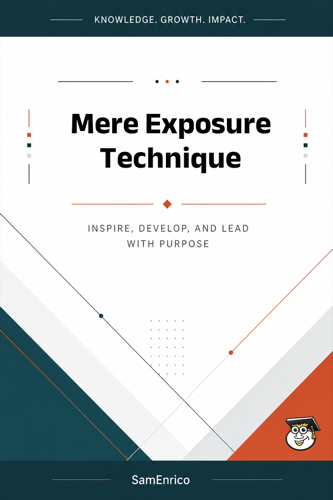
Non-FictionSelf-HelpExposure Effect
Mere Exposure Technique eBook
Repeats message to increase familiarity and liking
by Tackett Lien
Repeats message to increase familiarity and liking.
Formats
Free sample
Chapter 1: The Invisible Lever--–- You have been lied to about persuasion.Not with malice, necessarily. Not through conspiracy. But through a quiet, centuries-old misunderstanding that has infected every book on influence, every marketing seminar, and every conversation you have ever had about why people say yes or no.The lie is this: that people reject your ideas, your products, or yourself because of what you are offering. That the quality of your argument, the elegance of your design, or the sincerity of your heart is the primary driver of acceptance or rejection.This is comforting nonsense.It is comforting because it gives you an illusion of control. If rejection stems from a flaw in your offer, you can fix that flaw.
Sharper logic. Better photos. More features. Lower price. You can iterate your way to acceptance.But what if the rejection had nothing to do with your offer at all?What if the brilliant presentation you spent weeks perfecting failed not because it was weak, but because it was new?
What if the product you know would change your customer’s life sits on the shelf not because it is overpriced, but because it is unfamiliar? What if the person you are trying to connect with—romantically, professionally, socially—keeps their distance not because of anything you did, but because your face has not yet crossed their field of vision enough times?This is the invisible lever. The force that shapes human preference without logic, without argument, and almost entirely without conscious awareness. It is the most powerful influence tool you have never been taught to use deliberately. And it is called the Mere Exposure Effect.The Discovery That Changed Everything In 1968, a Polish-born psychologist named Robert Zajonc published a paper that should have detonated the field of social psychology.
Instead, it was absorbed slowly, almost reluctantly, because its implications were too strange, too simple, and too threatening to the established order.Zajonc did something almost cruel to his research subjects. He showed them nonsense.Not complex ideas. Not persuasive arguments. Not beautiful images or clever slogans. He showed them meaningless symbols: Chinese characters to non-Chinese speakers, Turkish words to non-Turkish speakers, and completely invented nonsense shapes that resembled nothing in the natural world.These symbols had no inherent meaning.
They carried no information. They were, in every sense, empty vessels.Then Zajonc showed them again. And again. Some symbols appeared five times. Some appeared ten times.
Some appeared twenty-five times. Others appeared only once.After the exposure phase, Zajonc asked his subjects a simple question: which of these symbols do you like?The results were not subtle. The symbols that had appeared most frequently were rated as significantly more positive, more appealing, and more likable than the symbols that had appeared rarely or not at all. Subjects preferred the nonsense they had seen most often—not because it was better nonsense, but simply because it was familiar.Zajonc had discovered what he called the "mere exposure effect": the phenomenon where repeated exposure to a stimulus is sufficient to increase liking for that stimulus, even in the absence of any reward, any rational argument, or any conscious awareness of the repetition itself.Think about how radical this is.No sales pitch. No value proposition.
No emotional appeal. No social proof. No authority figure endorsing the symbol. Just repetition. Pure, mechanical, meaningless repetition.
And that was enough to shift human preference.Zajonc went further. In subsequent experiments, he showed that the effect held even when the exposures were subliminal—flashed on a screen so quickly that subjects could not consciously report having seen anything at all. Their brains registered the stimulus. Their conscious minds did not. And still, the preference shifted.
The symbols they had been subliminally exposed to more often were rated as more likable, even though the subjects had no idea they had ever seen them.This is the invisible lever at work. A force operating entirely beneath the surface of conscious thought, shaping what you like, whom you trust, and what you believe—without your permission and without your awareness.The Brain’s Laziness Is Your Opportunity Why does this work? Why would the human brain, supposedly the most sophisticated reasoning engine in the known universe, fall for such a cheap trick?The answer lies in the fundamental architecture of your nervous system. Your brain is not primarily a thinking machine. It is primarily a survival machine.
And survival, for a creature with a limited energy budget, depends on efficiency.Every decision, every judgment, every flicker of preference costs metabolic energy. Your brain runs on glucose and oxygen, both of which are finite resources. Evolution has therefore equipped you with a vast array of shortcuts—heuristics, rules of thumb, cognitive efficiencies—that allow you to navigate the world without exhausting your mental fuel.The most important of these shortcuts is something psychologists call cognitive fluency.Cognitive fluency is the subjective experience of ease or difficulty associated with processing information. When you see something familiar, your brain processes it quickly, smoothly, and with minimal energy expenditure. That feeling of ease is cognitive fluency.
When you see something unfamiliar, your brain struggles. It has to work harder, analyze more, and expend more energy. That feeling of strain is cognitive disfluency.Here is the crucial trick: your brain does not experience cognitive fluency as a neutral signal. It experiences it as good.The ease of processing is itself interpreted as a positive emotional signal. Your brain thinks: “That was easy to process.
Easy things are safe. Safe things are good. Therefore, I like it.”This is not a rational inference. It is a hardwired biological shortcut. And it happens in milliseconds, long before your conscious mind has a chance to interject with objections like “But that symbol is meaningless” or “That jingle is objectively annoying” or “I have no reason to trust that person.”The fluency is the reason.
Or rather, the fluency feels like the reason.This is why familiar stimuli—even objectively neutral or mildly negative stimuli—become preferred over time. The repetition builds fluency. The fluency creates ease. The ease generates liking. No logic required.Why Your Best Ideas Die Alone Let this land where you live.You have experienced the pain of rejection countless times.
The proposal that was ignored. The product launch that fizzled. The date who never called back. The brilliant insight that was met with a shrug.In each case, you probably assumed the rejection was about content. Your idea wasn’t sharp enough.
Your product was missing a feature. You said the wrong thing. You needed to improve the offer.But what if the rejection was about context? What if the person on the other side of the table simply hadn’t been exposed to you, your idea, or your product enough times for fluency to build?Consider a simple experiment conducted decades after Zajonc’s original work. Researchers showed participants a series of photographs of faces.
Some faces appeared once. Others appeared five times. Others appeared twenty times. Then participants rated each face on likability, trustworthiness, and attractiveness.The result: the faces that appeared most frequently were rated as significantly more likable…
This is the end of the free sample. Get the eBook to keep going. Buy now
About this book
Details
- Author
- Tackett Lien
- Publisher
- SamEnrico
- Language
- English
- Genre
- Non-Fiction, Self-Help, Exposure Effect
- Released
- 2026-06-09
- Pages (approx.)
- 144
- Available as
- eBook, Audiobook

Read better in the ZLOADR app
Your eBooks on your phone or tablet. Sign in with your SamEnrico account and start reading.
More by Tackett Lien
 Unemployment Benefits Navigation GuideTackett Lien$11.99
 Battle Of Quatre Bras AccountTackett Lien$11.99
 The Power of No Interruption CourseTackett Lien$11.99
 Piriformis Syndrome Deep ReliefTackett Lien$11.99
 Rob Walton ChairTackett Lien$11.99
 Teen Self Esteem and GamingTackett Lien$11.99
 Scott Peterson Alibi LiesTackett Lien$11.99
 The Freelance Health Insurance BridgeTackett Lien$11.99
 The Trial of Antigone: A Rebellion in Three ActsTackett Lien$11.99
 The Ironclad Innovators: The Black Engineers of the Ethiopian EmpireTackett Lien$11.99
 The Vanishing Billionaire: The Untold Hunt for Jho LowTackett Lien$11.99
 The Complete Guide to the New York DietTackett Lien$11.99
You may also like
 Hong Kong Handover 1997Dunn Johnnie$11.99
 Zumba For Postnatal Recovery CourseNeal Christian$11.99
 Zumba for BeginnersLadner Nikia$11.99
 YouTube Comment Mining GuideHumes Pandora$12.99
 Worry Box MeditationCarlin Rudy$11.99
 Workplace Stress MeditationNguyen Lynn$11.99
 Workplace Stress and Sleep RepairHawley Ivory$11.99
 Workplace Perfectionism CureDelaney Jeffry$11.99
 Workplace Injustice Anger GuideWallen Isabelle$11.99
 Work Addiction and Burnout LinkGreenwood Ester$11.99
 Women in Yoga and WellnessBeattie Galina$11.99
 Women in Stand Up ComedyChun Evangeline$11.99