
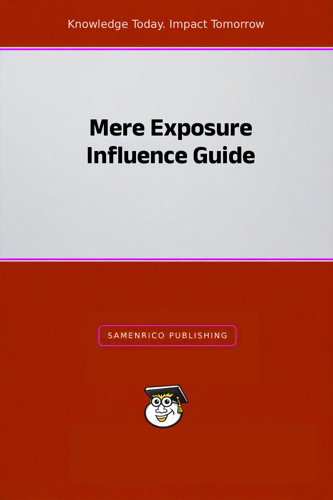
Non-FictionSelf-HelpMere ExposureFamiliarity
Mere Exposure Influence Guide eBook
Increase liking through repeated, non conscious ex
Increase liking through repeated, non conscious exposure to stimuli.
Formats
Free sample
Chapter 1: The Invisible Ladder--Every time you hum a jingle you claim to hate, every time you trust a brand you cannot remember seeing, every time you feel strangely drawn to a face in a crowd you have never met—you are climbing a ladder you did not know existed. The rungs are invisible. The ascent is silent. And at the top, waiting for you, is a simple but profound truth: repetition creates preference without permission, without memory, and almost always without your conscious awareness.This is the mere exposure effect. It is one of the most replicable, robust, and yet underappreciated findings in the history of psychology.
First identified and systematically demonstrated by the Polish-born psychologist Robert Zajonc in the 1960s, the mere exposure effect states that the mere repeated presentation of a stimulus—a word, a face, a symbol, a sound, a product—results in an increased positive attitude toward that stimulus, provided the initial presentation is neutral or mildly positive. In plain language: the more often you see something without anything bad happening, the more you will like it. No reward required. No conscious memory necessary. Just repetition.Before we descend into the experiments, the neuroscience, and the strategic applications that will occupy the rest of this book, we must first understand the fundamental shape of this effect.
Chapter 1 lays the foundation for everything that follows. Here we will establish the logarithmic curve of liking, dismantle the myth that familiarity breeds contempt, introduce the concept of safety as the brain's first draft of goodness, and set the stage for the unified decision tree that will guide your application of mere exposure across every domain of your life and work.The Most Important Study You Have Never Heard Of Let us begin in 1968, at the University of Michigan, where Zajonc designed a series of experiments that would upend decades of assumptions about how attitudes form. The prevailing wisdom at the time, inherited from behaviorist psychology, held that positive attitudes developed through reinforcement—rewards paired with stimuli. If you wanted someone to like a symbol, you showed it to them while giving them food, money, or pleasure. Zajonc suspected otherwise.
He suspected that repetition alone, in the complete absence of any reward, might be sufficient.His method was deceptively simple. He showed participants a series of Turkish words and Chinese characters—symbols that were utterly unfamiliar to his American and European subjects. Each symbol appeared on a screen for a brief moment. Some symbols appeared only once. Others appeared five times.
Still others appeared ten times, or twenty-five times. The participants were not asked to memorize anything. They were not rewarded for correct answers. They simply watched the screen as the symbols flashed before them.After the exposure phase, Zajonc asked the participants to rate each symbol on a simple scale. How positive or negative did the symbol feel?
How much did you like it? The results were astonishing in their consistency. Across multiple studies, with multiple types of stimuli, the pattern held: the more frequently a symbol had been shown, the more positively it was rated. Symbols shown twenty-five times were rated significantly more favorably than symbols shown ten times, which were rated more favorably than symbols shown five times, which were rated more favorably than symbols shown once. The relationship was not linear—more on that shortly—but it was unmistakable.
Repetition created liking.Zajonc published his findings in 1968 in the Journal of Personality and Social Psychology, in a paper titled "Attitudinal Effects of Mere Exposure." The paper has since been cited more than ten thousand times. And yet, remarkably, most people outside of academic psychology have never heard of it. This book aims to change that.But Zajonc was not finished. In a series of follow-up studies, he asked an even more provocative question: what if the participants never consciously saw the stimuli at all? He designed experiments where images were flashed for one to five milliseconds—far too fast for conscious perception.
Between these subliminal flashes, the screen showed neutral patterns to occupy conscious attention. The participants saw nothing. They reported seeing nothing. And yet, when later asked to rate the flashed images alongside novel images, they consistently preferred the images that had been flashed subliminally. They had no memory of the exposure.
They had no idea why they preferred one image over another. But the preference was real, measurable, and reliable.This finding—that conscious memory is not required for mere exposure to work—would become one of Zajonc's most controversial and influential contributions. It suggested that the brain processes familiarity and generates preference on multiple levels, many of them entirely beneath the threshold of awareness. You can feel that something is familiar without knowing why. You can prefer something without remembering ever having seen it.
The invisible ladder had invisible rungs.The Logarithmic Curve of Liking Here is where the shape of the effect becomes critically important. If you plot Zajonc's results on a graph, with the number of exposures on the horizontal axis and the degree of liking on the vertical axis, you do not get a straight line. You get a curve that rises steeply at first and then flattens out. This is called a logarithmic curve, and it has profound implications for how you should apply mere exposure in the real world.The first three to five exposures generate approximately eighty percent of the total liking effect. Exposure number one moves you from neutral to slightly positive.
Exposure number two adds another substantial increment. Exposure number three adds a bit less. By the time you reach exposure number ten, you have captured perhaps ninety percent of the total possible benefit. Exposure number twenty adds almost nothing. Exposure number thirty-seven—to pick a deliberately absurd number—adds nothing at all.
Your brain has reached a plateau. It has classified the stimulus as safe, familiar, and mildly positive, and it has no further interest in updating that classification.This is why jingles work after a week of radio play but not after a year. The first five times you hear the Mc Donald's "I'm Lovin' It" jingle, your brain moves from indifference to mild preference. The next fifty times, you stop noticing it. The next five hundred times—if you are a radio programmer or a fast-food employee—you may begin to actively dislike it.
But that active dislike is not a function of the mere exposure effect itself; it is a function of satiation, which we will explore in depth in Chapter 3. For now, understand the logarithmic curve as a blessing and a warning. The blessing: you do not need hundreds of exposures to build liking. A handful will do. The warning: after a certain point, more exposure is wasted effort.
You are climbing a ladder that has already reached its highest rung.Consider a practical example. Imagine you are launching a new brand. You have a budget for advertising. You could spend that budget on one hundred exposures each to one thousand people, or on five exposures each to twenty thousand people. The logarithmic curve tells you that the second option is vastly more effective.
The one hundredth exposure to a single person adds almost nothing. The fifth exposure to a new person adds nearly…
This is the end of the free sample. Get the eBook to keep going. Buy now
About this book
Details
- Author
- Moreland Janette
- Publisher
- SamEnrico
- Language
- English
- Genre
- Non-Fiction, Self-Help, Mere Exposure, Familiarity
- Released
- 2026-06-07
- Pages (approx.)
- 147
- Available as
- eBook, Audiobook

Read better in the ZLOADR app
Your eBooks on your phone or tablet. Sign in with your SamEnrico account and start reading.
More by Moreland Janette
 Paper Planner Scheduling GuideMoreland Janette$11.99
 LinkedIn Career Gap ShameMoreland Janette$11.99
 Self Talk for Bullying RecoveryMoreland Janette$11.99
 Menopause and Breast Cancer Risk GuideMoreland Janette$11.99
 Gilgamesh and the Sword of Eternal KingsMoreland Janette$11.99
 Listed Equity Regional GuideMoreland Janette$12.99
 Order PickerMoreland Janette$11.99
 Understanding Juvenile Myoclonic EpilepsyMoreland Janette$17.99
 How to Become a Nozzle TenderMoreland Janette$11.99
You may also like
 Hong Kong Handover 1997Dunn Johnnie$11.99
 Zumba For Postnatal Recovery CourseNeal Christian$11.99
 Zumba for BeginnersLadner Nikia$11.99
 YouTube Comment Mining GuideHumes Pandora$12.99
 Worry Box MeditationCarlin Rudy$11.99
 Workplace Stress MeditationNguyen Lynn$11.99
 Workplace Stress and Sleep RepairHawley Ivory$11.99
 Workplace Perfectionism CureDelaney Jeffry$11.99
 Workplace Injustice Anger GuideWallen Isabelle$11.99
 Work Addiction and Burnout LinkGreenwood Ester$11.99
 Women in Yoga and WellnessBeattie Galina$11.99
 Women in Stand Up ComedyChun Evangeline$11.99