
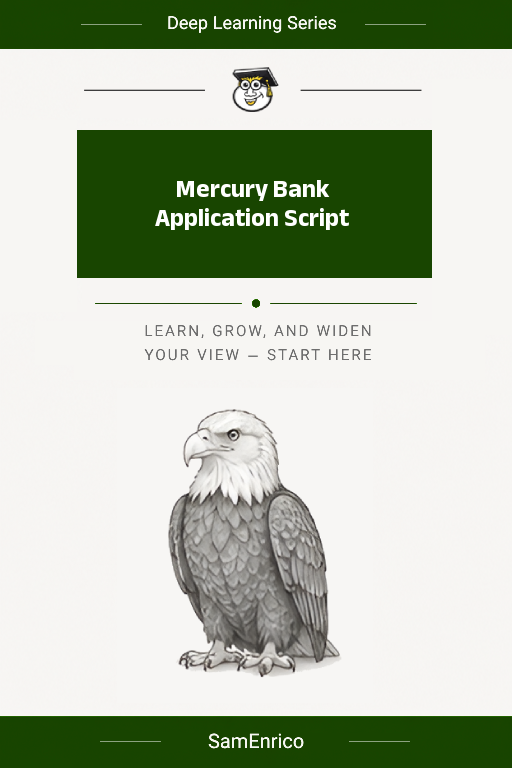
Mercury Bank Application Script eBook
Answer Mercury's non-resident application question
by Worth Oliva
Answer Mercury's non-resident application questions with wording that matches their approval patterns.
Formats
Free sample
Chapter 1: The Machine Decides--The moment you click “Submit” on Mercury’s application, you are not speaking to a banker. You are speaking to a machine. That machine has approximately 47 milliseconds to decide whether you are a legitimate founder or a money launderer. And if it decides against you, no human will ever see your application.This is the single most important truth that non-resident founders fail to understand. They spend weeks perfecting their business plan, polishing their pitch deck, and recruiting advisors.
Then they rush through Mercury’s online form, treating it like a minor administrative hurdle. They write their business description in vague, enthusiastic language. They use their registered agent’s address because it’s convenient. They answer “Source of Funds” with a casual “personal savings.” And then they wait.Forty-eight hours later, a generic rejection email arrives: “We are unable to open an account for your business at this time due to our internal risk assessment.”The founder is confused. Their business is legitimate.
Their entity is properly registered. They have customers. Why did Mercury say no?The answer is not personal. It is not a judgment on your character or your business model. The answer is algorithmic.
You tripped a wire. You used a keyword that the machine has been trained to fear. You submitted an address that appears in a blacklist database. You left a field blank that should have contained a specific phrase. And because you tripped that wire, your application was automatically sorted into the digital incinerator before any human being ever read a single word.This chapter is about understanding that machine.
Not as abstract technology, but as a series of predictable rules, weighted scores, and binary decisions. Once you understand how Mercury’s application scoring actually works, you stop guessing and start engineering your approval.The Two-Stage Gate: Why Most Founders Never Meet a Human Mercury, like nearly all modern fintech banks, operates a two-stage application process. The first stage is fully automated. The second stage involves a human compliance officer. The critical insight – the one that separates successful applicants from rejected ones – is that the automated stage rejects approximately eighty percent of all applications before any human gets involved.Let that sink in.
Eight out of ten founders who click “Submit” are eliminated by software. Their applications never reach a human reviewer. They receive the same generic rejection email as everyone else, but the underlying cause is purely algorithmic.The automated stage works like a series of weighted gates. Each question on the application form is not just a field to be filled; it is a test. Your answer is compared against internal risk dictionaries, blacklists, and scoring models.
Some answers add points to your risk score. Other answers subtract points. If your total risk score exceeds a certain threshold – a threshold that Mercury never discloses but that we can reverse-engineer from thousands of rejection patterns – the application is automatically denied.Only applications that pass the algorithmic gate are forwarded to the human queue. And that queue is slow. If you receive a “pending” status that lasts longer than forty-eight hours, that is actually good news.
It means you passed the algorithm. You are now in the human queue, waiting for a compliance officer who has approximately ninety seconds to review your file.The difference between a twenty-four-hour approval and a thirty-day rejection, therefore, is not about the quality of your business. It is about whether you tripped the algorithm. And tripping the algorithm is almost always caused by one of three things: a blacklisted keyword in your business description, a blacklisted address in your physical location field, or an inconsistency in your identity verification documents.The Three-Headed Monster: Fin CEN, FDIC, and Internal Risk To understand why Mercury’s algorithm is so aggressive, you must understand the regulatory pressures that shape every decision. Mercury does not want to reject you.
Rejections mean lost customers, lost fees, and negative reviews. But Mercury wants even less to be fined, shut down, or sued.Mercury serves three masters simultaneously, and a failure to satisfy any one of them could destroy the company.The first master is Fin CEN, the Financial Crimes Enforcement Network. Fin CEN enforces the Bank Secrecy Act, which requires all financial institutions to maintain anti-money laundering programs. If Mercury is found to have processed transactions for a sanctioned entity or failed to report suspicious activity, the fines can reach into the millions of dollars. Individual compliance officers can face prison time.
This is not theoretical; banks have been destroyed by anti-money laundering failures.The second master is Mercury’s FDIC partner bank. Mercury is not a bank. It is a financial technology company that partners with Choice Financial Group and Column N.A., both of which are FDIC-insured banks. Those partner banks have their own compliance requirements, their own risk appetites, and their own examiners. If Mercury’s customer base creates too much risk for the partner bank, the partnership can be terminated.
Without a partner bank, Mercury ceases to exist.The third master is Mercury’s own internal risk appetite. This is the most flexible but also the most mysterious. Mercury must decide, as a business, which industries it wants to serve and which it does not. These decisions are not always rational. Sometimes Mercury rejects a perfectly legitimate business simply because it has already reached its internal quota for that industry that month.
Sometimes Mercury rejects a business because a similar business in the same category was recently involved in fraud.When you combine these three pressures – Fin CEN’s legal requirements, the partner bank’s safety demands, and Mercury’s own business judgment – you get an application algorithm that errs heavily on the side of rejection. False positives, rejecting a good customer, are cheap. False negatives, accepting a bad customer, are catastrophic.The Non-Resident Flag: Why You Are Already at a Disadvantage If you are a non-resident founder – meaning you are not a United States citizen, not a United States green card holder, and not physically living in the United States – your application receives additional scrutiny from the very first millisecond. This is not discrimination. This is risk modeling.Mercury’s algorithm assigns a baseline risk score to every application based on the founder’s residency status.
A United States citizen with a United States address and a United States Social Security Number starts with a low baseline score. A non-resident founder with no United States presence starts with a higher baseline score. That means you have less room for error. You cannot afford to trip any additional flags because your starting position is already elevated.However, and this is crucial, lacking a United States Social Security Number or Individual Taxpayer Identification Number does NOT cause an automatic rejection. This is a persistent myth that prevents many non-residents from even applying.
The truth is more nuanced. The algorithm does not reject you for being a non-resident. It rejects you for being a non-resident without sufficient compensating factors.What are compensating factors? They are pieces of evidence that reduce your risk score. A Delaware C-Corporation formation reduces your risk score.
A physical United States address that is not a registered agent reduces your risk score. A business description that uses…
This is the end of the free sample. Get the eBook to keep going. Buy now
About this book
Details
- Author
- Worth Oliva
- Publisher
- SamEnrico
- Language
- English
- Genre
- Non-Fiction, First 30 Days, Application Strategy, Fintech Approval
- Released
- 2026-06-01
- Pages (approx.)
- 132
- Available as
- eBook, Audiobook

Read better in the ZLOADR app
Your eBooks on your phone or tablet. Sign in with your SamEnrico account and start reading.
More by Worth Oliva
 Creative Warm Up Team GuideWorth Oliva$11.99
 NVC for Faith CommunitiesWorth Oliva$11.99
 Risk Reversal Writing TechniquesWorth Oliva$11.99
 Focus Block CalendarWorth Oliva$11.99
 Breaking The Yelling CycleWorth Oliva$11.99
 Lymphoma Survivor MemoirWorth Oliva$11.99
 Intuitive Eating for BingersWorth Oliva$11.99
 Blue Zone Sunlight ExposureWorth Oliva$11.99
 Judy Garland RainbowWorth Oliva$11.99
 The Lost Tapes of the Titanic's Last CallWorth Oliva$11.99
 Codebreaker: The Untold Story of Margaret Hamilton and Apollo 11Worth Oliva$11.99
 The Ballot That Broke the EmpireWorth Oliva$11.99