
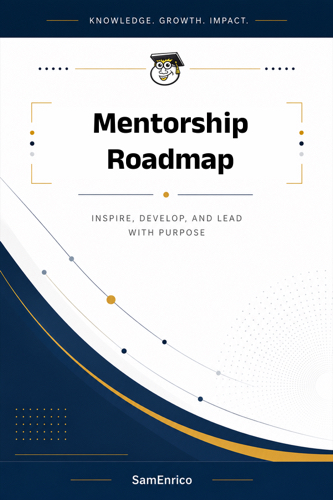
Non-FictionSelf-HelpMentorship
Mentorship Roadmap eBook
Identify, approach, and maintain relationships wit
Identify, approach, and maintain relationships with career changing mentors.
Formats
Free sample
Chapter 1: The Fairy Godmother Fallacy–- Every professional I have ever met secretly believes in fairy godmothers. They would never admit it, of course. Ask them directly, and they will roll their eyes at the very suggestion. But watch their behavior long enough, and the pattern becomes undeniable. They wait.
They hope. They perform their jobs competently, sometimes brilliantly, and they assume that someday—probably after a particularly impressive quarter or a well-received presentation—a senior leader will magically appear, tap them on the shoulder, and say, “I have been watching you. I believe in you. I will personally invest my time and reputation to guide you to the top.”That moment almost never comes.When it does, it is rarely magic. It is the result of invisible preparation, deliberate signaling, and a set of skills that no one ever taught them in school.
But because the fairy godmother myth is so pervasive, most professionals spend the first five to ten years of their careers in a state of passive waiting. They attend networking events without a strategy. They admire senior leaders from a distance. They assume that hard work alone is a sufficient invitation for mentorship.It is not.This book exists because that myth is not just wrong—it is actively harmful. The belief that mentors find you, rather than the reverse, has delayed more careers than any single skill gap or technical deficiency.
And the statistics bear this out. Studies consistently show that approximately seventy-five percent of executives credit mentors for their success, yet fewer than forty percent of early-career professionals have ever formally asked someone to be their mentor. Think about that disconnect. Almost every successful person had help, but most people never ask for it. They are waiting to be chosen.The Mentorship Roadmap is built on a single, radical premise: mentorship is not a lottery.
It is a learnable skill. And like any skill—coding, sales, public speaking, negotiation—it can be broken down into a repeatable process. That process is what this book delivers.The Anatomy of Passive Waiting Before we build the roadmap, we must first clear the wreckage of the myth. Let me describe the passive waiting pattern in detail, because chances are excellent that you have engaged in it yourself.Passive waiting looks like this. You identify a senior leader you admire.
Perhaps it is your boss’s boss. Perhaps it is a vice president in a different department who gave a talk you found inspiring. Perhaps it is an industry figure you follow on Linked In. You watch their work. You read their posts.
You hope that someday, in some organic way, you will end up on their radar.Then you wait.Months pass. You deliver solid results. You update your resume. You attend the occasional company-wide meeting where this person speaks, and you nod along, hoping to make eye contact. But you never approach them.
The thought of walking up to their office or sending a cold email fills you with dread. What would you even say? “I admire you, please mentor me” sounds desperate. “I have been watching your career” sounds creepy. So you say nothing.The waiting continues.Then a colleague—one who is no more talented than you, perhaps less so—suddenly gets a promotion.
Or a plum assignment. Or a public endorsement from that same senior leader you have been admiring from afar. You feel a hot flash of resentment. Why them? What do they have that you lack?The answer is almost never technical skill.
The answer is almost always that they knew how to initiate and cultivate a mentoring relationship. They did not wait to be chosen. They chose themselves first.The Seventy-Five Percent Problem Let me ground this in data, because the numbers are too striking to ignore. A decade of research into career advancement consistently shows that between seventy and eighty percent of executives report having had a mentor who significantly accelerated their career. In some industries—finance, law, technology, academia—that number climbs above ninety percent.
Mentorship is not a nice-to-have. It is the closest thing to a prerequisite for executive leadership that exists.But here is the problem. The same research shows that fewer than forty percent of early-career professionals have ever formally initiated a mentoring relationship. The gap between those who receive mentorship and those who seek it is enormous. And the reasons people cite for not seeking mentorship are revealing.“I did not want to be a burden.” “I assumed they were too busy.” “I did not know what to ask for.” “I thought a mentor would naturally appear if I did good work.” “I was afraid of rejection.”Notice what all of these reasons have in common.
They are stories we tell ourselves about other people’s willingness to help us. They assume that mentors are scarce, that their time is too valuable, and that we are not yet worthy of their attention. These are not facts. They are fears dressed up as logic.The truth is that most senior leaders are far more willing to mentor than junior professionals assume. In study after study, when asked whether they would accept a request for a single informational interview from a junior colleague, over ninety percent of executives say yes.
The barrier is not on the mentor’s side. It is on the mentee’s side. Most people never ask.The Four-Phase Framework This book is organized around a framework that has been tested and refined in mentorship literature for decades, most notably in the work of Lois Zachary, whose research on the mentorship lifecycle remains the gold standard. The framework is simple: every successful mentoring relationship moves through four predictable phases.The first phase is Preparing. This is the invisible work that happens before you ever speak to a potential mentor.
It includes self-assessment, gap analysis, and the clarification of your own goals and values. Most people skip this phase entirely, which is why their initial requests feel vague and unappealing to busy executives. The preparing phase transforms you from a supplicant into a compelling investment.The second phase is Negotiating. This is the initial meeting and the formal establishment of the relationship. It is not about impressing the mentor with your accomplishments.
It is about negotiating mutual expectations—goals, logistics, boundaries, confidentiality, and a trial period. The negotiating phase prevents the number one reason mentorships fail: mismatched expectations.The third phase is Enabling. This is the long middle of the relationship, where real growth happens. It is characterized by support, challenge, and vision. Within the enabling phase, there will be a natural period of friction—what some call the testing phase—where the mentee disagrees with advice or feels vulnerable.
That friction is normal, even healthy. It is not a sign of failure. It is a sign of deepening trust.The fourth phase is Coming to Closure. Almost every mentoring relationship ends. The mentee outgrows the mentor’s wisdom, or learning needs shift, or a new role makes the old format impossible.
The closure phase is about ending gracefully, providing feedback to the mentor, and transforming the relationship into a different form—often a peer-level…
This is the end of the free sample. Get the eBook to keep going. Buy now
About this book
Details
- Author
- Savage Felice
- Publisher
- SamEnrico
- Language
- English
- Genre
- Non-Fiction, Self-Help, Mentorship
- Released
- 2026-06-10
- Pages (approx.)
- 148
- Available as
- eBook, Audiobook

Read better in the ZLOADR app
Your eBooks on your phone or tablet. Sign in with your SamEnrico account and start reading.
More by Savage Felice
 Mindful Communication MBSR HandbookSavage Felice$11.99
 PTA Fluid Camera WorkSavage Felice$11.99
 FIFA Ultimate Team Pack FixSavage Felice$11.99
 The Gig Economy Savings Ratio GuideSavage Felice$11.99
 The Beast of Toronto: The 1880s Zoo Escape That Terrified a CitySavage Felice$11.99
 Understanding Mental RSavage Felice$17.99
 Project Management Integration StackSavage Felice$12.99
 Working for UN Agencies ExplainedSavage Felice$12.99
 How to Become a Splitting-machine TenderSavage Felice$11.99
 Ruby DeveloperSavage Felice$11.99
You may also like
 Hong Kong Handover 1997Dunn Johnnie$11.99
 Zumba For Postnatal Recovery CourseNeal Christian$11.99
 Zumba for BeginnersLadner Nikia$11.99
 YouTube Comment Mining GuideHumes Pandora$12.99
 Worry Box MeditationCarlin Rudy$11.99
 Workplace Stress MeditationNguyen Lynn$11.99
 Workplace Stress and Sleep RepairHawley Ivory$11.99
 Workplace Perfectionism CureDelaney Jeffry$11.99
 Workplace Injustice Anger GuideWallen Isabelle$11.99
 Work Addiction and Burnout LinkGreenwood Ester$11.99
 Women in Yoga and WellnessBeattie Galina$11.99
 Women in Stand Up ComedyChun Evangeline$11.99