
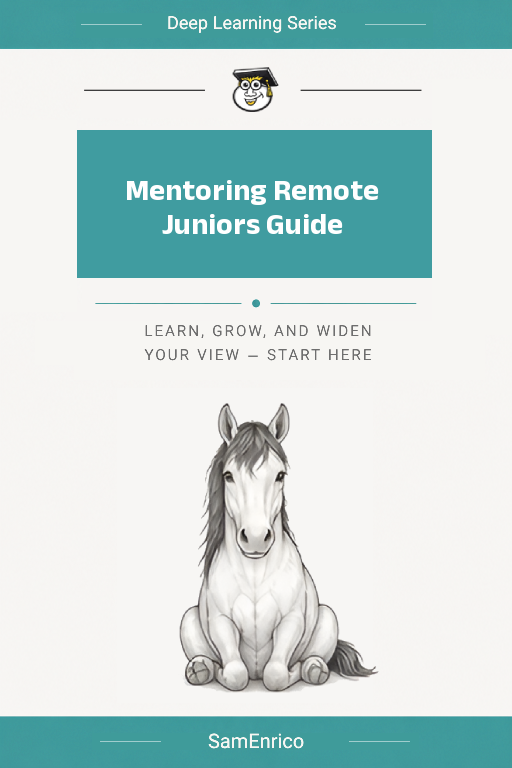
Non-FictionProfessional's Cheat SheetRemote
Mentoring Remote Juniors Guide eBook
Build trust and career development for junior coll
Build trust and career development for junior colleagues working remotely across cultures.
Formats
Free sample
Chapter 1: The Broken Rung--–- The email arrived at 11:47 PM on a Tuesday. Maria, a junior data analyst in São Paulo, had been working remotely for a San Francisco-based tech company for eight months. Her manager, David, was a well-intentioned but overwhelmed director who had never been trained to lead people he couldn't see. That day, Maria had completed a complex migration of customer data—work that would save the company roughly forty hours of manual effort per week. She had documented her process, written a clean summary, and posted it to the team’s shared channel.
No one replied. Not a single emoji. Not a "thank you." Not a "question about your approach."At 11:47 PM, David’s message finally arrived: "Quick question—can you update the Q3 forecast by tomorrow AM? Nothing major, just refresh the numbers." No acknowledgment of the data migration. No comment on her growing expertise.
No signal that anyone had even noticed. Maria closed her laptop and cried for five minutes before opening it again to update the forecast. She was twenty-six years old, highly skilled, and deeply invisible.This scene plays out thousands of times each day across the remote work economy. It is not a story of malice or incompetence. David was not a bad manager.
Maria was not a bad employee. What they were experiencing was the quiet collapse of the traditional mentorship pipeline—a collapse that has left an entire generation of junior talent stranded on what organizational psychologists call the broken rung.THE BROKEN RUNG DEFINEDThe "broken rung" is a term borrowed from women's workplace advancement research, but it applies with even greater force to remote junior employees across all demographics. In traditional office environments, the first step from entry-level to manager was fragile but visible. Juniors could be seen staying late, asking questions in hallways, and volunteering for stretch assignments. Managers could pull promising juniors into projects based on casual observations.
That informal social contract has evaporated.In the remote context, the broken rung describes a specific phenomenon: remote juniors receive the same task-based instructions as their in-office counterparts but lack access to the developmental relationships that convert task completion into career advancement. They are given work. They are not given sponsorship. The difference is everything.Consider the data. According to a 2023 study of distributed teams published in the Harvard Business Review, remote junior employees received 47 percent less informal feedback than their co-located peers.
A separate analysis by the workplace analytics platform Scoop found that junior employees in fully remote roles were 2.3 times more likely to be laid off during restructuring than senior employees in the same remote roles. The most troubling statistic comes from a longitudinal study of global teams: juniors in the Global South working for companies headquartered in North America or Europe had a 62 percent lower rate of promotion within the first two years compared to juniors based in the headquarters country.These numbers are not random. They are the predictable output of a system designed around physical proximity, retrofitted for digital distance without retooling the human processes. The watercooler is gone. The hallway conversation is gone.
The spontaneous "come look at this" over a shared monitor is gone. What remains is the scheduled check-in, the Jira ticket, the Slack thread, and the slow erosion of trust.The argument of this book is straightforward: the solution is not more meetings, stricter key performance indicators, or surveillance software. The solution is intentional, trust-based sponsorship delivered across cultural and geographical divides. But before we can build that solution, we must understand precisely why the current system fails. The answer lies in three intersecting forces: the collapse of informal mentorship, the tyranny of proximity bias, and the confusion between mentorship and sponsorship.THE COLLAPSE OF INFORMAL MENTORSHIPMentorship in the pre-remote era was largely an accidental process.
It did not appear on organizational charts. It was not budgeted. It emerged from shared space, shared struggle, and shared time. A senior engineer noticed a junior staying late to debug a particularly thorny issue and offered to pair program. A marketing director overheard a junior account manager handling a difficult client call with poise and invited them to shadow a pitch meeting.
A finance VP saw a junior analyst's name on a well-structured model and asked, "Who built this?"These moments were not scheduled. They were not documented. They were the ambient humidity of office life—invisible until removed. Remote work removed them entirely.What replaced ambient mentorship was structured, transactional management. The weekly one-on-one became the primary (and often only) site of developmental conversation.
But the one-on-one, as typically practiced, is a deeply flawed container for mentorship. It is constrained by time, structured around status updates, and dominated by the manager's agenda. A typical sixty-minute remote one-on-one, when analyzed for content, breaks down roughly as follows: forty minutes of task coordination ("Where are we on the dashboard update?"), twelve minutes of administrative noise ("Did you submit your timesheet?"), five minutes of relationship maintenance ("How’s the weather there?"), and three minutes of career development ("Anything you want to learn next?").Eighty percent task coordination. Twenty percent everything else. This is not mentorship.
This is project management with a human face.The problem is compounded by the loss of observational learning. In an office, juniors learned organizational culture by watching how senior people behaved in meetings, how they phrased emails, how they recovered from mistakes, how they disagreed with authority. Remote work hides these modeling opportunities behind video-off defaults, shared screens, and the polite fiction that everyone is equally visible. Juniors cannot imitate what they cannot see.One junior software engineer in Nairobi, interviewed for the research behind this book, described the experience vividly: "I know my manager wants me to succeed. He says it every week.
But I have no idea how he actually thinks. When he makes a decision, I just see the result. I don't see the trade-offs he considered, the people he consulted, the things he decided not to do. I'm learning the output of his brain, not the process." This is the hidden curriculum of remote work: juniors learn what to produce, but not how to think.PROXIMITY BIAS: THE INVISIBLE TYRRANYIf informal mentorship collapsed accidentally, proximity bias is its ruthless enforcer. Proximity bias is the unconscious preference for workers who are physically near, visible, and accessible.
It is not malicious. It is cognitive efficiency. The human brain privileges information that is salient, frequent, and emotionally available. A junior who appears in the same physical space several times a day is more salient than a junior who appears in a Zoom square once a week. The brain does not care about fairness.
The brain cares about processing load.Proximity bias manifests in remote contexts in three destructive ways.First, visibility affects opportunity assignment. When a manager has a high-visibility, high-pressure task that cannot fail, they will assign it to someone they trust. Trust, in this context, is not about competence—it is about predictability. A remote junior whose work habits are unknown feels risky. An in-office junior whose work habits are visible every day feels safe.
The remote junior gets the routine work. The in-office junior gets the stretch assignment. Over two years, that gap becomes…
This is the end of the free sample. Get the eBook to keep going. Buy now
About this book
Details
- Author
- Mabry Lekisha
- Publisher
- SamEnrico
- Language
- English
- Genre
- Non-Fiction, Professional's Cheat Sheet, Remote
- Released
- 2026-06-01
- Pages (approx.)
- 143
- Available as
- eBook, Audiobook

Read better in the ZLOADR app
Your eBooks on your phone or tablet. Sign in with your SamEnrico account and start reading.
More by Mabry Lekisha
 The Client Feedback FilterMabry Lekisha$11.99
 Wholesaling Commercial Real EstateMabry Lekisha$11.99
 The MBSR for Chemo BrainMabry Lekisha$11.99
 Chronic Stress Inflammation LinkMabry Lekisha$11.99
 Mentorship for Operations LeadersMabry Lekisha$11.99
 Assertiveness For Social MediaMabry Lekisha$11.99
 Zumba Arm Toning WorkoutMabry Lekisha$11.99
 Mindfulness for Drivers GuideMabry Lekisha$11.99
 Breath While Parenting GuideMabry Lekisha$11.99
 Silks and Spices: The Fashion Empire of the Portuguese ExplorersMabry Lekisha$11.99
 The Lighthouse Keepers' Last Broadcast: A Stormy MysteryMabry Lekisha$11.99
 The Last Broadcast: The 1998 Radio Tower Siege of BournemouthMabry Lekisha$11.99
You may also like
 Hong Kong Handover 1997Dunn Johnnie$11.99
 Zumba For Postnatal Recovery CourseNeal Christian$11.99
 Zumba for BeginnersLadner Nikia$11.99
 YouTube Comment Mining GuideHumes Pandora$12.99
 Worry Box MeditationCarlin Rudy$11.99
 Workplace Stress MeditationNguyen Lynn$11.99
 Workplace Stress and Sleep RepairHawley Ivory$11.99
 Workplace Perfectionism CureDelaney Jeffry$11.99
 Workplace Injustice Anger GuideWallen Isabelle$11.99
 Work Addiction and Burnout LinkGreenwood Ester$11.99
 Women in Yoga and WellnessBeattie Galina$11.99
 Women in Stand Up ComedyChun Evangeline$11.99