
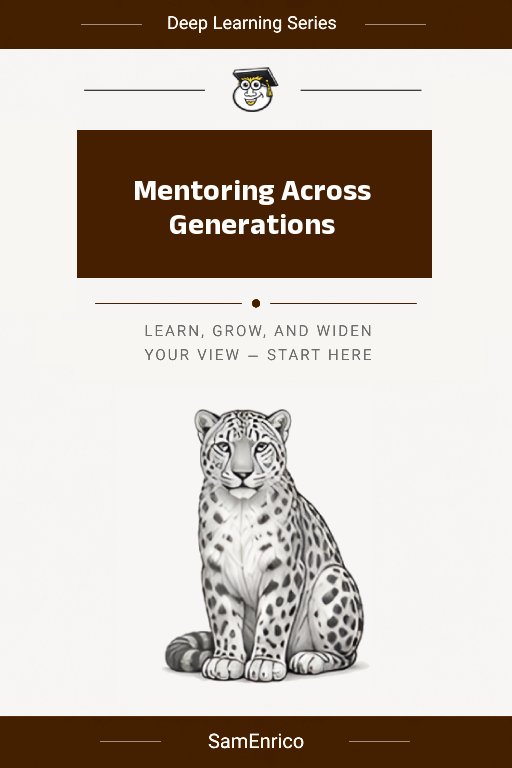
Mentoring Across Generations eBook
Bridge generational gaps when mentoring Gen Z and
by Haskins Elia
Bridge generational gaps when mentoring Gen Z and Millennial junior colleagues globally.
Formats
Free sample
Chapter 1: The Respect Hypothesis--When a 24-year-old junior analyst in Singapore burst into tears because her manager said “Let’s discuss your report’s formatting errors” in a slightly louder voice than usual, the manager assumed she was fragile. When a 22-year-old software developer in Berlin walked out of a performance review after being told “You need to be more proactive” and never returned to the office, his team assumed he was entitled. When a 26-year-old marketing associate in São Paulo stopped speaking up in meetings after being interrupted three times by a senior director, her colleagues assumed she was lazy.All of these assumptions were wrong. And they are costing organizations billions of dollars in turnover, disengagement, and lost talent every year.The problem is not that young people are fragile, entitled, or lazy. The problem is that most mentors, managers, and senior leaders do not understand the neurobiological reality of the 18-to-27-year-old brain.
Specifically, they do not understand what this chapter calls the Respect Hypothesis: that young adults are neurologically wired to crave status, autonomy, and social approval more intensely than any other age group, while simultaneously being hypersensitive to social pain—shame, humiliation, condescension, and public correction.This chapter dismantles the lazy generational stereotypes that dominate workplace conversations and replaces them with a science-backed framework for understanding why Gen Z and the youngest Millennials behave the way they do. More importantly, it introduces the Mentor Mindset—a specific, teachable orientation that transforms how senior leaders show up for their junior colleagues. By the end of this chapter, you will understand why your best intentions may have backfired, and you will have a concrete path forward.The Cost of Getting It Wrong Before diving into the science, let us be honest about the stakes. In 2025, a global study of 15,000 knowledge workers found that 47 percent of Gen Z employees had left a job within the first 12 months, and the single most cited reason was not salary, not workload, not commute—it was “feeling disrespected by my manager.” Not disrespected through overt abuse. Disrespected through tone, through being talked down to, through feedback that felt more like a verdict than a conversation.Simultaneously, 62 percent of senior leaders in that same study reported feeling “exhausted” by managing young employees, describing them as “too sensitive,” “unwilling to pay dues,” or “unable to take criticism.” Both groups are miserable.
Both groups blame the other. And both groups are trapped in a cycle that the neurobiology of the young brain explains perfectly.The financial cost is staggering. Gallup estimates that actively disengaged Gen Z employees cost the global economy $8.8 trillion in lost productivity annually. But the human cost is worse: anxiety, burnout, and the quiet erosion of confidence that leads talented young people to shrink themselves into invisible, compliant workers rather than the innovative contributors they could have been.This is not an argument for lowering standards. It is an argument for raising our understanding.The Neurobiology You Cannot Ignore Between the ages of 18 and 27, the human brain undergoes what neuroscientists call “the second wave of synaptic pruning.” The first wave happens in early childhood.
The second wave happens in late adolescence and young adulthood, and it specifically targets the brain’s reward system—the network of neurons that processes pleasure, motivation, and social reinforcement.David Yeager, a developmental psychologist at the University of Texas at Austin, has spent two decades studying this period. His research, synthesized in the bestselling book *10 to 25*, reveals a counterintuitive truth: the young brain is not less sensitive to social feedback than an adult brain. It is more sensitive.Specifically, the ventral striatum—the part of the brain that lights up when you receive a compliment, a promotion, or public recognition—is significantly more active in people under 27 than in those over 35. Receiving respect from a high-status person (a mentor, a boss, an admired peer) feels physiologically rewarding to a young adult in a way that it simply does not to someone with a fully matured prefrontal cortex.Conversely, the anterior cingulate cortex—the region that processes social pain, rejection, and humiliation—is also more active. Being publicly corrected, condescended to, or dismissed triggers the same neural pathways as physical pain.
In young brains, that signal is amplified.This is not weakness. This is biology. The young brain is designed to be exquisitely tuned to social hierarchy because, evolutionarily, status determined survival. Being ejected from the tribe meant death. The fact that modern workplaces have replaced physical tribes with quarterly reviews and Slack channels does not change the underlying wiring.Consider the following experimental finding, replicated across seven countries: When young adults are given a difficult task and then receive either (a) direct critical feedback or (b) the same critical feedback preceded by the phrase “I’m giving you this feedback because I have very high standards and I know you can meet them”—the second group performs 32 percent better on subsequent tasks, reports higher motivation, and is significantly more likely to ask for help when stuck.The only difference is the presence of what Yeager calls a wise feedback intervention: a single sentence that communicates respect, high expectations, and belief in the young person’s capacity.
That sentence takes five seconds to say. It changes outcomes dramatically.The Three Mindsets: Enforcer, Buddy, and Mentor If the neurobiology is clear, why do so many mentors get it wrong? Because most of us default to one of two flawed mindsets. This chapter names them, describes their damage, and then introduces the only effective alternative.The Enforcer Mindset The Enforcer believes that the world is too soft, that young people need to toughen up, and that the mentor’s job is to provide “honest feedback” without sugarcoating. The Enforcer’s internal script sounds like this: “I survived worse when I was their age.
They need to learn resilience. If they can’t handle direct criticism, they won’t survive in this industry.”On the surface, the Enforcer seems to value high standards. But the Enforcer’s approach lacks the second critical ingredient: support. The Enforcer delivers criticism without context, without relationship, and without any signal that they believe in the junior’s ability to improve. The result is not resilience—the result is shame, withdrawal, and quiet quitting.The Enforcer produces compliance at best, and at worst, a hollowed-out employee who does exactly what they are told and nothing more.
Creativity dies. Initiative dies. And the mentor ends up baffled: “I told them exactly what they needed to fix. Why didn’t they fix it?”Because you told them they were broken, but you did not tell them they could be fixed.The Buddy Mindset At the opposite extreme is the Buddy. The Buddy believes that young people are fragile, that the mentor’s job is to protect them from stress, and that the most important outcome is that the junior likes them.
The Buddy’s internal script sounds like this: “I don’t want to crush their spirit. I’ll just let the small stuff slide. They’ll learn eventually.”The Buddy praises everything, corrects almost nothing, and slowly lowers standards to avoid uncomfortable conversations. The junior feels warm and fuzzy—until they enter a…
This is the end of the free sample. Get the eBook to keep going. Buy now
About this book
Details
- Author
- Haskins Elia
- Publisher
- SamEnrico
- Language
- English
- Genre
- Non-Fiction, Professional's Cheat Sheet, Generations
- Released
- 2026-05-29
- Pages (approx.)
- 148
- Available as
- eBook, Audiobook

Read better in the ZLOADR app
Your eBooks on your phone or tablet. Sign in with your SamEnrico account and start reading.
More by Haskins Elia
 Remote Exit Interviews GuideHaskins Elia$11.99
 Newsletter Content Strategy GuideHaskins Elia$11.99
 Self Hypnosis For Fertility Support CourseHaskins Elia$11.99
 People Pleasing in RelationshipsHaskins Elia$11.99
 The Vitamin K2 BreakthroughHaskins Elia$11.99
 The Phantom Ledger: The $1.2 Billion Heist That Vanished Without a TraceHaskins Elia$11.99
 The Ancient Healers: North America’s Forgotten AntibioticsHaskins Elia$11.99
 How to Become a InvestigatorHaskins Elia$11.99
 Lead Mobile DeveloperHaskins Elia$11.99
 House Sitting Long Term GuideHaskins Elia$12.99
 Understanding Epitheliopathy (Apmppe)Haskins Elia$17.99