
Non-FictionProfessional's Cheat SheetMentorshipSupport Network
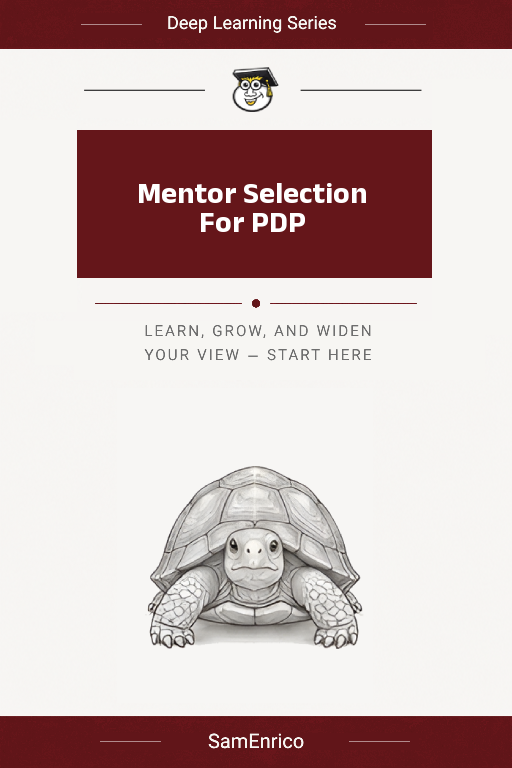
Mentor Selection For PDP eBook
Find and approach mentors who can support your per
by Kane Larae
Find and approach mentors who can support your personal development plan goals including mentor agreement templates.
Formats
Free sample
Chapter 1: The 5-Why Death Spiral–- Sarah had been passed over for promotion three times in five years. On paper, she was perfect: Ivy League MBA, glowing performance reviews, and a reputation for delivering projects under budget. Yet every time the director list came out, her name was missing. Her assigned corporate mentor—a well-meaning senior manager from a different department—kept telling her to "be more strategic" and "increase her visibility." Sarah nodded, took notes, and tried harder. Nothing changed.One afternoon, she sat across from a retired executive she had met through a alumni coffee chat.
Not a formal mentor, just a curious stranger willing to listen. After hearing Sarah's frustration, the older woman asked a single question: "Why do you think you're not getting promoted?"Sarah gave the obvious answer: "Because the people above me don't see my potential.""Why don't they see it?""Because I'm not in the right meetings.""Why aren't you in those meetings?"Sarah hesitated. "Because my manager doesn't invite me.""Why doesn't your manager invite you?"This was the painful part. Sarah's voice dropped. "Because the last time I was in a high-stakes meeting, I froze when the CFO asked me a question.
I stumbled through an answer. My manager had to step in and save me. I think he lost trust in my ability to handle pressure."The retired executive leaned forward. "So the real problem isn't visibility. It's not meetings.
It's that you freeze under pressure from senior executives. That's what we need to work on. Not 'being more strategic.' Not 'networking.' That specific thing right there."Sarah sat in stunned silence. In five years of corporate mentorship, no one had ever asked her the fifth why. No one had ever drilled down to the actual skill deficit.
She had been asking for help with the wrong problem because she had never been taught how to find the real one.This chapter is about making sure you never waste another mentor's time—or your own—by bringing the wrong question to the table.The #1 Barrier to Finding a Mentor After studying hundreds of mentoring relationships across technology, finance, healthcare, and creative industries, a clear pattern emerges: the vast majority of failed mentorships do not fail because of personality conflicts, scheduling issues, or even bad advice. They fail because the mentee cannot articulate what they actually need.Walk into any corporate mentoring program and listen to the opening conversations. You will hear variations of the same vague statements:"I want to improve my leadership skills.""I need to be more strategic.""I want to get to the next level.""I need to work on my executive presence."These are not asks. These are ghosts. They sound like goals, but they point to nothing specific.
A mentor hearing "I want to improve my leadership skills" has no idea where to start. Should they teach you how to run a meeting? How to give feedback? How to delegate? How to handle a crisis?
How to inspire a team? All of these are leadership skills, and they require completely different interventions.The result is predictable: the mentor guesses. They offer generic advice pulled from their own experience. The mentee nods, tries a few things, sees no progress, and both parties drift apart. The mentor feels their time was wasted.
The mentee feels abandoned. And the cycle repeats.The Specific Aims Method This chapter introduces a tool borrowed from an unlikely source: scientific grant writing. Researchers applying for funding from the National Institutes of Health (NIH) must complete a "Specific Aims" page. They cannot write "I want to cure cancer." That is too vague. Instead, they must break their grand ambition into a single page of precise, testable, falsifiable aims.A good Specific Aims page might read: "Aim 1: Determine whether Protein X binds to Receptor Y in vitro.
Aim 2: Measure the rate of apoptosis in Cell Line Z following binding. Aim 3: Compare survival rates in murine models with and without Protein X intervention."Notice the precision. Notice how each aim can be answered with a yes or no. Notice how a stranger reading that page knows exactly what the researcher will do for the next 12 months.Your Personal Development Plan (PDP) deserves the same rigor. Most corporate PDPs are written like vague wishes: "Develop presentation skills," "Build cross-functional relationships," "Improve data analysis." These are not plans.
They are placeholders.The Specific Aims Method for your PDP involves breaking your development into three granular categories. Each category answers a different question about what you need from a mentor.Competencies: The "What" of Development Competencies are specific, teachable skills that can be practiced and measured. They answer the question: "What do I need to be able to do that I cannot do today?"Examples of well-defined competency aims:"Deliver a 10-minute presentation to senior executives without reading from notes.""Build a three-statement financial model in Excel with no errors.""Write a one-page strategic memo that gets approved without revision requests.""Conduct a performance review conversation that leaves the employee motivated."Notice how each of these is observable and verifiable. A mentor watching you present knows whether you read from notes. A mentor reviewing your model knows whether it has errors.
There is no ambiguity.Poorly defined competency aims sound like:"Improve my communication.""Get better at finance.""Be more strategic."These are not aims. They are aspirations. Aspirations are fine for vision boards, but they are useless for mentorship agreements because no one can tell you when you have achieved them.Experiences: The "Where" of Development Experiences are specific projects, assignments, rotations, or stretch opportunities that force you to practice competencies in real conditions. They answer the question: "Where can I apply this skill to build evidence of competence?"Examples of well-defined experience aims:"Lead a cross-functional team of at least three people on a project lasting longer than two months.""Present a quarterly business review to the C-suite without a script.""Own a full sales cycle from prospecting to close for a deal worth at least $50,000.""Mediate a conflict between two direct reports and document the resolution process."These experiences are the proving ground for competencies. You can practice public speaking in a mirror all day, but you will not know if you can actually do it until you stand in front of a hostile audience.
The mentor's role is not just to teach you the skill but to help you find or create the experience where you test it.Poorly defined experience aims sound like:"Get more leadership experience.""Work on bigger projects.""Be more visible."These are not experiences. They are descriptions of feelings. A mentor cannot help you find "more visibility." They can help you identify a specific high-stakes meeting where visibility matters.Exposures: The "Who" of Development Exposures are specific people, networks, or audiences that you need access to in order to advance. They answer the question: "Who needs to see me perform so that my career accelerates?"Examples of well-defined exposure aims:"Present a recommendation to the VP of Product and receive verbal approval.""Shadow a senior partner during a client pitch and debrief afterward.""Get introduced to three external recruiters in my target industry.""Receive written feedback from two…
This is the end of the free sample. Get the eBook to keep going. Buy now
About this book
Details
- Author
- Kane Larae
- Publisher
- SamEnrico
- Language
- English
- Genre
- Non-Fiction, Professional's Cheat Sheet, Mentorship, Support Network
- Released
- 2026-06-01
- Pages (approx.)
- 145
- Available as
- eBook, Audiobook

Read better in the ZLOADR app
Your eBooks on your phone or tablet. Sign in with your SamEnrico account and start reading.
More by Kane Larae
 TM Cardiovascular ResearchKane Larae$11.99
 Delegation for PhotographersKane Larae$11.99
 Men's Cardio Oncology GuideKane Larae$11.99
 Australian Green Incentives HandbookKane Larae$11.99
 Remote Work Stress Management GuideKane Larae$11.99Remote Work Stress Management GuideKane Larae$11.99
 The Silent Auction: How a 19th-Century Art Heist Foreshadowed CybercrimeKane Larae$11.99
 Understanding Chromosome 16Kane Larae$17.99
 Language Test for Express EntryKane Larae$12.99
 How to Become a TaperKane Larae$11.99
You may also like
 Hong Kong Handover 1997Dunn Johnnie$11.99
 Zumba For Postnatal Recovery CourseNeal Christian$11.99
 Zumba for BeginnersLadner Nikia$11.99
 YouTube Comment Mining GuideHumes Pandora$12.99
 Worry Box MeditationCarlin Rudy$11.99
 Workplace Stress MeditationNguyen Lynn$11.99
 Workplace Stress and Sleep RepairHawley Ivory$11.99
 Workplace Perfectionism CureDelaney Jeffry$11.99
 Workplace Injustice Anger GuideWallen Isabelle$11.99
 Work Addiction and Burnout LinkGreenwood Ester$11.99
 Women in Yoga and WellnessBeattie Galina$11.99
 Women in Stand Up ComedyChun Evangeline$11.99