
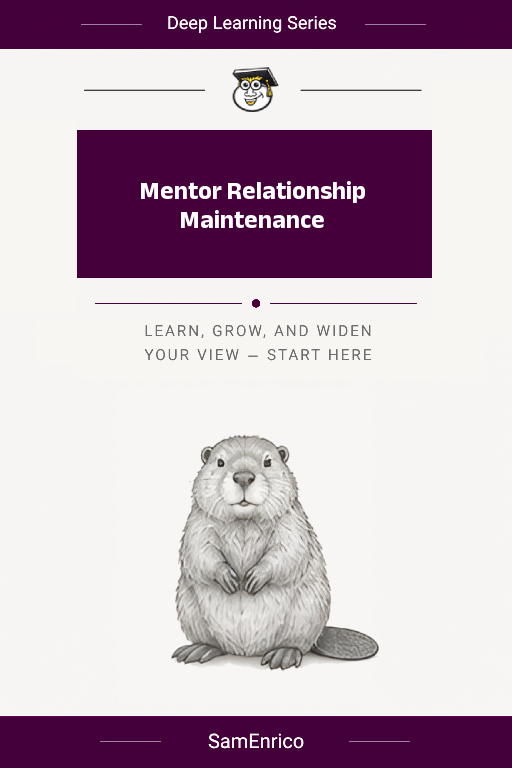
Non-FictionFirst 30 DaysRetentionLong-Term Value
Mentor Relationship Maintenance eBook
Share monthly progress updates and ask one follow-
by Ludwig Norah
Share monthly progress updates and ask one follow-up question to keep the connection active.
Formats
Free sample
This is a fascinating topic, as most mentoring books focus on either the initial "match" or the final "transition," leaving a gap in practical advice for the day-to-day maintenance of the relationship.Based on the core tenets of The Mentor's Way (Routledge, 2017) -1, the operational guidance from the Elements of Effective Practice for Mentoring Programs -2, and the deep-dive research into The Power of Follow-Up Questions -9, here is a 12-chapter outline for "Mentor Relationship Maintenance."The outline is structured to move from the foundational mindset to the specific execution of the monthly update, and finally to long-term evolution.Book Title: The Sustaining Link: A 12-Chapter Guide to Mentor Relationship Maintenance Core Thesis: The difference between a mentoring relationship that fizzles out and one that lasts for decades is not chemistry or time, but a specific, repeatable set of maintenance behaviors centered on proactive communication, structured accountability, and curious inquiry.Part I: The Architecture of "Active" Connections Chapter 1: The Leaky Vessel – Why 70% of Mentoring Relationships Fail Within Six Months The Problem: Analysis of "ghosting" in professional relationships. Why high-intention matches fail due to entropy (the natural tendency toward disorder).The Solution: Introduction to Maintenance Theory—the idea that relationships require specific energy inputs to remain static.The Preview: How the "Monthly Progress Update + 1 Question" formula acts as the anchor against entropy.Chapter 2: Beyond the Onboarding – Shifting from Excitement to Execution The Honeymoon Phase: Distinguishing between the initial chemistry of the "match" and the structural integrity of the "relationship."Managing Expectations: Using the "Working Agreement" (drawing from Yale mentoring contracts) to set rules of engagement for updates -10.The 80/20 Rule: Reviewing the dynamic where the mentee should drive 80% of the conversation and the mentor guides 20% -6.Chapter 3: The Psychology of The Follow-Up Question The Research: Review of the Yeomans et al. study (2017) proving that follow-up questions increase "perceived partner responsiveness" and likeability -9.The "Proof of Listening": Why a specific follow-up question is the only way to demonstrate you are actually hearing the other person.Reciprocal Vulnerability: How asking "How did that make you feel?" or "What will you do next?" builds trust faster than giving advice.Part II: The Monthly Operating System (M.O.S.)Chapter 4: Anatomy of the Perfect Monthly Update The Three-Part Structure: The "What I Did," "Where I Stumbled," and "What I Need" framework.Brevity as Respect: Why updates should take less than 5 minutes to read (the "Inbox Zero" rule for mentors).Template Design: Visual layouts for progress updates that highlight data (metrics) over narrative -5-10.Chapter 5: The One Question – The Catalyst for Engagement Differentiating Questions: "Status update questions" (Did you meet the deadline?) vs. "Connection questions" (What surprised you about that process?).The "One Question" Rule: Why asking a single, deep, open-ended question is more effective than sending a list of three generic questions.The Archive: 52 "High-Rapport" follow-up questions (e.g., "You mentioned a roadblock last month; how did your approach to that problem evolve?").Chapter 6: The 15-Minute Monthly Huddle Synchronous vs. Asynchronous: How to use the written update to prepare for a short, high-impact video call or coffee chat.The Agenda: The 5/5/5 model (5 min on their update, 5 min on your insight, 5 min on the next step).Handling the "Dump": What to do when a mentee sends a 10-page report or, conversely, a one-sentence update.Part III: Deepening the Dialogue Chapter 7: The Art of Strategic Silence Listening vs.
Waiting: Mentors often "listen" only to find an opening to talk. Nemanick’s rule of "Lead by Following" -1-4.The Pause: Using silence after an update to force the mentee to self-correct and go deeper into their own analysis.Non-Verbal Cues: How to read between the lines of a text-based monthly update (emotional tone, avoidance language).Chapter 8: Navigating Low-Momentum Months The Slump: What to do when the monthly update reads "Nothing new this month."The "Safe Place" Protocol: Revisiting the rules of confidentiality and psychological safety to uncover the real reason for stagnation -1-3.Reframing "Failure": Sharing mentor’s own past failures (self-disclosure) to lower the mentee's anxiety about reporting bad news -3-9.Chapter 9: Resource Management – Sharing Your Toolkit Active vs. Passive Support: Moving from "giving advice" to "filling the toolkit" -1-4.The "Micro-Challenge": How to end a monthly update with a tiny, specific request for the mentor (e.g., "Can you introduce me to one person in X department?").The Introduction: The etiquette of the "warm handoff" based on the mentee's demonstrated progress.Part IV: Long-Term Evolution and Closure Chapter 10: The Quarterly Deep Dive (The Relationship Review)The Pause: Every third month, the "progress update" shifts to a "relationship review."The Clutterbuck Metrics: Using specific scales to measure Trust, Challenge, and Value -6.Re-contracting: How to reset goals when the original plan becomes obsolete.Chapter 11: Celebrating Milestones as Maintenance The Psychology of Recognition: Why celebrating small wins (a finished project, a raised salary) is a functional maintenance task, not just a social one.The "Public Praise" Metric: How to balance confidentiality with the mentee’s need for visibility.Rituals: Creating annual rituals (e.g., anniversary of the first meeting) to anchor the relationship in time -2.Chapter 12: The Graceful Exit – Transitioning from Mentor to Sponsor Recognizing the End: When monthly updates become redundant because the mentee has become a peer.The Final Update: Structuring the "graduation" update that summarizes the journey.The Alumni Contract: How to maintain a "loose touch" network (annual check-ins) without the burden of monthly maintenance.Appendix: The "Mentor Relationship Maintenance" Toolkit The 12-Month Template: A tear-out sheet of 12 monthly prompts and the specific "One Question" to ask each month.The "Bad Update" Triage Guide: Flowchart for handling late, short, or concerning updates.Scripts for Difficult Conversations: Specific language for asking for more time, more detail, or to end the relationship.
This is the end of the free sample. Get the eBook to keep going. Buy now
About this book
Details
- Author
- Ludwig Norah
- Publisher
- SamEnrico
- Language
- English
- Genre
- Non-Fiction, First 30 Days, Retention, Long-Term Value
- Released
- 2026-05-30
- Pages (approx.)
- 132
- Available as
- eBook, Audiobook

Read better in the ZLOADR app
Your eBooks on your phone or tablet. Sign in with your SamEnrico account and start reading.
More by Ludwig Norah
 The Eight Week MBSR WorkbookLudwig Norah$11.99
 Eisenhower For Vacation PlanningLudwig Norah$11.99
 Assertiveness for Medical PatientsLudwig Norah$11.99
 Pregnancy Loss Couples GuideLudwig Norah$11.99
 Ann Winblad HummerLudwig Norah$11.99
 The Non Violent Parent AngerLudwig Norah$11.99
 Religious Fervor FactorLudwig Norah$11.99
 Elder Emotion GuideLudwig Norah$11.99
 Gratitude for Body FunctionLudwig Norah$11.99
 The Vaccine Gambit: How a Rogue Scientist Saved MillionsLudwig Norah$11.99
 The Cricketing Titans: The Birth of Modern Baseball in 18th-Century EnglandLudwig Norah$11.99
 Blood on the Senate Floor: The Trial That Split a NationLudwig Norah$11.99
You may also like
 Hong Kong Handover 1997Dunn Johnnie$11.99
 Zumba For Postnatal Recovery CourseNeal Christian$11.99
 Zumba for BeginnersLadner Nikia$11.99
 YouTube Comment Mining GuideHumes Pandora$12.99
 Worry Box MeditationCarlin Rudy$11.99
 Workplace Stress MeditationNguyen Lynn$11.99
 Workplace Stress and Sleep RepairHawley Ivory$11.99
 Workplace Perfectionism CureDelaney Jeffry$11.99
 Workplace Injustice Anger GuideWallen Isabelle$11.99
 Work Addiction and Burnout LinkGreenwood Ester$11.99
 Women in Yoga and WellnessBeattie Galina$11.99
 Women in Stand Up ComedyChun Evangeline$11.99