
Non-FictionFirst 30 DaysDiversity
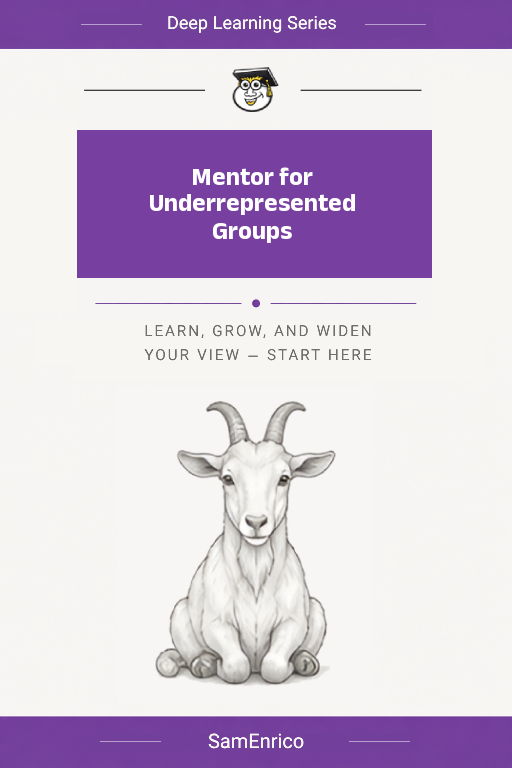
Mentor for Underrepresented Groups eBook
Find mentors from similar backgrounds who understa
Find mentors from similar backgrounds who understand unique workplace challenges.
Formats
Free sample
Chapter 1: The Advice That Almost Broke You--The first time someone told me to "just be more confident," I almost believed them.I was twenty-four years old, three months into my first corporate job, and I had just been interrupted for the seventh time in a single meeting. Each time I opened my mouth, a senior male colleague talked over me. Each time, I closed my mouth, wrote down my idea, and deleted it later. After the meeting, my mentor—a well-meaning senior director who looked nothing like me and had never faced the particular flavor of invisibility I was drowning in—pulled me aside. "You have great ideas," he said.
"You just need to speak up more. Be more assertive."So I did.The next week, I spoke up. I interrupted back. I held my ground. And within a month, I was being called "aggressive," "difficult to work with," and "not a team player." The same behavior that my male colleagues exhibited daily—interrupting, speaking over others, dominating airtime—was praised as "leadership" when they did it and punished as "arrogance" when I did it.
My mentor was confused. "I don't understand," he said. "You did exactly what I told you to do."That was the moment I realized something that would take me another decade to fully articulate: traditional mentorship is built for people who already fit the culture. If you are the wrong gender, the wrong race, the wrong class, the wrong neurotype, or the wrong identity in any meaningful way, the standard advice doesn't just fail. It can actively harm you.This book is the antidote to that harm.The Promise of This Chapter By the time you finish this chapter, you will understand exactly why the mentorship advice you have received in the past has felt so frustrating, so inadequate, and sometimes so damaging.
You will learn the critical distinction between mentorship and sponsorship—and why most underrepresented people chase the wrong one first. You will take a self-assessment that will reveal whether you have been receiving "generic" advice when what you actually needed was "contextual" wisdom. And you will leave with a clear, actionable understanding of what this book offers that no other mentorship book has offered before: a system for finding mentors who share your background and can teach you how to navigate, survive, and ultimately change the culture that is currently grinding you down.This is not a book about fixing yourself. This is a book about finding your people.The Problem with "Good Advice"Let me tell you about Elena. Elena is a first-generation Latina lawyer at a prestigious firm.
She is brilliant. She graduated top of her class. She has won every award available to a junior associate. And she is miserable.Elena's firm assigned her a mentor—a senior partner named David. David is white, male, fifty-seven years old, and genuinely wants to help.
He gives Elena what he believes is excellent advice. "You need to be more visible," he tells her. "Volunteer for the high-profile cases. Speak up in partner meetings. Make sure everyone knows your name."Elena follows his advice.
She volunteers for a high-profile case. She speaks up in the partner meeting. She makes sure everyone knows her name. And then she is told, in her next review, that she is "too aggressive," "not collaborative enough," and "needs to learn to read the room." The partners interpret her confidence as arrogance. Her visibility as self-promotion.
Her ambition as a threat.David is baffled. "I don't understand," he says again. "You did exactly what I told you to do."Here is what David does not understand, cannot understand, because he has never had to understand it: the rules are different for Elena. The same behavior that would be praised as "leadership" in a white male associate is punished as "aggression" in a Latina woman. The confidence that would open doors for David closes them for Elena.
The visibility that would accelerate his career stalls hers.This is not a conspiracy. It is not even conscious bias, necessarily. It is the accumulated weight of cultural expectations, implicit assumptions, and unexamined norms that shape how every behavior is perceived. And it is invisible to people who have never been on the receiving end of it.This is the blind spot of traditional mentorship.What Traditional Mentorship Gets Right Before we dismantle traditional mentorship, let me be clear about what it gets right.Traditional mentorship—the kind where a senior, usually dominant-culture person advises a junior person on how to navigate the organization—has genuine value. It can teach you corporate language, meeting etiquette, strategic thinking, and technical skills.
It can help you understand the formal power structure, the official promotion criteria, and the stated values of the organization. It can provide useful feedback on your presentations, your writing, and your project management.David, Elena's mentor, is not a bad person. He is not trying to harm her. He is genuinely invested in her success. He gives her the same advice he would give any junior associate, and that advice would work perfectly well for a junior associate who looked like him, talked like him, and moved through the world like him.The problem is not that traditional mentors are malicious.
The problem is that they are limited. They can teach you the formal rules, but they cannot teach you the informal ones. They can tell you what the handbook says, but they cannot tell you how the culture actually works. They can see your behavior, but they cannot see how that behavior is filtered through the lens of your identity.This is not a failure of character. It is a failure of perspective.
And it is precisely why you need something different.The Critical Distinction: Mentorship vs. Sponsorship Drawing directly from Rosalind Chow's groundbreaking work in The Doors You Can Open, this book rests on a crucial distinction that will guide everything that follows.Mentorship is about helping you change your behavior to fit the existing culture. A mentor gives you advice, feedback, and guidance. They tell you what you are doing wrong and how to do it right. They help you develop skills, build competence, and correct mistakes.
Mentorship is valuable. Mentorship is necessary. But mentorship, by itself, is not enough.Sponsorship is about using social capital to change how others see you. A sponsor advocates for you in rooms you are not in. They say your name when you are not there.
They connect your name to successful outcomes. They put their reputation on the line to open doors for you. Sponsorship is what gets you promoted. Sponsorship is what gets you assigned to high-visibility projects. Sponsorship is what changes your trajectory.Here is the problem that most underrepresented people face: you cannot get a sponsor until you have a mentor who understands your context.A sponsor will not risk their reputation on someone they do not know.
But more importantly, a sponsor cannot advocate for you effectively unless you already know how to navigate the cultural landmines that are unique to your identity. If you walk into a partner meeting and speak up in exactly the way…
This is the end of the free sample. Get the eBook to keep going. Buy now
About this book
Details
- Author
- Perales Myrtis
- Publisher
- SamEnrico
- Language
- English
- Genre
- Non-Fiction, First 30 Days, Diversity
- Released
- 2026-05-30
- Pages (approx.)
- 131
- Available as
- eBook, Audiobook

Read better in the ZLOADR app
Your eBooks on your phone or tablet. Sign in with your SamEnrico account and start reading.
More by Perales Myrtis
 Parent Caregiver Guilt GuidePerales Myrtis$11.99
 Relationship Stress Academic GuidePerales Myrtis$11.99
 Phobia and Sweating HyperhidrosisPerales Myrtis$11.99
 Bilingual Talent MigrationPerales Myrtis$11.99
 Mindfulness Meditation for Better SleepPerales Myrtis$11.99
 Broadcast Spectrum AuctionsPerales Myrtis$11.99
 Master the Method of LociPerales Myrtis$11.99
 Metta For Healthcare WorkersPerales Myrtis$11.99
 Emotional Flashbacks ManagementPerales Myrtis$11.99
 The Last Letter of Cleopatra’s PhysicianPerales Myrtis$11.99
 Icarus Ascendant: The Architect of the LabyrinthPerales Myrtis$11.99
 Ultimate Handbook Guide to Luzhou : (China) Travel GuidePerales Myrtis$11.99
You may also like
 Hong Kong Handover 1997Dunn Johnnie$11.99
 Zumba For Postnatal Recovery CourseNeal Christian$11.99
 Zumba for BeginnersLadner Nikia$11.99
 YouTube Comment Mining GuideHumes Pandora$12.99
 Worry Box MeditationCarlin Rudy$11.99
 Workplace Stress MeditationNguyen Lynn$11.99
 Workplace Stress and Sleep RepairHawley Ivory$11.99
 Workplace Perfectionism CureDelaney Jeffry$11.99
 Workplace Injustice Anger GuideWallen Isabelle$11.99
 Work Addiction and Burnout LinkGreenwood Ester$11.99
 Women in Yoga and WellnessBeattie Galina$11.99
 Women in Stand Up ComedyChun Evangeline$11.99