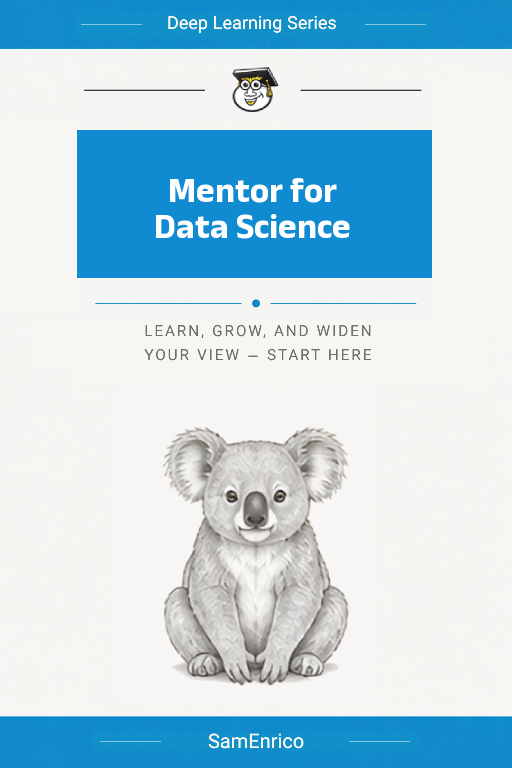
Mentor for Data Science eBook
Find analytics leaders for guidance on portfolio,
by Reiter Bonny
Find analytics leaders for guidance on portfolio, tools, and data science career progression.
Formats
Free sample
Chapter 1: The Model That Failed Upward...--–- The first time Maya presented a model to the VP of Product, she thought she was going to throw up. Not from nerves exactly—she had presented at academic conferences before, back when she was a statistics master’s student with a poster board and too much coffee. No, this was different. This was the real world. This was a room with a glass table, twelve uncomfortable chairs, and a man named Steven who had the power to greenlight her project or send her back to pulling SQL queries for someone else’s dashboard.Maya had spent three weeks on the churn model.
Three weeks of feature engineering, hyperparameter tuning, cross-validation, and late nights in the office when the air conditioning turned off and the only sound was the hum of her laptop fan. She had achieved a 0.92 AUC. She had documented her code. She had even prepared a slide deck with clean visualizations and a reassuring amount of statistical rigor.Steven walked in three minutes late, checked his phone, and said, “So, what do you have for me?”Maya clicked to her second slide. “I built a gradient-boosted model to predict customer churn,” she began.
“The AUC is 0.92, which means the model is highly discriminative. The precision-recall curve shows…”Steven held up a hand. “Stop. I don’t know what any of those words mean.”Maya blinked. She had practiced for hours.
She had anticipated questions about overfitting, about feature importance, about the trade-off between precision and recall. She had not anticipated that her audience would simply not understand the language she was speaking.“Okay,” she said, recovering. “The model is good at predicting which customers are likely to leave.”“That I understood,” Steven said. “Now tell me: what do I do with that?”Maya felt the floor tilt. She had the prediction.
She did not have the action.“You could… send them a retention offer?” she offered.“What kind of offer? To how many customers? At what cost? And how do I know it will work?” Steven leaned back in his chair. “Maya, I approved three weeks of your time for this.
I need a decision, not a metric.”The meeting ended seven minutes later. Maya packed her laptop, walked back to her desk, and sat in silence for a long time. She had built a Ferrari with no steering wheel. She had done everything right—technically—and still failed.That night, she emailed a senior data scientist she had never spoken to before, a woman named Priya who had a reputation for getting things done. Maya’s email was short, honest, and slightly desperate: “I just spent three weeks building a model that no one knows how to use.
What did I do wrong?”Priya replied within an hour. Her answer changed everything.“You built what you wanted to build, not what the business needed. Your job is not to build models. Your job is to reduce uncertainty for decision makers. If you don’t start with the decision, nothing else matters.”That conversation, more than any technical tutorial or online course, was the beginning of Maya’s transformation from solo coder to strategic leader.
And it is the starting point for this book.The Myth That Keeps Data Scientists Stuck If you are reading this book, you have likely fallen into the same trap as Maya. You believed that technical excellence was the path to career advancement. You thought that if you could just master Python, ace Kaggle, or achieve one more decimal point of accuracy, the promotions and recognition would follow.They have not followed. Or they have followed slowly, frustratingly, while you watch less technically skilled colleagues get the interesting projects, the face time with leadership, and the title changes you deserve.Here is the brutal truth that no coding bootcamp or online course will tell you: technical skills are table stakes, not differentiators. Every data scientist on the market knows Python.
Every candidate has done a Kaggle competition. Every junior can build a random forest. These skills get you in the door. They do not get you promoted.What gets you promoted is something entirely different. It is the ability to translate business problems into analytical questions.
It is the judgment to know when a simple answer is better than a perfect one. It is the skill of reducing uncertainty for people who have budgets, deadlines, and their own career pressures. It is, in short, thinking like a leader before you have the title.This chapter dismantles the most common and destructive belief in data science: the myth of the pure coder. We will explore why technical skills alone are insufficient, what leaders actually value, and how to reframe your entire approach to data work. By the end of this chapter, you will have a new definition of success and a concrete plan for pursuing it.The Value Arbitrage: Why 70% Can Beat 99%Let us start with a thought experiment.
You have two models. Which one is more valuable to your company?Model A: 99% accurate at predicting which customers will click on a promotional email. The email generates $0.10 per click. The total addressable audience is 10,000 customers.Model B: 70% accurate at predicting which customers will churn in the next 30 days. Each retained customer is worth $500 in annual revenue.
The total addressable audience is 50,000 at-risk customers.Do the math. Model A generates 990inincrementalrevenue(10,000customers×0.99accuracy×990 in incremental revenue (10,000 customers × 0.99 accuracy × 990inincrementalrevenue(10,000customers×0.99accuracy×0.10). Model B generates 17.5millioninprotectedrevenue(50,000customers×0.70accuracy×17.5 million in protected revenue (50,000 customers × 0.70 accuracy × 17.5millioninprotectedrevenue(50,000customers×0.70accuracy×500). Model B is 17,000 times more valuable despite being 29 percentage points less accurate.This is value arbitrage—the principle that business impact is not a function of technical precision but of the intersection between accuracy and the importance of the decision being made. A model that is 70% accurate on a high-stakes problem is worth infinitely more than a model that is 99% accurate on a trivial problem.And yet, data scientists consistently optimize the wrong variable.
They obsess over hyperparameters, squeeze out additional decimal points of accuracy, and spend weeks tuning models that should have been delivered in days. Why? Because accuracy is measurable. It feels like progress. It is safe.Business value is messy.
It requires conversations with stakeholders, negotiation about priorities, and the uncomfortable admission that you do not know everything. It is harder. It is also the only thing that matters.I have watched hundreds of data scientists over the course of my career. The ones who get promoted are not the ones with the highest Kaggle rankings. They are the ones who can answer three questions about any project:What decision is this analysis enabling?Who owns that decision?How will we measure success in terms of business outcomes, not technical metrics?If you cannot answer all three questions before you write a single line of code, you are not doing data science.
You are doing a hobby.The Two Data Scientists: A Case Study in Promotion Let me tell you about two real people. I have changed their names and some details, but the story is true.Alex joined a mid-sized e-commerce company as a junior data scientist. He…
This is the end of the free sample. Get the eBook to keep going. Buy now
About this book
Details
- Author
- Reiter Bonny
- Publisher
- SamEnrico
- Language
- English
- Genre
- Non-Fiction, First 30 Days, Data
- Released
- 2026-05-28
- Pages (approx.)
- 151
- Available as
- eBook, Audiobook

Read better in the ZLOADR app
Your eBooks on your phone or tablet. Sign in with your SamEnrico account and start reading.
More by Reiter Bonny
 In Law Stress Management GuideReiter Bonny$11.99
 Combined Loci Peg SystemReiter Bonny$11.99
 Loving Kindness For TeensReiter Bonny$11.99
 Meditation for Illness AnxietyReiter Bonny$11.99
 Memory Retention Study GuideReiter Bonny$11.99
 Unionization Talent FlowsReiter Bonny$11.99
 Surge Pricing EvidenceReiter Bonny$11.99
 Parent Caregiver MistakesReiter Bonny$11.99
 Mesa Verde Cliff DwellingsReiter Bonny$11.99
 The Great Bitcoin Heist: How Iceland’s Cold War Became a Crypto Gold RushReiter Bonny$11.99
 Love in the Casbah: A Soldier and a Rebel in the Algerian WarReiter Bonny$11.99
 The Spinners: Could It Be I’m Falling in Love, YesReiter Bonny$11.99