
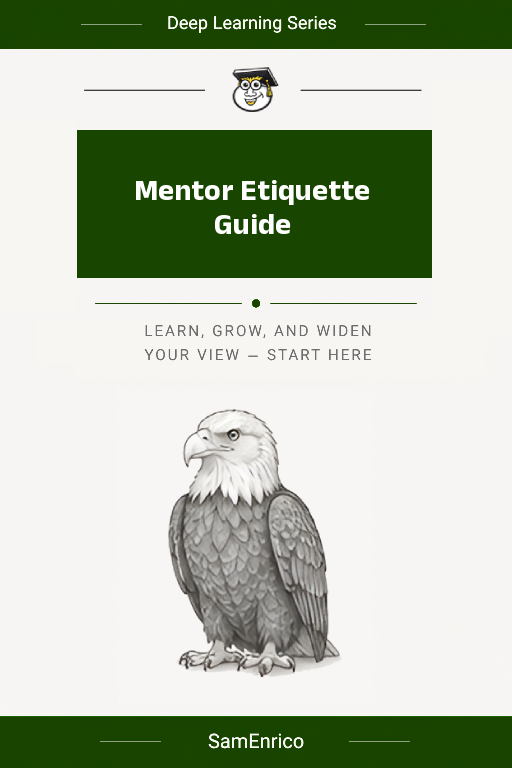
Non-FictionFirst 30 DaysEtiquette
Mentor Etiquette Guide eBook
Respect mentor time, prepare questions in advance,
by Johnson Luz
Respect mentor time, prepare questions in advance, and always send thank-you notes.
Formats
Free sample
Chapter 1: The Silent Contract--Every mentorship begins before the first word is spoken. Before the email is sent, before the calendar invite appears, before the mentor knows your name—the relationship is already being shaped by forces neither party will name aloud. This is the silent contract, and most mentees violate it within the first thirty seconds of their very first interaction.The silent contract is simple, brutal, and rarely discussed. It states that your mentor is giving you something they can never get back: time. Not advice, not connections, not encouragement—though those come with it.
The primary currency of mentorship is attention, and attention is the only resource in human relationships that cannot be manufactured, saved, or recovered once spent. A mentor who gives you thirty minutes has lost those thirty minutes forever. They will never have them again. Your job—your only job, really—is to make those thirty minutes worth more to them than anything else they could have done with that time.Most mentees fail at this before they even understand the game they are playing.This chapter will teach you the true nature of the mentor-mentee relationship, expose the hidden expectations that destroy most mentorships within the first three meetings, and give you a framework—The Loop—that will guide every interaction you ever have with someone who has chosen to invest their irreplaceable attention in you.The Unspoken Exchange Let us name what no one says out loud. When you ask someone to be your mentor, you are asking them to accept a series of invisible costs.
The most obvious is the time spent in meetings, but that is merely the surface. Beneath it lies cognitive load—the mental energy of remembering your situation, tracking your progress, and holding space for your questions. Beneath that lies emotional labor—the subtle work of delivering feedback in a way you can hear it, of managing their own frustration when you do not act on their advice, of caring about your success without becoming invested in your drama. Beneath that lies reputational risk—because when a mentor recommends you or opens a door for you, their own credibility is now tied to your performance.What do you give in return? In the early stages of a mentorship, the honest answer is: very little.
You lack their experience, their network, their wisdom. You cannot pay them back in the same currency they are giving you. This imbalance is the source of nearly every mentorship failure. The mentee feels anxious and tries to overcompensate with enthusiasm or flattery. The mentor feels drained and begins to distance themselves.
Neither party says anything because neither wants to admit that the relationship feels unequal.The solution is not to pretend the imbalance does not exist. The solution is to understand that mentorship operates on a different economic model than other professional relationships. It is not a transaction. It is not a trade. It is an investment that the mentor makes with no guarantee of return, and the only ethical response from the mentee is to become an investment worth making.This is where etiquette enters.
Etiquette is not about being polite. It is about signaling that you understand the value of what you have been given. When you send an agenda forty-eight hours in advance, you are not being organized—you are proving that you know their time is scarce. When you ask a question that cannot be answered by Google, you are not being clever—you are showing that you have done your homework before asking for their help. When you send a thank-you note within twenty-four hours, you are not being nice—you are acknowledging that they spent something irreplaceable on you.The Four Mistakes That Kill Mentorships Before we build the framework that will save your mentorships, we must first examine the wreckage of those that have failed.
Based on analysis of hundreds of mentoring relationships, four mistakes account for more than eighty percent of premature endings. Read these carefully, because you have probably made at least two of them without realizing it.The first mistake is the unprepared meeting. The mentee arrives with no agenda, no specific questions, and no update on previous advice. When asked what they want to discuss, they say "I just wanted to pick your brain" or "I thought we could catch up." To the mentor, this sounds like: "I did not value your time enough to spend ten minutes preparing, so I will instead ask you to spend your time extracting information from me." The unprepared meeting is not a meeting—it is a theft of cognitive labor. The mentor must now do the work of figuring out what you need, diagnosing your situation, and pulling questions out of you.
By the end of the session, the mentor is exhausted and the mentee has learned nothing useful.The second mistake is the unanswered question. Not a question the mentor fails to answer—a question the mentee fails to act on. A mentor gives specific, actionable advice. The mentee nods enthusiastically, says "That is brilliant," and then does nothing. Three weeks later, they meet again and the mentee asks the same question in different words.
The mentor realizes that their advice was ignored. They may not say anything—most mentors will not confront you directly—but they will begin to invest less. Why would they pour wisdom into a vessel with a hole in the bottom?The third mistake is the silent ghost. The mentee cancels last-minute, reschedules repeatedly, or simply stops responding. Sometimes there is a genuine emergency.
More often, there is not. The mentee gets busy, or anxious, or distracted. They tell themselves they will reach out next week. Next week becomes next month. Next month becomes never.
The mentor is left wondering what happened, and more importantly, whether they did something wrong. This is not just disrespectful—it is cruel. A mentor who volunteers their time should never be left wondering if they were the problem.The fourth mistake is the entitlement spiral. The mentee begins to expect more than was agreed upon. They ask for introductions to the mentor's entire network.
They request last-minute calls. They treat the mentor as a therapist, a career coach, and a reference all rolled into one. The mentor, who agreed to three thirty-minute calls, now feels buried under an avalanche of unspoken demands. The relationship ends not with a conversation, but with a slow fade that leaves both parties feeling used.If you recognize yourself in any of these mistakes, you are not alone. Nearly every mentee makes them at some point.
The question is not whether you have made mistakes—it is whether you will continue to make them.Introducing The Loop: Your Mentorship Operating System The Loop is a four-phase framework that will govern every interaction you have with your mentor. It is simple enough to remember, rigorous enough to transform your relationships, and adaptable enough to work whether you meet weekly, monthly, or once a quarter.The four phases are Ask, Prepare, Engage, and Close.Ask is the phase before the relationship begins—the initial request, the first meeting, the contract you establish about what you…
This is the end of the free sample. Get the eBook to keep going. Buy now
About this book
Details
- Author
- Johnson Luz
- Publisher
- SamEnrico
- Language
- English
- Genre
- Non-Fiction, First 30 Days, Etiquette
- Released
- 2026-06-01
- Pages (approx.)
- 142
- Available as
- eBook, Audiobook

Read better in the ZLOADR app
Your eBooks on your phone or tablet. Sign in with your SamEnrico account and start reading.
More by Johnson Luz
 The Math Anxiety SolutionJohnson Luz$11.99
 Drug Dependency ResearchJohnson Luz$11.99
 Empathy Development Practical GuideJohnson Luz$11.99
 Mindfulness Meditation for the WorkplaceJohnson Luz$11.99
 The Rhyme Peg SystemJohnson Luz$11.99
 Childhood Trauma DreamsJohnson Luz$11.99
 Palace JournalJohnson Luz$11.99
 Wrangell St Elias IceJohnson Luz$11.99
 Loving Kindness For Your Inner CriticJohnson Luz$11.99
 The Battle of Salamis: Thebes vs. Athens - A Clash of Greek TitansJohnson Luz$11.99
 Sumo in the Sands: The Unlikely Olympic Dream of the Middle EastJohnson Luz$11.99
 The Last Stand of the Great Barrier ReefJohnson Luz$11.99
You may also like
 Hong Kong Handover 1997Dunn Johnnie$11.99
 Zumba For Postnatal Recovery CourseNeal Christian$11.99
 Zumba for BeginnersLadner Nikia$11.99
 YouTube Comment Mining GuideHumes Pandora$12.99
 Worry Box MeditationCarlin Rudy$11.99
 Workplace Stress MeditationNguyen Lynn$11.99
 Workplace Stress and Sleep RepairHawley Ivory$11.99
 Workplace Perfectionism CureDelaney Jeffry$11.99
 Workplace Injustice Anger GuideWallen Isabelle$11.99
 Work Addiction and Burnout LinkGreenwood Ester$11.99
 Women in Yoga and WellnessBeattie Galina$11.99
 Women in Stand Up ComedyChun Evangeline$11.99