
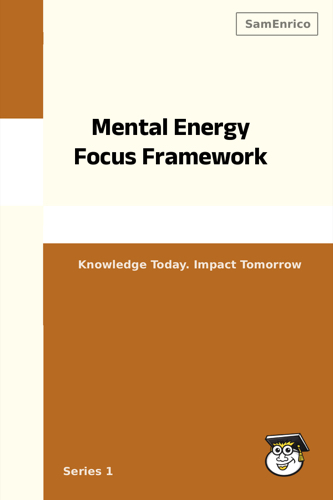
Non-FictionBusiness BriefFocus
Mental Energy Focus Framework eBook
Protect deep work periods and reduce decision fati
by Thorn Ilona
Protect deep work periods and reduce decision fatigue throughout your day.
Formats
Free sample
Chapter 1: The Fragmentation Epidemic--–- You check your email. You write two sentences of a report. You answer a Slack message. You return to the report but forget where you were. Your phone buzzes with a news alert.
You read it. You check email again. Thirty minutes have passed. You have accomplished nothing meaningful. Yet you feel exhausted.This is not laziness.
This is not a lack of willpower. This is a neurological trap, and it is the single greatest destroyer of mental energy in the modern workplace. Welcome to the fragmentation epidemic.The Great Productivity Paradox Let us begin with a paradox that defines contemporary knowledge work. Since 1980, the average office worker’s nominal productivity—measured in tasks completed, emails sent, meetings attended—has increased substantially. We have more tools, faster internet, and instant access to information that would have taken days to retrieve a generation ago.
Yet at the same time, the percentage of workers who report feeling “productive” has steadily declined. More striking still, the number of professionals who report completing their most important work before noon has dropped by nearly 40 percent since the introduction of the smartphone.We are doing more and achieving less. We are busy but not productive. We are exhausted but not fulfilled.This paradox has a name: fragmentation. It is the condition of having your attention broken into ever-smaller pieces, scattered across ever-more platforms, until your cognitive capacity resembles a shattered windshield rather than a laser beam.
Fragmentation is the natural consequence of living in what technologists call the “push economy” of information—where notifications, messages, and alerts compete for your attention whether you invited them or not.The purpose of this chapter—and indeed this entire book—is to diagnose fragmentation with surgical precision, understand its neurological mechanisms, and provide you with the first practical tools to reverse it. By the time you finish reading, you will understand why you feel exhausted at 5 PM despite having spent ten hours at your desk. More importantly, you will have completed a diagnostic exercise that reveals exactly where your mental energy is leaking.The Anatomy of a Fragmented Hour Let us walk through a typical hour in the life of a fragmented knowledge worker. We will call her Sarah. Sarah is a marketing manager at a mid-sized technology company.
She is competent, motivated, and genuinely wants to do good work. She is also losing approximately three hours of cognitive capacity every day to fragmentation.At 9:00 AM, Sarah opens her laptop with the intention of drafting a quarterly strategy document. This is her most important task of the day—a deep work activity that requires sustained concentration, analytical thinking, and creative synthesis. She estimates it will take two hours.At 9:02 AM, her email inbox pings. A colleague has sent a message asking for a quick review of a slide deck.
The request is not urgent, but the ping triggers a small dopamine release—the promise of a new, potentially rewarding stimulus. Sarah clicks over to email. She reads the message, spends thirty seconds deciding whether to respond now or later, and decides to respond “quickly.” She types: “Looks good! Send to the team.” This takes forty-five seconds.At 9:04 AM, she returns to her strategy document. But her brain is no longer fully on the document.
Part of her cognitive processing—what neuroscientists call attention residue—remains stuck on the email. Did she phrase her response appropriately? Should she have offered more detailed feedback? The ghost of the previous task lingers.At 9:07 AM, Slack notifies her that a team member has posted in the #general channel. The message is a link to a company announcement.
Sarah knows she does not need to read this now. But the notification badge—a small red circle with the number “1”—creates a low-grade anxiety. She clicks over, reads the announcement, and spends another twenty seconds scrolling through the responses.At 9:09 AM, she returns to the strategy document. She has now lost approximately four minutes to active distraction and another two minutes to attention residue. More critically, she has broken her focus twice.
Each break costs her not only the time spent on the interruption but also the time required to re-engage.At 9:12 AM, her phone buzzes with a text message from her partner asking about dinner plans. She picks up the phone. She replies. She notices a news alert about a developing story. She reads the headline.
She does not click through—she has enough discipline for that—but the headline lodges in her mind as an open loop.At 9:18 AM, Sarah realizes she has written only three sentences of her strategy document. She feels a wave of frustration. She resolves to focus. She closes Slack. She closes her email.
She puts her phone face-down. She writes for twelve uninterrupted minutes. This is progress.At 9:30 AM, another email arrives. This one is from her manager, marked “Urgent.” Sarah opens it. The request is actually not urgent—it is a question about a meeting scheduled for next week—but the “Urgent” label triggers a stress response.
Sarah spends four minutes crafting a detailed response, then returns to her document.At 9:45 AM, she realizes she has been staring at the same paragraph for ten minutes. She is not writing. She is not thinking. She is simply… stuck. The cumulative weight of twelve interruptions, fifteen open loops, and constant context switching has depleted her cognitive reserves.
Her prefrontal cortex—the part of the brain responsible for focus, planning, and impulse control—is exhausted.At 10:00 AM, Sarah gives up on the strategy document. She spends the rest of the morning in shallow work: answering emails, attending a low-stakes status meeting, and organizing her calendar. At 5:00 PM, she leaves work exhausted, having accomplished nothing of significance. She tells herself she will do better tomorrow.This is the fragmentation epidemic. And it is not Sarah’s fault.The Neuroscience of Attention Residue To understand why fragmentation is so destructive, we must first understand a concept that will appear throughout this book: attention residue.
This term was coined by Professor Sophie Leroy, a organizational behavior researcher at the University of Washington Bothell. In a series of groundbreaking studies, Leroy demonstrated that when you switch from Task A to Task B, your attention does not fully transfer. Instead, a portion of your cognitive processing remains stuck on Task A.Leroy’s experiments are worth describing in detail because they reveal the hidden cost of every interruption. In her primary study, participants were asked to work on a complex task—say, solving a set of analytical problems. After a period of focused work, they were interrupted and asked to switch to a different task.
Some participants were given a brief “transition” period to mentally close the first task before moving to the second; others were forced to switch immediately. Leroy then measured how quickly and accurately participants performed on the second task.The results were striking. Participants who switched immediately performed significantly worse on the second task—not because they lacked ability, but because their brains were still processing the first task. Even more surprisingly, the effect persisted for several minutes after the switch. Participants reported that their minds “wandered back”…
This is the end of the free sample. Get the eBook to keep going. Buy now
About this book
Details
- Author
- Thorn Ilona
- Publisher
- SamEnrico
- Language
- English
- Genre
- Non-Fiction, Business Brief, Focus
- Released
- 2026-06-06
- Pages (approx.)
- 144
- Available as
- eBook, Audiobook

Read better in the ZLOADR app
Your eBooks on your phone or tablet. Sign in with your SamEnrico account and start reading.
More by Thorn Ilona
 The Adoptive Parent Self Care WorkbookThorn Ilona$11.99
 Self Esteem And Partner's Social MediaThorn Ilona$11.99
 Behavioral Addiction in Professional SportsThorn Ilona$11.99Behavioral Addiction in Professional SportsThorn Ilona$11.99
 The Phantom of the Pacific: The Untold Story of Operation HighjumpThorn Ilona$11.99
 Nephthys: The Silent Goddess of Mourning and ShadowsThorn Ilona$11.99
 E-Commerce Headless Commerce OutlookThorn Ilona$12.99
 First Month Business Launch PlanThorn Ilona$12.99
 Aeroplane FlyingThorn Ilona$11.99
 Understanding Hepatitis EThorn Ilona$17.99
 How to Become a Kettle OperatorThorn Ilona$11.99
You may also like
 Hong Kong Handover 1997Dunn Johnnie$11.99
 Zumba For Postnatal Recovery CourseNeal Christian$11.99
 Zumba for BeginnersLadner Nikia$11.99
 YouTube Comment Mining GuideHumes Pandora$12.99
 Worry Box MeditationCarlin Rudy$11.99
 Workplace Stress MeditationNguyen Lynn$11.99
 Workplace Stress and Sleep RepairHawley Ivory$11.99
 Workplace Perfectionism CureDelaney Jeffry$11.99
 Workplace Injustice Anger GuideWallen Isabelle$11.99
 Work Addiction and Burnout LinkGreenwood Ester$11.99
 Women in Yoga and WellnessBeattie Galina$11.99
 Women in Stand Up ComedyChun Evangeline$11.99