
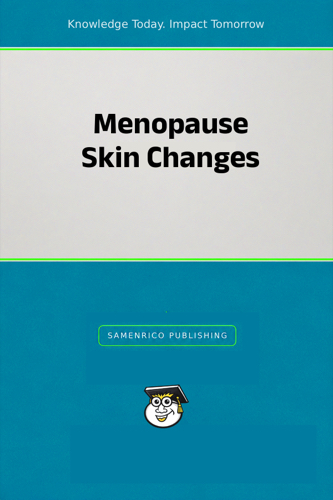
Menopause Skin Changes eBook
Combat dryness and collagen loss with moisturizers
by Abernathy Jc
Combat dryness and collagen loss with moisturizers.
Formats
Free sample
Chapter 1: The Invisible Thief--The first time a patient cried in my office over a moisturizer, I knew that menopause skincare was different from everything I had been taught.She was fifty-two years old, a former Olympic swimmer with a muscular build and the kind of sun-bleached hair that spoke of decades spent outdoors. She had never worn foundation, never needed concealer, and never once worried about dry skin. For forty years, her skin had been reliably, predictably oily. She washed her face with bar soap—the same drugstore brand her mother had used since the 1970s—and she had never moisturized. Not once.At forty-eight, her skin was still supple.
At fifty, she noticed a slight tightness after her morning shower. At fifty-one, her cheeks began to flake for the first time in her life. And at fifty-two, she stood in my examination room with a hundred-dollar jar of "intensive hydration cream" in one hand and a receipt in the other, asking a question I would hear a thousand times over the next decade."What happened to my skin?"The answer, I told her, had nothing to do with the expensive cream she had just bought. The answer had everything to do with a hormone she had never thought much about—until it was gone. That hormone is estrogen.
And its decline during perimenopause and menopause is the single most significant event in the life of a woman's skin.This is not your imagination. This is not "just aging." This is biology. And once you understand it, you can fight back.The Thirty Percent Cliff Let us begin with a number that will stop you cold. In the first five years after menopause, the skin loses roughly thirty percent of its collagen.That is not a typo. Thirty percent.To put that number in perspective, consider this: the average woman loses approximately one percent of her skin's collagen per year due to chronological aging alone.
That slow, steady decline is what your grandmother called "getting older." But the menopausal drop is not slow. It is not steady. It represents three decades of collagen loss compressed into five years. It is the difference between sliding down a gentle hill and falling off a cliff.I want you to sit with that number for a moment. Thirty percent.
Nearly one-third of your skin's structural support, gone in the time it takes to watch a child graduate from middle school to high school. This is why so many women look in the mirror at age fifty-two and see a face they do not recognize. Not because they have aged ten years overnight, but because they have lost collagen at ten times the normal rate.The research behind this number comes from a landmark study published in the journal Climacteric in 2012. Researchers measured skin collagen in a group of women before and after menopause, carefully controlling for age, sun exposure, smoking status, and body mass index. They found that women in the first five years post-menopause had lost significantly more collagen than women of the same age who were still menstruating.
The difference could not be explained by chronological aging alone. The difference was hormonal.Even more striking: the study found that the rate of collagen loss was highest in the first three years after the final menstrual period, then slowed considerably. This suggests that the initial drop in estrogen triggers a rapid remodeling phase, after which the skin stabilizes at a new, lower baseline. The implication is clear and urgent: the early post-menopausal years are a window of opportunity. Interventions that support collagen during this period—topical retinoids, oral collagen peptides, barrier repair, and in some cases, hormone replacement therapy—have the potential to preserve skin quality in ways that are not possible later on.But what if you are already past that window?
What if you are ten or fifteen years post-menopause? Do not despair. While the rapid collapse occurs early, the skin never stops responding to good care. You cannot turn back the clock, but you can absolutely slow it down. The chapters that follow will show you how.The Master Regulator Estrogen is the master regulator of skin health.
I use that phrase sparingly in this book—exactly once, in this chapter—because it is the single most important sentence a menopausal woman can read. Estrogen controls everything from sebum production to fibroblast activity, from hyaluronic acid synthesis to epidermal thickness.Let me break that down in plain English.Sebum production. Sebum is the waxy, oily substance produced by your sebaceous glands. It lubricates and waterproofs your skin. It is nature's moisturizer, and it works better than anything you can buy in a bottle.
Estrogen directly regulates how much sebum these glands produce. When estrogen drops, the glands shrink. When the glands shrink, sebum production plummets. When sebum production plummets, your skin loses its natural barrier against water loss. This is why a woman who struggled with acne and oiliness her entire life may wake up at fifty-two with tight, flaking, painfully dry skin.
Her skin type has not changed because she finally "outgrew" her oiliness. Her skin type has changed because her sebaceous glands have atrophied.Fibroblast activity. Fibroblasts are the cells in your dermis—the middle layer of your skin—that produce collagen and elastin. These cells are studded with estrogen receptors. When estrogen binds to these receptors, it tells the fibroblasts to keep working, to keep building, to keep repairing.
Think of estrogen as the foreman on a construction site, shouting encouragement to the workers. When estrogen disappears, the foreman walks off the job. The workers go dormant. Collagen production slows. Existing collagen begins to break down faster than it can be replaced.
The dermis thins. The skin loses its support structure.Hyaluronic acid synthesis. Hyaluronic acid is a molecule that can hold up to one thousand times its weight in water. It is the sponge of your skin. It is what gives young skin that bouncy, plump, juicy quality.
Estrogen stimulates the production of hyaluronic acid in the dermis. When estrogen falls, hyaluronic acid levels drop. The skin becomes less able to hold water, even when you drink plenty of fluids and use hydrating serums.Epidermal thickness. The epidermis is the outermost layer of your skin. It is your first line of defense against bacteria, pollution, irritants, and water loss.
Estrogen thickens the stratum corneum—the outermost layer of dead skin cells that forms your protective barrier. It increases the production of ceramides, cholesterol, and fatty acids, the three lipids that hold skin cells together like mortar between bricks. When estrogen falls, the epidermis thins. The barrier weakens. Water escapes.
Irritants enter. The skin becomes reactive to products it once tolerated without issue.This is why your old moisturizer stopped working. It is not that the moisturizer was bad. It is that your skin is no longer the same skin that moisturizer was designed for.The Difference Between Then and Now The distinction between chronological aging and hormonal aging is not academic hair-splitting. It is the difference between using the wrong map and arriving at the wrong destination.Chronological aging is the inevitable slowing of cell turnover that happens…
This is the end of the free sample. Get the eBook to keep going. Buy now
About this book
Details
- Author
- Abernathy Jc
- Publisher
- SamEnrico
- Language
- English
- Genre
- Non-Fiction, Health & Wellness, Dermatology
- Released
- 2026-06-11
- Pages (approx.)
- 140
- Available as
- eBook, Audiobook

Read better in the ZLOADR app
Your eBooks on your phone or tablet. Sign in with your SamEnrico account and start reading.
More by Abernathy Jc
 Income Elasticity WorkbookAbernathy Jc$11.99
 Food Addiction and CholesterolAbernathy Jc$11.99
 Body Scan for Trauma HealingAbernathy Jc$11.99
 The Forgotten Siege: Changsha's Three Defenses Against Japan (1939-1944)Abernathy Jc$11.99
 Department Budget Forecast GuideAbernathy Jc$12.99
 How to Produce Accessories and PartsAbernathy Jc$11.99
 Program Management DirectorAbernathy Jc$11.99
 How to Become a Glove FormerAbernathy Jc$11.99
You may also like
 Cannabis Use Disorder and Skin HealthMcgrew Coralie$11.99
 Pantothenic Acid Acne GuideFelton Viki$11.99
 Low Testosterone and Hair LossMott August$11.99
 Naturopathy for Skin HealthBuckmaster Denisse$11.99
 Microbiome Skin Health GuideRhodes Bryan$11.99
 Lactose Intolerance And Acne GuideCovert Yi$11.99
 Postpartum Skin ChangesBarker Lee$11.99
 PCOS Spironolactone Anti AndrogenCorbin Adell$11.99
 Micronutrients For Hair Skin NailsHitchcock Anneliese$11.99
 HGH Skin Aging ReversalFlood Shandra$11.99
 HGH and Skin Aging ReversalDumas Sam$11.99
 Adrenal Fatigue and Skin IssuesTroutman Beula$11.99