
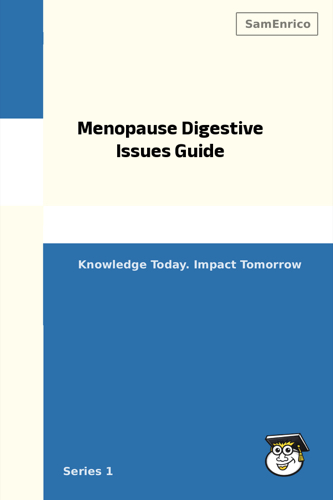
Non-FictionHealth & WellnessDigestionIBS
Menopause Digestive Issues Guide eBook
Manage bloating, constipation, and IBS flare ups t
by Roark Elroy
Manage bloating, constipation, and IBS flare ups triggered by hormonal changes.
Formats
Free sample
Chapter 1: The Estrogen Echo--–- On a crisp Tuesday morning in her forty-seventh year, a former marathon runner named Elena found herself sitting on the bathroom floor, knees pulled to her chest, convinced she had swallowed a balloon. Her abdomen had swelled to the size of a five-month pregnancy by six o’clock each evening, yet every morning she woke up flat. Her doctor had run the standard tests—celiac, thyroid, a cursory “are you sure it’s not just gas?”—and found nothing. “Eat more fiber,” he said, handing her a pamphlet about constipation. Elena wanted to laugh, except laughing made the bloating worse.
She had already tried more fiber. She had tried less fiber. She had tried gluten-free, dairy-free, sugar-free, and, for one desperate week, fun-free. Nothing worked. What Elena did not yet know—and what this chapter will make unmistakably clear—was that her digestive system had begun listening to a conversation her ovaries had stopped having.
Her gut was not broken. It was responding to an estrogen echo: the lingering, fading signal of a hormone that had once kept her intestinal lining tight, her motility brisk, and her pain threshold mercifully high.This is the single most overlooked truth in menopausal digestive care. The vast majority of nutrition advice, gastroenterology protocols, and wellness content treat the menopausal gut as if it were simply an older version of a younger gut. It is not. The decline of estrogen and the fluctuation of progesterone do not merely “affect” digestion—they rewire the very architecture of how the gut functions, from the genetic expression of your intestinal cells to the speed at which a bite of food travels from mouth to colon.
Without understanding this hormonal blueprint, you will continue to chase symptoms with the wrong tools. You will blame yourself for bloating after a “clean” salad. You will assume your IBS has mysteriously worsened. You will try elimination diets that starve your microbiome and raise your cortisol, which then makes everything worse. This chapter ends that cycle.
Here, you will learn exactly why your intestines are listening to your ovaries, what happens when that signal fades, and why the standard advice to “eat more fiber and drink more water” fails so catastrophically for menopausal women. By the final page, you will never look at a glass of Metamucil the same way again.The Forgotten Organ: Why Your Gut Has Estrogen Receptors Let us begin with a fact that surprises even some physicians: your gastrointestinal tract is a hormonal organ. From your esophagus to your rectum, your gut lining is studded with estrogen receptors—specifically estrogen receptor alpha (ERα) and estrogen receptor beta (ERβ). These receptors are not decorative. They are functional switches that, when activated by circulating estrogen, trigger a cascade of effects that keep your digestive system running smoothly.
Think of estrogen as a key and these receptors as locks. When the key turns, three critical things happen.First, estrogen reinforces the tight junctions between your intestinal cells. Tight junctions are the microscopic seals that determine how permeable your gut lining is. With adequate estrogen, these seals are tight. Large food particles, bacterial fragments, and inflammatory compounds are kept where they belong—inside the intestinal lumen, not wandering into your bloodstream.
When estrogen drops, those seals loosen. This is not a matter of opinion or diet; it is a matter of molecular biology. Looser junctions mean a “leaky gut” in the literal, measurable sense. And a leaky gut does not just cause bloating. It triggers low-grade systemic inflammation, fatigue, joint pain, and the kind of brain fog that makes you forget why you walked into the kitchen.Second, estrogen stimulates the migrating motor complex (MMC).
The MMC is a wave of electrical activity that sweeps through your small intestine every ninety minutes or so when you are not eating. Its job is to clear out leftover food particles, bacteria, and digestive debris. Without a functioning MMC, bacteria that belong in your colon migrate upward into your small intestine, where they ferment carbohydrates and produce gas. This is small intestinal bacterial overgrowth (SIBO), and it is dramatically more common in perimenopausal and postmenopausal women than in younger women, precisely because low estrogen disables the MMC.Third, estrogen modulates visceral sensitivity. Your gut has its own nervous system, the enteric nervous system, which contains as many neurons as your spinal cord.
Estrogen influences how those neurons process pain and distension signals. When estrogen is abundant, your brain ignores many of the normal, harmless sensations of digestion—the gentle churn of a migrating motor complex, the passage of a gas bubble, the mild stretch of a full stomach. When estrogen falls, the volume on those signals gets turned up. What was once imperceptible becomes uncomfortable. What was once uncomfortable becomes unbearable.
This is why a menopausal woman can feel painfully bloated after eating the same meal that caused her no trouble at age thirty-five. Her gut is not producing more gas. She is simply feeling the normal amount of gas more intensely.Progesterone: The Other Player, Often Misunderstood If estrogen is the accelerator of gut motility, progesterone is the brake. Progesterone relaxes smooth muscle throughout the body, including the smooth muscle of the intestinal wall. This is an evolutionary adaptation: during pregnancy, progesterone slows intestinal transit to allow more time for nutrient absorption, benefiting the growing fetus.
In perimenopause, however, progesterone becomes erratic. Some weeks it is high (after ovulation), other weeks it is low (during the follicular phase or anovulatory cycles), and its effects on the gut are not always straightforward.For the majority of women, progesterone slows transit time, leading to constipation. This is the classic pattern: in the luteal phase (the week before your period, when progesterone peaks), stools become harder, less frequent, and more difficult to pass. For a subset of women, however—and this is important—progesterone can have the opposite effect. Oral micronized progesterone, in particular, can alter bile acid metabolism, leading to looser stools or diarrhea in about ten to fifteen percent of users.
Additionally, some women experience rapid gastric emptying or altered intestinal permeability in response to progesterone surges. The key takeaway is this: there is no single “progesterone response.” Your individual reaction depends on your baseline motility, your bile acid profile, your microbiome composition, and even your genetic variants in progesterone receptors.This is why the book will never tell you that “progesterone always causes constipation” or “estrogen always loosens stools.” Instead, we will teach you to track your own patterns. In perimenopause, the hallmark is unpredictability: one week you are constipated, the next week you have loose stools, and you cannot find a dietary trigger because the trigger is hormonal. In postmenopause, when both estrogen and progesterone have settled at low, stable levels, the hallmark is a new baseline: slower overall motility, a thinner gut lining, and increased sensitivity. Neither state is permanent.
Both are manageable. But you cannot manage what you do not measure, and you cannot measure what you do not understand.The Sudden Drop vs. The Gradual Decline: Two Different Stories One of the most important distinctions in this book is between the sudden estrogen withdrawal of late…
This is the end of the free sample. Get the eBook to keep going. Buy now
About this book
Details
- Author
- Roark Elroy
- Publisher
- SamEnrico
- Language
- English
- Genre
- Non-Fiction, Health & Wellness, Digestion, IBS
- Released
- 2026-06-10
- Pages (approx.)
- 146
- Available as
- eBook, Audiobook

Read better in the ZLOADR app
Your eBooks on your phone or tablet. Sign in with your SamEnrico account and start reading.
More by Roark Elroy
 SEAL Team Six Operator MemoirRoark Elroy$11.99
 The Trigger Tracking AppRoark Elroy$11.99
 The Workaholic's Spirituality GuideRoark Elroy$11.99
 Critical Thinking in Teams GuideRoark Elroy$11.99
 Whispers of the Vanishing Giants: The Last of the Irish ElkRoark Elroy$11.99
 The Denisovans: Ghosts of the Altai MountainsRoark Elroy$11.99
 How to Become a Director Of PlacementRoark Elroy$11.99
 Offline Radio Marketing WorkbookRoark Elroy$12.99
 TESOL for Chinese StudentsRoark Elroy$12.99
 Barge OperationRoark Elroy$11.99
 Understanding FucosidosisRoark Elroy$17.99
You may also like
 Hong Kong Handover 1997Dunn Johnnie$11.99
 Zumba For Postnatal Recovery CourseNeal Christian$11.99
 Zumba for BeginnersLadner Nikia$11.99
 YouTube Comment Mining GuideHumes Pandora$12.99
 Worry Box MeditationCarlin Rudy$11.99
 Workplace Stress MeditationNguyen Lynn$11.99
 Workplace Stress and Sleep RepairHawley Ivory$11.99
 Workplace Perfectionism CureDelaney Jeffry$11.99
 Workplace Injustice Anger GuideWallen Isabelle$11.99
 Work Addiction and Burnout LinkGreenwood Ester$11.99
 Women in Yoga and WellnessBeattie Galina$11.99
 Women in Stand Up ComedyChun Evangeline$11.99