
Non-FictionHealth & WellnessNutritional Therapy
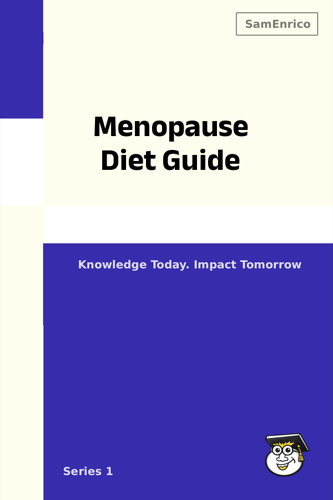
Menopause Diet Guide eBook
Eat phytoestrogens, calcium, and fiber for symptom
Eat phytoestrogens, calcium, and fiber for symptom control.
Formats
Free sample
Chapter 1: The Great Unraveling--You wake up at 3:17 a.m. again. Your nightgown is plastered to your skin, your heart is racing as if you just sprinted up a flight of stairs, and the pillow beneath your head feels like it was pulled from a dryer that never stopped spinning. You lie there, staring at the ceiling, trying to remember the last time you slept through the night without interruption. It has been months.
Maybe longer. You kick off the sheets, swing your legs over the side of the bed, and sit in the darkness, wondering what is happening to your body. You are not sick. You are not dying. But you are also not the person you were three years ago.
And no one—not your doctor, not your mother, not your best friend who went through this five years ahead of you—has given you a straight answer about why.This chapter is that straight answer. Not the clinical, rushed, five-minute version you get in a crowded exam room. Not the dismissive “it’s just aging, dear” that leaves you feeling invisible and unheard. And certainly not the alarmist, fear-driven nonsense that sells supplements and promises cures that do not exist. This is the real, evidence-based, biologically honest explanation of what happens when your hormones begin their great unraveling—and, more importantly, why the food you put on your plate tonight can be the single most powerful tool you have to put yourself back together.The Three Phases of the Transition Before we talk about solutions, we need to name the enemy.
But here is the first surprise: menopause itself is not the problem. Menopause is simply a single day—the day that marks twelve consecutive months without a menstrual period. Everything before that day is the transition, and everything after is the rest of your life in a new hormonal reality.Perimenopause is the long, slow, frustrating, and often bewildering decade (yes, decade) leading up to that final period. It typically begins in a woman’s mid-to-late forties, though some women notice changes as early as thirty-five. During perimenopause, your ovaries do not simply turn off like a light switch.
Instead, they become erratic. Some months you ovulate. Some months you do not. Some months your estrogen surges to levels higher than you have ever experienced, leaving you with tender breasts, bloating, and migraines. Other months estrogen plummets, and with it goes your sleep, your temperature regulation, and your patience.
This hormonal chaos is why perimenopause often feels more destabilizing than menopause itself. You never know which version of yourself will wake up in the morning.Menopause is the single day of confirmation. Most women reach it around age fifty-one, though the normal range is anywhere from forty-five to fifty-five. On that day, you have officially gone twelve months without a period. But here is what no one tells you: the symptoms do not magically stop on that day.
For many women, hot flashes, night sweats, and sleep disturbances continue for another four to seven years. For a significant minority, they persist for more than a decade.Postmenopause is everything after that marker. Your hormone levels have settled into a new, lower baseline. The chaos of perimenopause has ended, but the long-term consequences of low estrogen—bone loss, cardiovascular changes, and cognitive shifts—begin to accelerate. This is not a time for resignation.
It is a time for strategic intervention.Understanding these three phases matters because the dietary approach that works best in perimenopause (when your body still produces some estrogen but does so unpredictably) is slightly different from what works in postmenopause (when estrogen production has essentially ceased). This book will teach you how to adjust your pillars—phytoestrogens, calcium, and fiber—across each phase. But before we get there, you need to understand the single most important biological player in this entire story: estradiol.Estradiol: The Hormone You Never Knew You Needed Estradiol is the most potent of the three estrogens naturally produced by the human body. (The others are estrone and estriol, but estradiol does the heavy lifting when it comes to symptoms.) During your reproductive years, estradiol orchestrates a symphony of functions that go far beyond reproduction. It regulates your body’s thermostat by acting on the hypothalamus, the part of your brain that controls temperature.
It maintains the integrity of your blood vessels, keeping them flexible and responsive. It influences neurotransmitters like serotonin and dopamine, which directly affect your mood and sense of well-being. It helps your muscles repair after exercise and your skin maintain its thickness and elasticity. It even plays a role in how your brain processes and stores memories.When estradiol levels are stable, you do not notice any of this. You simply feel like yourself.
But when estradiol begins to fluctuate and then fall, every system that depends on it suddenly has to adapt. Some systems adapt quickly. Others struggle. And some—like your temperature regulation system—simply malfunction without it.Here is the critical insight that most menopause books get wrong: your body does not stop needing estradiol just because your ovaries stop producing it. Your cells still have estrogen receptors scattered throughout your brain, your bones, your blood vessels, your skin, and even your gut.
Those receptors are still waiting for a signal. The question is not whether you can live without estrogen. You clearly can. The question is how much suffering you will endure while your body fumbles around looking for a substitute.This is where food enters the picture. Certain plants produce compounds that are structurally similar enough to human estrogen that they can fit—imperfectly, but meaningfully—into those empty estrogen receptors.
These are phytoestrogens, and they are the subject of Chapter 2. For now, simply understand that nature has provided a key that can turn a locked door. It is not the original key. It will not open the door as smoothly. But it can open it enough to stop the alarm from blaring.Why Symptoms Vary So Wildly Between Women If you have ever compared notes with a friend who is the same age and felt frustrated that she sailed through menopause with barely a hot flash while you feel like you are living inside a furnace, you are not imagining things.
The range of menopausal symptoms is astonishingly wide, and science has identified several reasons why.Genetics play a significant role. If your mother had severe hot flashes for a decade, you are statistically more likely to have a similar experience. But genetics are not destiny. Identical twins, who share 100 percent of their DNA, still show meaningful differences in menopausal symptom severity, which tells us that environment and lifestyle matter.Body composition matters, and this is where many women receive dangerously misleading advice. Adipose tissue (fat cells) produces estrone, a weak estrogen, through a process called aromatization.
This means that women with higher body fat percentages often have a smoother transition because their fat cells are producing a backup supply of estrogen. This is not an endorsement of obesity. Carrying excess visceral fat—the deep belly fat that surrounds your organs—comes with its own serious health risks, including diabetes, heart disease, and certain…
This is the end of the free sample. Get the eBook to keep going. Buy now
About this book
Details
- Author
- Jacobs Martha
- Publisher
- SamEnrico
- Language
- English
- Genre
- Non-Fiction, Health & Wellness, Nutritional Therapy
- Released
- 2026-06-06
- Pages (approx.)
- 130
- Available as
- eBook, Audiobook

Read better in the ZLOADR app
Your eBooks on your phone or tablet. Sign in with your SamEnrico account and start reading.
More by Jacobs Martha
 HIIT Intensity ProgressionJacobs Martha$11.99
 Body Scan Meditation HandbookJacobs Martha$11.99
 Food Addiction and Chronic DietingJacobs Martha$11.99
 Hagia Sophia: The Crown Jewel of ByzantiumJacobs Martha$11.99
 Global Team All Hands GuideJacobs Martha$12.99
 How to Produce Absinthe FountainsJacobs Martha$11.99
 How to Start a Hobby in American Civil War reenactmentJacobs Martha$11.99
 Procurement AssociateJacobs Martha$11.99
You may also like
 Hong Kong Handover 1997Dunn Johnnie$11.99
 Zumba For Postnatal Recovery CourseNeal Christian$11.99
 Zumba for BeginnersLadner Nikia$11.99
 YouTube Comment Mining GuideHumes Pandora$12.99
 Worry Box MeditationCarlin Rudy$11.99
 Workplace Stress MeditationNguyen Lynn$11.99
 Workplace Stress and Sleep RepairHawley Ivory$11.99
 Workplace Perfectionism CureDelaney Jeffry$11.99
 Workplace Injustice Anger GuideWallen Isabelle$11.99
 Work Addiction and Burnout LinkGreenwood Ester$11.99
 Women in Yoga and WellnessBeattie Galina$11.99
 Women in Stand Up ComedyChun Evangeline$11.99