
Non-FictionHealth & WellnessThyroid Health
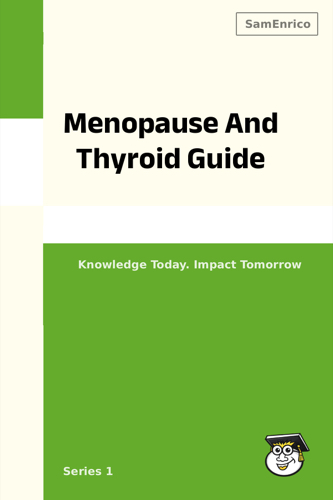
Menopause And Thyroid Guide eBook
Distinguish menopause symptoms from thyroid dysfun
by Arevalo Fran
Distinguish menopause symptoms from thyroid dysfunction with proper testing.
Formats
Free sample
Chapter 1: The Great Imposter--The 48-year-old woman sitting in my office had already seen three doctors that year. The first, a gynecologist, told her she was in perimenopause and prescribed a low-dose birth control pill to regulate her cycles. When her fatigue worsened, she saw a primary care physician who ran a basic metabolic panel, declared everything normal, and suggested she try yoga and magnesium supplements. The third, an endocrinologist, checked only her TSH, found it to be 3.8 (within the reference range of 0.5 to 4.5), and told her she did not have a thyroid problem.She came to me with a spiral notebook containing thirty pages of daily symptom logs. She had gained twenty-three pounds over eighteen months despite eating less and moving more.
Her hair was thinning at the outer edges of her eyebrows. She slept nine hours a night and woke up feeling as though she had not slept at all. She was cold when her husband was warm, and she wore socks to bed in July. She had stopped socializing because she could not follow conversations through the fog in her brain."Every doctor tells me I'm fine," she said. "But I am not fine."I ordered a full thyroid panel including TSH, Free T4, Free T3, Reverse T3, TPO antibodies, and Thyroglobulin antibodies.
I also checked her ferritin, vitamin D, vitamin B12, selenium, and zinc. Her TSH was 3.9. Her Free T4 was normal. Her Free T3 was in the bottom five percent of the reference range. Her Reverse T3 was elevated.
Her TPO antibodies were positive at 412 IU/m L. Her ferritin was 18 ng/m L. Her selenium was below optimal.She did not have a simple thyroid problem. She did not have a simple menopause problem. She had Hashimoto's thyroiditis triggered by the hormonal volatility of perimenopause, complicated by low iron from heavy menstrual bleeding, further complicated by poor T4-to-T3 conversion driven by falling estrogen and low selenium, all presenting as "normal" labs because nobody had looked beyond TSH.She is not a rare case.
She is the rule.The Epidemic of Missed Diagnoses Women between the ages of forty and sixty are the most misdiagnosed demographic in modern medicine. The reason is not malice or incompetence. It is a structural failure in how medical education, clinical practice, and laboratory reporting have separated conditions that nature has joined together.The symptoms of declining estrogen—fatigue, weight gain, brain fog, mood swings, sleep disruption, hair loss, low libido, and feeling cold or hot at inappropriate times—are nearly identical to the symptoms of thyroid dysfunction. The overlap is so complete that even the most sophisticated symptom checkers cannot reliably distinguish them. The European Menopause and Andropause Society, in its 2024 clinical guidelines, explicitly warned that clinicians default to "it's just menopause" in women aged forty-five to fifty-five, missing treatable thyroid disease in a substantial percentage of cases.
Conversely, some clinicians attribute everything to thyroid dysfunction and fail to recognize the distinct pattern of vasomotor symptoms that define estrogen withdrawal.The result is a diagnostic no-man's-land. Women are told their labs are normal when they are not. They are given antidepressants for what is actually low T3. They are prescribed hormone therapy for hot flashes that are actually caused by hyperthyroidism. They are sent to health coaches for fatigue that would resolve with sixty days of levothyroxine.
They are told to exercise more when their basal metabolic rate has dropped by twenty percent because their thyroid is failing.This chapter exists to ensure that you are not one of those women.Why Your Symptoms Are Being Dismissed To understand why so many women receive incomplete or incorrect diagnoses, you must understand three structural problems in how medicine currently operates.The first problem is the reference range illusion. When you receive lab results, each value is compared to a reference range derived from a population sample. For thyroid tests, that reference range is typically 0.5 to 4.5 m IU/L for TSH. What most women do not know—and what many doctors do not emphasize—is that these ranges are statistical averages, not optimal ranges for health. A TSH of 4.2 is "normal" by this standard, but the vast majority of healthy, asymptomatic women have a TSH between 0.5 and 2.5.
A TSH of 4.2 in a symptomatic woman is not normal. It is a missed diagnosis.The second problem is the silo effect. Gynecologists focus on reproductive hormones. Endocrinologists focus on the thyroid. Primary care physicians have fifteen minutes per appointment and are incentivized to address the most obvious complaint first.
No single specialist is trained to look at both systems simultaneously. The patient who presents with fatigue, weight gain, and irregular periods will be seen by a gynecologist, who will treat the periods. The patient who presents with fatigue, weight gain, and cold intolerance will be seen by an endocrinologist, who will treat the thyroid. The patient who presents with all four—irregular periods, fatigue, weight gain, and cold intolerance—will likely be sent to a psychiatrist.The third problem is the biotin interference epidemic. Biotin, or vitamin B7, is found in high doses in nearly every "Hair, Skin, and Nails" supplement on the market.
It is also in many multivitamins and energy drinks. Biotin interferes with the immunoassays used by most commercial laboratories to measure thyroid hormones. It causes falsely low TSH and falsely high T4 and T3, creating the appearance of hyperthyroidism in patients who may have normal or even low thyroid function. Women are told they have "mild hyperthyroidism" when they do not. They are taken off thyroid medication they need.
They are not told to stop biotin before testing. The interference lasts for three to five days after the last dose.The Overlap Trap: A Symptom-by-Symptom Breakdown Let me show you exactly how deep the overlap runs. The following symptoms are common to both menopause and thyroid dysfunction. If you have any of them, you cannot assume the cause without testing.Fatigue is the most common complaint in both conditions. But the quality of fatigue differs.
Menopausal fatigue often follows a cyclic pattern, worse in the days before a period if you are still cycling, and often accompanied by insomnia or disrupted sleep. Thyroid fatigue is constant and crushing, the kind where you sleep nine hours and wake up feeling as though you have run a marathon. You cannot exercise your way out of thyroid fatigue. You cannot meditate your way out of it. You need thyroid hormone.Weight gain is the second most common complaint.
Menopausal weight gain typically settles in the abdomen, driven by insulin resistance and cortisol dysregulation. Your waist-to-hip ratio changes even if your total weight changes little. Thyroid weight gain is more generalized, affecting the face, arms, legs, and trunk equally. It is driven by a slowed resting metabolic rate and fluid retention. You can starve yourself on a thyroid weight gain and lose nothing.
You can exercise for hours and lose nothing. You need thyroid hormone first.Brain fog is the third most common complaint. Menopausal brain fog affects short-term memory and word-finding. You walk into a room and forget why. You cannot remember the name of the actor in the movie you watched last…
This is the end of the free sample. Get the eBook to keep going. Buy now
About this book
Details
- Author
- Arevalo Fran
- Publisher
- SamEnrico
- Language
- English
- Genre
- Non-Fiction, Health & Wellness, Thyroid Health
- Released
- 2026-06-11
- Pages (approx.)
- 128
- Available as
- eBook, Audiobook

Read better in the ZLOADR app
Your eBooks on your phone or tablet. Sign in with your SamEnrico account and start reading.
More by Arevalo Fran
 Click Through Rate OptimizationArevalo Fran$11.99
 Political Disagreement CouplesArevalo Fran$11.99
 John Bardeen Two Time WinnerArevalo Fran$11.99
 Stress and Chest PainArevalo Fran$11.99
 GTD Weekly Review GuideArevalo Fran$11.99
 Boundary Setting HypnosisArevalo Fran$11.99
 ABCDE for EngineersArevalo Fran$11.99
 The Silk Road Runner: Letters of a Forgotten Warrior-PoetessArevalo Fran$11.99
 Socrates in the Sky: The Birth of Western ThoughtArevalo Fran$11.99
 10 Ways to Use Apricot Jam (Recipe Book)Arevalo Fran$11.99
 SWIFT vs Alternative Payment HandbookArevalo Fran$12.99
 Ghana Delivery Times CourseArevalo Fran$12.99
You may also like
 Hong Kong Handover 1997Dunn Johnnie$11.99
 Zumba For Postnatal Recovery CourseNeal Christian$11.99
 Zumba for BeginnersLadner Nikia$11.99
 YouTube Comment Mining GuideHumes Pandora$12.99
 Worry Box MeditationCarlin Rudy$11.99
 Workplace Stress MeditationNguyen Lynn$11.99
 Workplace Stress and Sleep RepairHawley Ivory$11.99
 Workplace Perfectionism CureDelaney Jeffry$11.99
 Workplace Injustice Anger GuideWallen Isabelle$11.99
 Work Addiction and Burnout LinkGreenwood Ester$11.99
 Women in Yoga and WellnessBeattie Galina$11.99
 Women in Stand Up ComedyChun Evangeline$11.99