
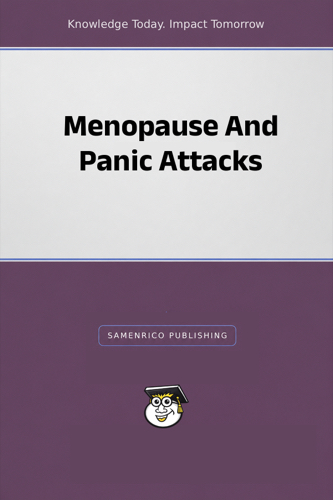
Menopause And Panic Attacks eBook
Differentiate hormonal panic from anxiety disorder
by Hay Marcelle
Differentiate hormonal panic from anxiety disorder with CBT and HRT trials.
Formats
Free sample
Chapter 1: The Great Mimic--–- The first time it happened, she was standing in line at the grocery store. One second she was comparing prices on olive oil, and the next second her chest felt like it had been plugged into a wall socket. Heat exploded from her sternum outward, racing up her neck and flooding her face. Her heart slammed against her ribs. The world tilted.
She grabbed the shopping cart handle to keep from falling, convinced she was having a heart attack, convinced she was about to die right there between the canned tomatoes and the breakfast cereal.By the time she reached the parking lot, the wave had passed. She sat in her car for twenty minutes, shaking, replaying the event in her mind. She drove herself to urgent care. They ran an electrocardiogram. They drew blood.
They told her everything was normal. They suggested she might be stressed. They sent her home.That was the first of three hundred and forty-seven panic attacks she would have over the next four years.She saw two cardiologists, three primary care doctors, and a psychiatrist. She wore a thirty-day heart monitor that showed nothing abnormal except occasional sinus tachycardia—fast heart rate, but a normal fast heart rate. She tried escitalopram, which made her feel numb and killed her libido.
She tried sertraline, which gave her diarrhea. She tried alprazolam, which worked beautifully but left her terrified of running out. She stopped going to the movies, then restaurants, then the gym. She started sleeping on a towel because she woke most nights drenched and trembling. She began to believe she was losing her mind.No one ever asked her about her menstrual cycle.She was forty-eight years old.
Her periods had become irregular two years earlier—some cycles lasting twenty days, some lasting fifty, some flooding so heavily she had to change her clothes at work. She had night sweats that soaked through her pajamas. She had mood swings that felt like puberty all over again. She had every classic symptom of perimenopause, and not a single doctor had connected those symptoms to her panic attacks.When she finally found a clinician who asked the right questions, the conversation lasted less than five minutes. The clinician explained that hot flashes and panic attacks are physiologically identical.
She explained that the grocery store incident was almost certainly a hot flash—a sudden, intense vasomotor symptom triggered by the destabilization of the hypothalamic thermostat. She explained that the fear of having another hot flash had created anticipatory anxiety, which lowered the threshold for the next hot flash, which triggered more fear, which amplified the next hot flash. She explained that the night sweats were not nocturnal panic attacks—they were vasomotor symptoms occurring during sleep, followed by waking in a state of fear.She prescribed a low-dose estradiol patch and micronized progesterone.Two weeks later, the panic attacks stopped. Not reduced. Stopped.
Completely.This woman’s story is not an anomaly. It is not a rare case study published in a obscure medical journal. It is, by my clinical estimation and a growing body of research, a routine occurrence that happens to hundreds of thousands of women every year. The only thing unusual about her story is that she eventually received the correct diagnosis.Most women do not.The Identical Twins of Autonomic Arousal Let me be absolutely precise about what I mean when I say that hot flashes and panic attacks are physiologically identical. I do not mean they feel similar.
I do not mean they have overlapping symptoms. I mean that if you measure the autonomic nervous system activity of a woman having a hot flash and a woman having a panic attack, the two traces would be indistinguishable to a blinded observer.Here is what happens during both events.First, the sympathetic nervous system activates. This is the “fight or flight” branch of the autonomic nervous system, responsible for mobilizing the body in response to threat. The sympathetic activation causes the adrenal medulla to release adrenaline and noradrenaline into the bloodstream. These catecholamines bind to beta-adrenergic receptors on the heart, increasing heart rate and contractility.
They bind to alpha-adrenergic receptors on blood vessels, causing vasoconstriction in some beds and—critically for hot flashes—vasodilation in the skin vessels of the face, neck, and chest.Second, heart rate increases. A typical hot flash raises heart rate by seven to fifteen beats per minute. A typical panic attack raises heart rate by ten to twenty beats per minute. The difference is not clinically meaningful. Both put the heart into the range that feels alarming—one hundred to one hundred and twenty beats per minute, the sensation of the heart “pounding” or “racing.”Third, skin conductance increases.
Sweat glands are innervated by sympathetic cholinergic fibers. When the sympathetic nervous system activates, sweating increases. This happens in both hot flashes and panic attacks. The woman cannot tell whether the sweat is due to thermoregulation (cooling the body during a hot flash) or due to anxiety (the body preparing for threat). It feels like sweat either way.Fourth, respiration changes.
Both events can trigger shortness of breath, a sensation of choking or smothering, or rapid shallow breathing. The mechanisms differ—hot flashes may affect respiratory drive through hypothalamic connections, while panic attacks involve hyperventilation from perceived threat—but the subjective experience is similar enough that women reliably report “couldn’t breathe” for both.Fifth, dizziness occurs. In hot flashes, dizziness comes from peripheral vasodilation—blood pools in the skin vessels, reducing venous return to the heart, causing a mild drop in blood pressure. In panic attacks, dizziness comes from hyperventilation-induced hypocapnia—low carbon dioxide levels causing cerebral vasoconstriction. The sensation of “the room spinning” or “feeling faint” is reported by women in both conditions.Sixth, a sense of doom or impending catastrophe.
This is where the two events diverge—but only in the mind of the experiencer. The hot flash itself does not cause a sense of doom. The interpretation of the hot flash as dangerous causes the sense of doom. A woman who knows she is having a hot flash may feel uncomfortable but not terrified. A woman who does not know what is happening to her body may believe she is dying.That last point is the key to everything.The Diagnostic Blind Spot The Diagnostic and Statistical Manual of Mental Disorders, Fifth Edition (DSM-5), the standard reference for psychiatric diagnosis, lists the criteria for panic disorder as follows: recurrent unexpected panic attacks, followed by at least one month of persistent concern about additional attacks, worry about the implications of the attack, or a significant maladaptive change in behavior related to the attacks.A woman having hot flashes that she misinterprets as dangerous meets every single one of those criteria.
Her panic attacks are recurrent. They are unexpected from her perspective. She worries about having more. She changes her behavior—avoiding situations that might trigger the heat, carrying medication, sleeping on towels. She meets the full diagnostic criteria for panic disorder.The DSM-5 does not include a differential diagnosis for menopausal vasomotor symptoms.
It does not instruct clinicians to ask about menstrual history when evaluating new-onset panic in midlife women. It does not…
This is the end of the free sample. Get the eBook to keep going. Buy now
About this book
Details
- Author
- Hay Marcelle
- Publisher
- SamEnrico
- Language
- English
- Genre
- Non-Fiction, Health & Wellness, Anxiety
- Released
- 2026-06-08
- Pages (approx.)
- 127
- Available as
- eBook, Audiobook

Read better in the ZLOADR app
Your eBooks on your phone or tablet. Sign in with your SamEnrico account and start reading.
More by Hay Marcelle
 Loneliness Recovery for Shift WorkersHay Marcelle$11.99
 College Student Meal PrepHay Marcelle$11.99
 The Immigrant Roll-Up StrategyHay Marcelle$11.99
 Winter Blues Survival GuideHay Marcelle$11.99
 C 5 Galaxy PilotHay Marcelle$11.99
 Purpose Discovery for ApathyHay Marcelle$11.99
 Fear of Failure for IT SupportHay Marcelle$11.99
 The Silent Queen of Sydney: How a Yakuza Matriarch Built an Empire Down UnderHay Marcelle$11.99
 Service Providers Guide to Cosmetics SalesHay Marcelle$11.99
 A Collector's Handbook to the Marcos 3-litre VolvoHay Marcelle$11.99
 How to Produce Laptop Screen DigitizersHay Marcelle$11.99
 Regression Analysis ExcelHay Marcelle$12.99
You may also like
 Anxiety Nap GuideSpradlin Jarred$11.99
 Performance Anxiety EDNagel Genesis$11.99
 IBS Overlap Anxiety GuideDonahue Lesha$11.99
 HIIT for Anxiety GuideWhitley Kina$11.99
 Withdrawal Anxiety ReliefCovington Andree$11.99
 Postpartum Anxiety Management WorkbookLudwig Janine$11.99
 IBS and Anxiety CycleSnipes Annett$11.99
 Ayurvedic Anxiety GuideMcneill Serafina$11.99
 Napping for Anxiety SufferersLadner Nikia$11.99
 IBS And Anxiety Management GuideHarley Ozell$11.99
 Gaming and Anxiety ConnectionPina Hildred$11.99
 Anxiety and Benzodiazepine AddictionNewsome Lise$11.99