
Non-FictionSelf-HelpMemory Reconsolidation
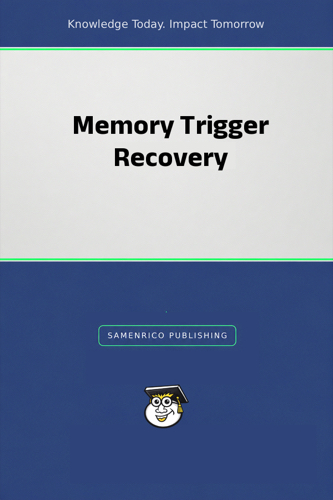
Memory Trigger Recovery eBook
Teaches when a present event reminds you of past h
Teaches when a present event reminds you of past hurt and how to separate timelines.
Formats
Free sample
Chapter 1: The Time Traveler Next Door...--–- The first time Maria realized she was a time traveler, she was standing in her own kitchen, wearing socks with rubber ducks on them, screaming at a man who had just offered to wash the dishes.It was a Tuesday. A perfectly ordinary Tuesday. The kind of Tuesday you do not remember unless something goes terribly wrong. The sun had set an hour earlier. The remnants of pasta carbonara congealed on two plates.
Her partner, David, had pushed back from the table with the satisfied sigh of a man who had eaten exactly the right amount of food, and he said the words that would, three seconds later, transport a thirty-four-year-old graphic designer back to the winter of 1998."I'll do the dishes," he said cheerfully.Then he picked up a pot. And he clanked it against the side of the sink.Maria’s heart did not race. It detonated. Her vision narrowed to a tunnel. She heard her own voice before she knew she was speaking: “Just leave me alone!
Get away from me!”David froze, pot in hand, dishwater dripping onto the floor. His face cycled through confusion, hurt, and then the careful neutrality of someone who has learned that his partner sometimes becomes someone else. Maria burst into tears. She could not explain why. She could not even explain what had just happened.
She only knew that for a moment – a single, shattering moment – she had been absolutely certain that she was about to be punished.The dishes were clean. David had not raised his voice. No one was in trouble.But Maria’s brain had already left the building. It was 1998. She was eight years old.
And somewhere behind her, her father was washing dishes – which meant, in the architecture of that childhood home, that she had precisely ninety seconds to finish her chores before the belt came out.She was not overreacting. She was time traveling.The Secret Shame of the "Overreactor"If you are reading this book, there is a very good chance that you have had a Maria moment in the last thirty days. Perhaps not over dishes. Perhaps over a text message that went unreturned for three hours. Perhaps over a specific tone of voice – the one your partner uses when they are “just asking a question” but your body interprets as the prelude to an interrogation.
Perhaps over a silence. A slammed car door. A particular smell (cigarette smoke, cheap cologne, chlorine from a swimming pool). A song. A date on the calendar.And after that moment – after the shouting, or the tears, or the cold withdrawal, or the panic attack in the bathroom at work – came the second wave.
The wave that feels even worse than the first.The shame.Why did I do that?Why can’t I just be normal?Everyone thinks I’m crazy.I ruin everything.I’m broken.You tell yourself that you overreacted. That you are too sensitive. That you need to try harder, calm down, let it go, grow up, get over it. You promise yourself that next time will be different. Next time you will be the calm, reasonable person you know you are most of the time.And then next time comes.
And the exact same thing happens. Because the problem is not your effort, your character, or your willpower. The problem is that your brain has confused similar with same. It has mistaken a 2026 trigger for a 1998 threat. And it has launched the full protocol for survival – adrenaline, tunnel vision, emotional flooding – before your conscious mind could say, “Wait, that’s just a pot.”This book is not about calming down.
It is about learning to recognize when you have left the present moment – and how to come back. It is about separating two timelines that your brain has collapsed into one. It is not about erasing the past. It is about putting the past back where it belongs: behind you, not on top of you.What This Book Is (And What It Is Not)Before we go any further, let me be very clear about what you are holding.This book is not a substitute for professional mental health treatment. If you are experiencing suicidal thoughts, self-harm, or severe dissociation that makes it difficult to function, please seek immediate help from a therapist, psychiatrist, or crisis hotline.
The exercises in this book are designed for people who are stable enough to engage with their memories without becoming destabilized. If you are unsure whether that describes you, err on the side of professional support.This book is not a tool to excuse abusive behavior. If you are currently in a relationship where someone yells at you, belittles you, controls you, threatens you, or harms you physically, that is not a “trigger.” That is abuse. Do not use this book to convince yourself to stay. Do not tell yourself, “It’s just my trauma reacting.” A trigger is an internal response to a past hurt.
Abuse is a present pattern of harm. They are not the same thing. If you are unsure whether your situation qualifies as abuse, call a domestic violence hotline or speak with a trained advocate.This book is not about becoming “trigger-free.” That is not a real goal. A person with no triggers is either dead, heavily medicated, or dissociated to the point of numbness. Triggers are not the enemy.
They are signals. The goal is not to eliminate the signal. The goal is to learn what the signal means – and to choose your response.What this book is is a practical, neuroscience-informed, twelve-chapter protocol for recognizing when you have left the present moment and returning to it with intention. It is built on decades of research into memory reconsolidation, narrative exposure therapy, and polyvagal theory. But you do not need a Ph D to understand it.
You only need to be willing to look at your own reactions with curiosity instead of shame.The Central Idea: Timeline Collapse Here is the idea that will change everything for you.Your brain maintains multiple timelines. There is the timeline of the present – this Tuesday, this kitchen, this pot clanking against this sink. And there is the timeline of the past – 1998, the childhood kitchen, the sound that meant punishment was coming.Normally, these timelines stay separate. You can remember 1998 without feeling like you are in 1998. You can recall the sound of the dish clank without your heart rate doubling.
The memory is a file. You open it when you want to. You close it when you are done.But when a present event shares enough sensory or emotional features with a past hurt, your brain does something that feels like magic but is actually just neurology: it collapses the timelines. It treats the present event as if it is the past event. The memory is no longer a file you open.
It is a room you fall into.This is not a metaphor. This is what happens in your amygdala, the part of your brain responsible for threat detection. The amygdala does not do calendars. It does not know that 1998 was twenty-eight…
This is the end of the free sample. Get the eBook to keep going. Buy now
About this book
Details
- Author
- Milligan Abigail
- Publisher
- SamEnrico
- Language
- English
- Genre
- Non-Fiction, Self-Help, Memory Reconsolidation
- Released
- 2026-06-06
- Pages (approx.)
- 121
- Available as
- eBook, Audiobook

Read better in the ZLOADR app
Your eBooks on your phone or tablet. Sign in with your SamEnrico account and start reading.
More by Milligan Abigail
 High Functioning Alcoholic RecoveryMilligan Abigail$11.99
 Post Hypnotic Suggestion for MotivationMilligan Abigail$11.99
 Alcohol Detox Supervision GuideMilligan Abigail$11.99
 The Quantum Leap: How Richard Feynman Redefined Science with a ChalkboardMilligan Abigail$11.99
 Best Online Banks for ForeignersMilligan Abigail$12.99
 How to Produce Clarinet Pegs and StandsMilligan Abigail$11.99
 SIPOC Diagram CreatorMilligan Abigail$11.99
 How to Become a Personnel RecruiterMilligan Abigail$11.99
You may also like
 Hong Kong Handover 1997Dunn Johnnie$11.99
 Zumba For Postnatal Recovery CourseNeal Christian$11.99
 Zumba for BeginnersLadner Nikia$11.99
 YouTube Comment Mining GuideHumes Pandora$12.99
 Worry Box MeditationCarlin Rudy$11.99
 Workplace Stress MeditationNguyen Lynn$11.99
 Workplace Stress and Sleep RepairHawley Ivory$11.99
 Workplace Perfectionism CureDelaney Jeffry$11.99
 Workplace Injustice Anger GuideWallen Isabelle$11.99
 Work Addiction and Burnout LinkGreenwood Ester$11.99
 Women in Yoga and WellnessBeattie Galina$11.99
 Women in Stand Up ComedyChun Evangeline$11.99